The Backyard You'll Have Next Summer Starts Now
Two summers. That is how long most homeowners carry the outdoor living vision before they either build it or bury it. The first summer is the awakening; the moment when the bare patio stops being acceptable and the imagined transformation takes root. You see the friend's pergola. You visit the restaurant with the screened courtyard. You spend a Saturday afternoon squinting into the sun on a patio that has no shade, no definition, and no answer for the bugs that arrive at dusk. The first summer is when you start saying "we should do something about the backyard." And you mean it.
The second summer is the reckoning. The vision has not faded. If anything, it has become more specific, more urgent, more detailed. You know what you want. You know what it would look like. You have shown your spouse the pictures on your phone. You have read the articles. You have gotten the quotes, or at least thought about getting the quotes. And yet the backyard looks exactly the same as it did twelve months ago. The second summer is when "we should" becomes "we should have," and the regret begins to compound.
This article is for the homeowner in the second summer. Or the third. Or the fifth. The one who has done enough research to fill a binder, enough imagining to furnish the entire outdoor room in their head, and not quite enough acting to turn any of it into a date on the calendar. This is not a sales pitch. This is the honest acknowledgment that the gap between vision and reality is not a chasm. It is a conversation. One conversation, followed by a date, followed by a transformation that will make you wonder why you waited.
Explore the complete outdoor living ecosystem at NextGen Screens
Two Summers of Thinking, and What You Have to Show for It
Let us do a quick audit of the last two years. Summer one: you mentioned the backyard project for the first time. You browsed some ideas. You maybe got one estimate. You decided it was not the right time, or the right budget, or the right season to begin. You told yourself you would revisit it in the fall. Fall came, and you were busy. Winter came, and it was easy to forget. Spring came, and the cycle started again.
Summer two: the vision returned, stronger than before. This time you did more research. You read about pavers and understood why concrete was failing you. You explored pergola types and understood the difference between louvered, solid, and open-beam. You discovered that motorized screens could eliminate the bugs without eliminating the view. You learned about the foundation-plus model and understood that the pergola is not just a shade structure; it is the platform that makes every other outdoor improvement possible. You know more now than you did twelve months ago. And the backyard still looks exactly the same.
The research was not wasted. The knowledge is real. The vision is sharp. What is missing is not information. What is missing is a decision. And the decision is simpler than the research process made it seem: do you want to live in this space this summer, or do you want to spend another summer looking at it through the window?
Learn about motorized screen options at Onetrack Screens
The Gap Between the Vision and the Calendar
The outdoor renovation planning process that produces results has a beginning, a middle, and an end. The beginning is the vision. The middle is the design. The end is the installation. Most homeowners spend ninety percent of their time in the beginning and never reach the middle.
The vision stage is comfortable because it involves no commitment, no expenditure, and no risk. You can imagine a beautiful outdoor room without committing to build one. You can research pavers without scheduling an excavation. You can compare pergola quotes without signing a contract. The vision stage feels productive because you are learning and deciding, but it produces no physical result. The patio at the end of the vision stage looks exactly like it did at the beginning.
The design stage is where the vision becomes a plan. A site assessment translates the imagined outdoor room into a specific layout on your specific property. Material selections become tangible. Engineering calculations become specific to your wind zone, your soil conditions, your structural requirements. The budget moves from a range to a number. The timeline moves from "someday" to a date. This is where the project becomes real, and it is where most homeowners stall, not because the process is difficult, but because the transition from imagining to committing requires a different kind of energy.
The installation stage is where the plan becomes a place. And it happens faster than most homeowners expect. The paver installation takes days, not weeks. The pergola goes up in a matter of days. The screens install in a day or two. The total transformation, from commitment to completion, is measured in weeks. The homeowner who starts the design conversation in February is living in the finished space by May. The homeowner who starts in April is enjoying it by July.
The gap between the vision and the calendar is not months. It is a phone call.
Discover hurricane-rated outdoor protection at Maxforce Screens
What the First Conversation Actually Looks Like
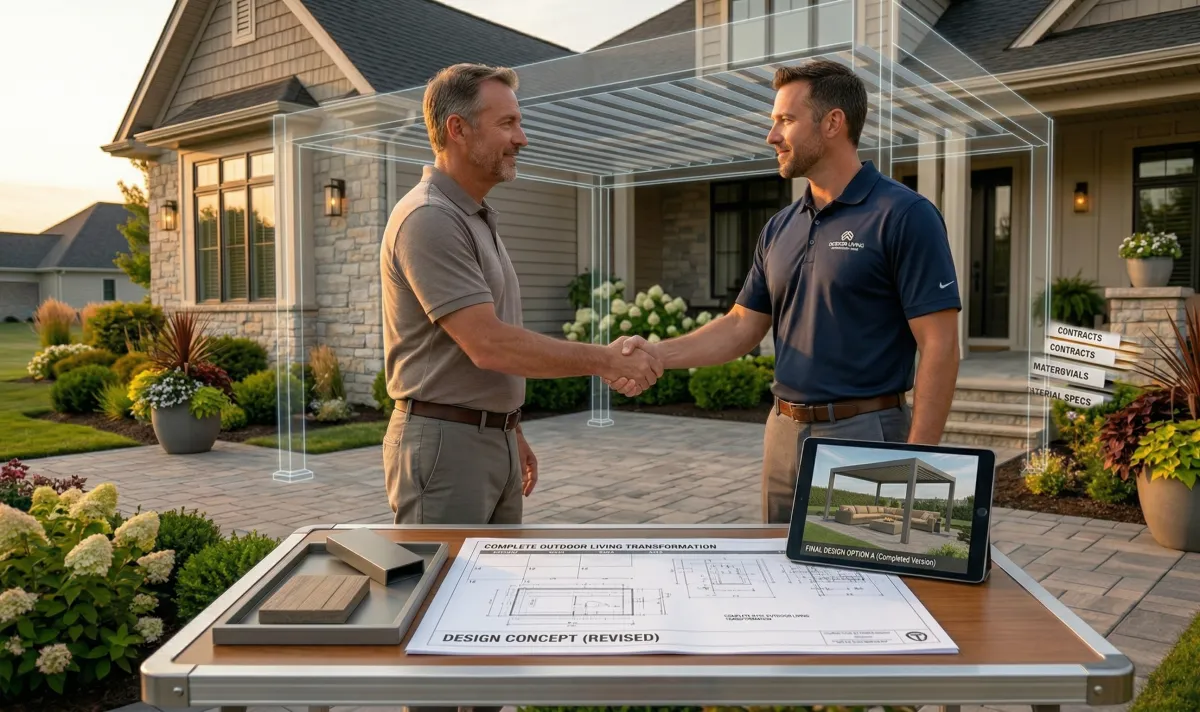
The outdoor living consultation is not a sales presentation. It is a design conversation. And it begins with two simple questions: what does your outdoor space look like now, and what do you want it to look and feel like when it is finished?
From those two questions, everything else follows. The consultant assesses the existing surface and recommends whether the current patio can support the project or whether a paver installation should come first. The consultant evaluates the space for pergola placement, considering sun angles, sight lines, architectural compatibility, and structural requirements. The consultant discusses screen options, explaining how different fabric types address different priorities; insect protection, weather control, hurricane rating, privacy, solar heat reduction.
The conversation covers budget. Honestly, with real numbers, not ranges designed to avoid scaring you. The conversation covers timeline. Realistically, with actual availability, not optimistic promises that will be revised later. And the conversation covers the phased approach; what can be done now, what can be added later, and how the sequence affects both cost and outcome.
How to start an outdoor living project is not a complicated question. You describe what you want. A professional describes what it takes. Together, you agree on a plan that respects your vision, your budget, and your calendar. And then the project moves from the idea stage to the scheduled stage, which is where everything changes.
Because the moment you have a date on the calendar, the backyard stops being a source of frustration and starts being a countdown to a transformation.
See the full outdoor living resource library at NextGen Screens
Pavers, Pergola, Screens: The Build Sequence in Plain Language
If you have been following this series, you already understand the build sequence. But here it is one more time, in the plainest possible language, because clarity is what turns research into action.
Step one: the surface. If your existing patio is cracked, settling, pooling water, or simply ugly, the paver installation addresses all of it. A new surface creates the foundation for everything that follows. If your existing surface is sound and level, you can skip this step and move directly to the structure.
Step two: the structure. The pergola creates the overhead element that transforms a flat surface into a room. It provides shade, spatial definition, and the mounting infrastructure for screens, fans, lights, and heaters. The pergola is the single investment that unlocks the entire outdoor living ecosystem.
Step three: the enclosure. Motorized screens mount to the pergola and create walls that appear on demand. When deployed, they eliminate insects, block wind, reduce sun, and create privacy. When retracted, they disappear. The outdoor room has walls when you want them and open air when you do not.
Step four, and beyond: the details. Fans for airflow. Lights for atmosphere. Heaters for season extension. Audio for ambiance. Furniture for comfort. Fire features for gathering. Each of these additions builds on the infrastructure of the first three steps.
When should I schedule a paver and pergola consultation? Now, if you want to enjoy the result this season. The total timeline from consultation to completion is six to twelve weeks. The installation calendar fills based on who acts first. And the homeowner who waits for the perfect moment usually discovers that the perfect moment was three weeks ago.
Explore pergola and screen integration at Onetrack Screens
What Changes the Day After Your Date Is Confirmed
Something shifts the day after the installation date is confirmed. The project is no longer abstract. It is no longer a list of links in your browser history or a folder of inspiration images on your phone. It is a date. A specific week when a crew will arrive at your property and begin the transformation you have been imagining for two years.
The anxiety dissolves. The research phase is over. The comparison shopping is finished. The decision has been made, and the decision, once made, feels lighter than you expected. The weight you have been carrying was not the cost or the complexity. It was the indecision. And now the indecision is gone.
In its place is something better: anticipation. You start planning around the date. You think about the furniture you will buy. You think about the first dinner you will host under the pergola. You think about the first evening with the screens down and the lights on and the bugs on the other side of the mesh. You think about the first Saturday that passes the Saturday Evening Test.
The outdoor space stops being a project and starts being a future you can see on the calendar.
Check out the complete outdoor living options at NextGen Screens
The Backyard Is Waiting: You Have Done the Research, Now Do the Thing
You have spent enough time in the vision stage. You have read the articles. You have compared the materials. You have understood why pavers outlast concrete, why pergolas unlock the entire outdoor ecosystem, why motorized screens complete the room, and why the phased approach means you do not have to do everything at once. You have learned the mistakes to avoid, the questions to ask, and the timeline to plan around. You have absorbed more information about outdoor living than ninety percent of homeowners will ever seek.
And now there is only one thing left to do. Not one more article to read. Not one more comparison to make. Not one more Pinterest board to curate. One conversation. The one where you describe the outdoor space you want and a professional describes the path to building it.
You have been imagining this transformation for a while. There is a reason the idea will not let go of you. It is not because you are indulgent. It is because you recognize that the space behind your house has potential that is going unrealized, and that the investment required to realize it is modest compared to what it returns in daily life. You are not being extravagant. You are trying to make a space work that currently does not.
Every great outdoor space started with a conversation like this one. The next step is seeing what is possible for yours.
The backyard you will have next summer depends on the call you make this season. The vision is ready. The calendar is open. And the resources, the technical documentation, the design inspiration, the engineering specifications, and the people who can turn imagination into architecture, are waiting for you.
Book your outdoor living consultation today.
Start exploring the complete outdoor living ecosystem at NextGen Screens
Discover Onetrack's motorized screen systems at Onetrack Screens
Learn about hurricane-rated protection with Maxforce Screens
