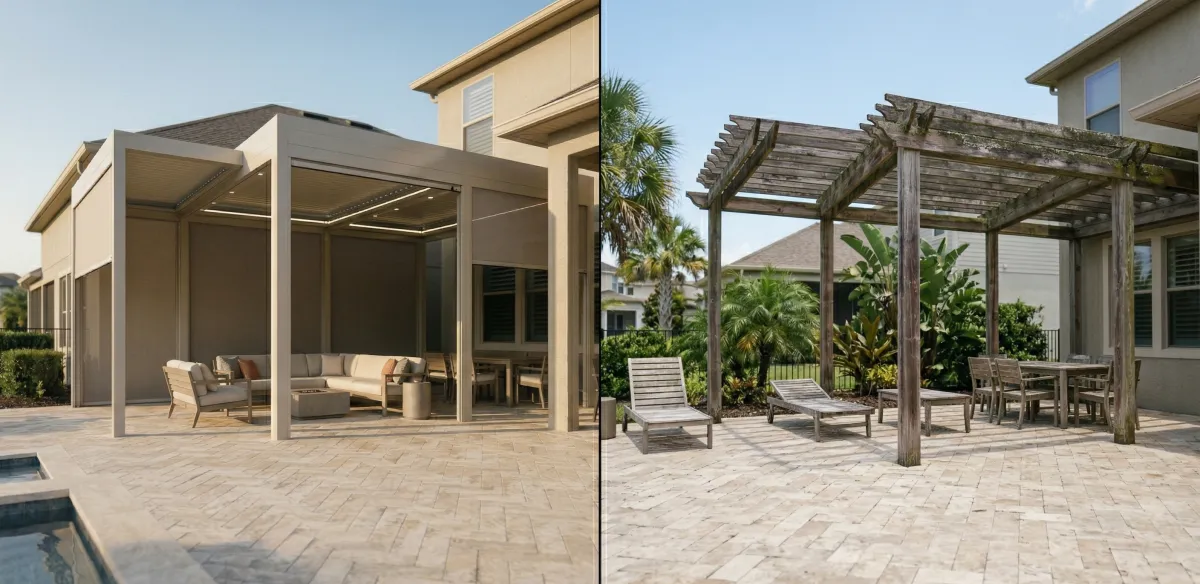
Aluminum, Wood, or Vinyl: The Pergola Material Decision Florida Homeowners Regret Most
Three quotes are sitting on the kitchen island. One is from a carpenter who builds custom wood pergolas, and it is the lowest number on the page. One is from a vinyl structure company whose brochure promises "lifetime beauty, zero maintenance," and it sits in the middle. One is from an aluminum pergola fabricator whose quote includes engineering calculations, wind load certifications, and a warranty document that is longer than the proposal itself. It is the highest number by a significant margin. And the homeowner, who wanted nothing more than shade and a place to hang string lights, is now staring at three fundamentally different products being sold under the same four-syllable word, trying to determine which definition of "pergola" is the one that will still be standing and performing in fifteen years.
This is the best pergola material Florida decision, and it is the one homeowners get wrong more often than any other outdoor living choice. Not because they are careless, but because the material comparison requires information that contractors are not incentivized to provide. The wood contractor sells wood. The vinyl contractor sells vinyl. The aluminum contractor sells aluminum. Each one presents their material as the obvious choice, and the homeowner, lacking a framework for comparison, defaults to the variable they can evaluate without expertise: price. Price is the worst possible basis for this decision. Here is why.
[Explore Go-Fenetex Residential Solutions → https://gofenetex.com/residential]
Wood in Florida: The Honest Truth
Wood is the material most homeowners imagine when they hear the word "pergola," and there is a good reason: wood is warm, organic, textured, and carries associations with craftsmanship and natural beauty that no manufactured material can fully replicate. Pressure-treated pine is the most affordable option, cedar is the mid-range choice prized for its natural resistance to insects and moisture, and ipe (Brazilian hardwood) is the premium option known for its extraordinary density and durability.
In a temperate, four-season climate with moderate humidity, all three options can perform well for decades with appropriate maintenance. Florida is not that climate. Florida is a subtropical environment with humidity levels that routinely exceed 80 percent, rainfall that totals 54 inches per year, UV exposure that degrades surface finishes within months, and a termite population that treats untreated wood as an invitation.
Pressure-treated pine in Florida shows visible degradation within three to five years: warping, splitting, checking (surface cracks), and graying that requires sanding and refinishing to address. Cedar lasts longer, typically seven to twelve years before significant structural degradation, but its natural oils, which provide its insect and moisture resistance, leach out faster in Florida's rain and humidity than in drier climates. Ipe is genuinely remarkable in its durability, but it is also genuinely remarkable in its cost: $40 to $60 per linear foot for material alone, plus specialized hardware and installation labor that can push a single pergola past $50,000.
All wood options in Florida require periodic maintenance: staining or sealing every one to three years, structural inspection for rot and insect damage, and eventual component replacement as members deteriorate. The aluminum vs wood pergola comparison is not just a material comparison. It is a comparison between a structure that requires ongoing maintenance to survive and a structure that requires none.
[See Why Homeowners Choose Go-Fenetex → https://gofenetex.com/why-go-fenetex]
Aluminum: The Engineering Case
Engineered aluminum pergolas are manufactured from extruded aluminum alloy profiles, powder-coated for corrosion resistance and UV stability, and designed to meet specific structural engineering requirements including wind load ratings that are certified by professional engineers. This is not decorative aluminum. This is structural aluminum, the same class of material used in commercial building facades, bridge components, and marine applications where the material must perform indefinitely in hostile environments.
The best pergola material Florida homeowners can choose, from a pure performance perspective, is aluminum. It does not rot. It does not warp. It does not attract termites. It does not require staining, sealing, sanding, or any form of periodic maintenance beyond occasional cleaning. Its powder-coated finish resists UV degradation, salt air corrosion, and the thermal cycling that causes wood to expand and contract with each temperature swing. Its structural profiles are engineered to precise dimensional tolerances, which means the columns maintain their geometry over time, the beams remain true, and the mounting points for fans, lights, and Go-Fenetex retractable motorized screens stay exactly where the engineer placed them.
For screen integration specifically, aluminum is the only pergola material that consistently supports the precision mounting requirements of the Keder track retention system and One-Track spring tensioning technology. The extruded profiles can be manufactured with integrated channels that accept screen cassette housings, track brackets, and electrical conduit without requiring field modification or structural reinforcement. Wood pergolas can accept screen mounting with additional hardware and blocking, but the dimensional stability issue, wood moves, remains. Vinyl pergolas, as we will see, present more significant challenges.
The trade-off is aesthetic warmth. Aluminum does not look like wood, and for homeowners whose design vision includes the organic texture and natural grain of timber, aluminum may feel too manufactured, too precise, too "perfect." Modern powder-coating technology has closed this gap significantly, with finishes available that convincingly replicate woodgrain texture and coloration, but the distinction remains perceptible at close range.
[Find a Go-Fenetex Dealer Near You → https://gofenetex.com/dealership]
Vinyl: The Compromise Question
Vinyl pergolas occupy the middle ground of the pergola material comparison, and they are marketed aggressively on two promises: zero maintenance and affordability. Both promises are partially true. Vinyl does not require staining or sealing. Vinyl is less expensive than aluminum and comparable to mid-range wood options. The question is what those promises cost in other dimensions.
Vinyl is a thermoplastic. In Florida's heat, vinyl expands and contracts more aggressively than aluminum, which can create visible gaps at joints, audible creaking during temperature swings, and gradual loosening of fastener connections over time. Vinyl's structural rigidity is lower than aluminum or wood, which limits the span lengths achievable without intermediate supports and restricts the weight of accessories that the structure can safely carry. Some vinyl pergolas cannot support the combined load of a ceiling fan, integrated lighting, and a motorized screen cassette without structural reinforcement that undermines the cost advantage.
Vinyl's UV resistance has improved significantly with modern formulations, but it is not immune to Florida's solar intensity. Over extended exposure, white vinyl can yellow, and colored vinyl can fade or chalk. Cleaning removes surface chalking but does not reverse the underlying UV degradation of the polymer.
For homeowners whose primary criteria are low maintenance and moderate cost, and whose outdoor room plans do not include heavy accessory integration (motorized screens, multiple fans, heaters), vinyl can be a reasonable choice. For homeowners planning a complete outdoor room with Go-Fenetex retractable screens, the structural limitations of vinyl make it a compromise that may constrain the room's potential.
[Explore Commercial Solutions by Go-Fenetex → https://gofenetex.com/commercial]
The Screen Integration Factor
The pergola material decision is not made in isolation. It is made in the context of what the pergola will support over its lifetime. For homeowners planning to complete the outdoor room with Go-Fenetex motorized retractable screens, the material's ability to maintain precise dimensional stability, support concentrated mounting loads, and integrate with the Keder track and One-Track tensioning systems is a functional requirement, not a preference.
Aluminum meets this requirement without compromise. Wood meets it with caveats (dimensional movement, maintenance burden, potential retrofit complexity). Vinyl meets it with limitations (structural load capacity, thermal expansion, mounting precision). The best pergola material Florida homeowners can choose for a complete outdoor room is the material that will perform as precisely on year fifteen as it did on day one. For motorized screen integration, that material is aluminum.
[See Go-Fenetex Home Page → https://gofenetex.com/home-page]
A Decision Framework for Your Climate and Vision
The material decision reduces to three honest questions. First: how long do you want this structure to perform without intervention? If the answer is decades, aluminum is the only material that delivers on that timeline in Florida without maintenance. Second: what do you plan to mount to this structure? If the answer includes motorized screens, fans, lights, and heaters, the structure must be engineered for those loads, and aluminum provides the clearest path. Third: what is your total budget, including maintenance over fifteen years? When wood's staining, sealing, and repair costs are factored in, the price gap between wood and aluminum narrows dramatically, and for some homeowners it reverses.
The pergola material is chosen. But between the decision and the installation lies a process that stops more outdoor projects than budget or indecision ever could: permits, HOA approvals, engineering drawings, and the bureaucratic reality that building anything permanent in Florida requires more paperwork than most homeowners anticipate. That process is the subject of our next article.
Start exploring the complete outdoor living ecosystem at NextGen Screens
Discover Onetrack's motorized screen systems at Onetrack Screens
Learn about hurricane-rated protection with Maxforce Screens
