One Space, Three Layers, Every Season: The Complete Outdoor Living Transformation Guide
Twelve weeks ago, you stood on a slab. You may not have called it a slab. You may have called it a patio, a deck, a backyard, an outdoor space. But it was a slab: a horizontal surface without definition, without shelter, without the systems that make a space livable. You stood on it and felt something wrong that you could not name. You knew the space should be more than it was. You did not know how to make it so.
Now you do.
Over the course of this series, you have learned what most homeowners never discover until they have already spent the money and made the mistakes: that outdoor living is not a product you buy. It is a system you build. Three layers, in sequence, each one supporting the one above it, each one contributing something the others cannot provide alone. You have learned the science, the engineering, the materials, the permits, the psychology, and the math. What remains is the decision to act, and the plan to execute that decision in a way that respects your budget, your timeline, and the vision you have been carrying since the first article in this series named the feeling you could not.
[Explore Go-Fenetex Residential Solutions → https://gofenetex.com/residential]
Where You Started, Where You Are Now
In week one, we named the problem: your patio is not a room. We introduced prospect-refuge theory and the three-layer model that transforms a surface into a space. In weeks two through four, we built the foundation: pavers versus concrete, Florida soil science, material selection, and pattern design. You learned that the ground beneath your feet determines what can be built above it, and that the foundation decision is the most consequential choice in the entire project.
In weeks five through seven, we built the structure: the pergola as platform, the material comparison that Florida homeowners need, and the permitting process that stands between the design and the installation. You learned that a pergola is not a decoration but an infrastructure backbone, and that the material you choose determines what the structure can support for the next two decades.
In week eight, we reached the pivot: the five gaps a pergola cannot close. Rain, bugs, wind, sun, and privacy. You learned that the pergola is essential and insufficient, and that Go-Fenetex motorized retractable screens are the completion layer that transforms an open structure into a sealed, year-round outdoor room.
In weeks nine through eleven, we explored what completion means in practice: the four enemies solved by one system, the seasonal extension from four months to ten, and the dual-return investment framework that measures the outdoor room's value in both daily use and property appreciation.
You are not the same homeowner who started reading this series. You are the homeowner who understands the system.
[See Why Homeowners Choose Go-Fenetex → https://gofenetex.com/why-go-fenetex]
Two Futures
Close your eyes. It is a Saturday evening, eleven months from now.
In the first future, the patio looks the same as it did when you started reading. The furniture is there. The planter is blooming. And the family is inside, because it rained at 4 p.m., the mosquitoes arrived at 6:30, and the neighbors' new deck light makes the backyard feel like a stage. The outdoor space exists. Nobody is in it. The grill sits unused. The table is dry because nobody set it. Another evening lost to conditions that were always going to arrive and were never going to be solved by a citronella candle.
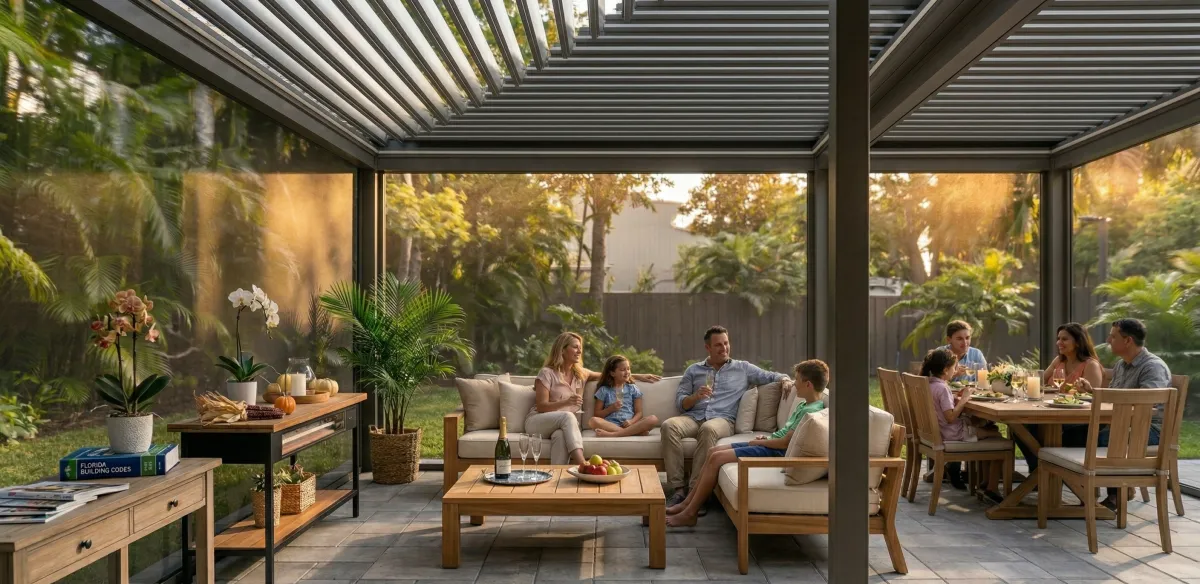
In the second future, the patio is a room. The pavers catch the last warmth of the day beneath your feet, travertine in herringbone, the pattern you chose in April after reading about material science and climate performance. The aluminum pergola frames the sky above, beams catching the golden hour light. And the Go-Fenetex motorized screens are deployed on three sides, insect mesh holding the mosquitoes at bay while the breeze moves freely through the room. The rain came at 4 p.m. You pressed a button, the vinyl screens descended along the Keder tracks, and the storm became background entertainment rather than a disruption. The screens retracted after the rain passed. The insect mesh stayed down. The evening continued without interruption.
Your daughter is setting the table. Your husband is arguing with the grill. The dog is asleep under the table. The neighbor's deck light is invisible behind the screen. Nobody is going inside.
The only difference between these two futures is a decision one of them made in the spring.
[Find a Go-Fenetex Dealer Near You → https://gofenetex.com/dealership]
The Three-Layer Execution Plan
The complete outdoor living transformation guide reduces to three phases that can be executed simultaneously or sequentially, depending on budget and timeline.
Phase One: Foundation (Pavers)
Engage a qualified hardscape installer with Florida-specific experience. Verify that the scope includes geotextile fabric, compacted aggregate base (minimum six inches), proper drainage slope, and edge restraint systems. Select paver material based on the four-question framework from week four: architecture, climate, maintenance tolerance, and visual harmony with the planned overhead structure. Budget: $15 to $35 per square foot installed, depending on material.
Phase Two: Structure (Pergola)
Select an aluminum pergola provider who includes engineering, permitting, and installation in the project scope. Verify that the design includes provisions for screen cassette mounting, electrical conduit for motors and lighting, and fan/heater brackets. Ensure the engineering package accounts for Go-Fenetex screen wind loads in addition to the open-frame structural loads. Budget: $15,000 to $45,000 depending on size, configuration, and accessories.
Phase Three: Completion (Go-Fenetex Motorized Screens)
Contact a Go-Fenetex authorized dealer for a site consultation. The dealer will assess the pergola structure, measure the openings, recommend screen configurations (insect mesh, vinyl, or dual), and specify the Keder track, One-Track tensioning, and motor systems appropriate for your application. Installation typically requires one to two days per opening. Budget: $3,000 to $8,000 per screen opening, depending on size and configuration.
Total three-layer investment for a typical 400-square-foot outdoor room: $45,000 to $120,000 depending on material selections, pergola configuration, number of screen openings, and accessory integration.
[Explore Commercial Solutions by Go-Fenetex → https://gofenetex.com/commercial]
The Phased Approach for Every Budget
Not every homeowner can execute all three phases simultaneously, and the three-layer model is designed to accommodate phased construction. Each layer delivers standalone value while creating the infrastructure for the next.
Phase one alone: a beautiful paver patio that transforms the outdoor aesthetic and increases property value immediately. Phase two adds the pergola: shade, spatial definition, and the platform for future completion. Phase three adds the screens: the year-round comfort envelope that maximizes the return on every dollar invested in phases one and two.
The beauty of phased construction is that there is no wasted investment. Every dollar spent on phase one is enhanced by phase two. Every dollar spent on phase two is maximized by phase three. The homeowner who completes phase one this spring and phase three next spring has not delayed gratification; they have distributed it across two seasons of incremental improvement, each one making the space better than the one before.
[See Go-Fenetex Home Page → https://gofenetex.com/home-page]
What Go-Fenetex Homeowners and Dealers Say
The transformation is consistent across every climate, every neighborhood, and every family configuration. Homeowners report the same shift: from occasional outdoor use to daily outdoor living. Dealers report the same observation: the most common response after installation is "I wish we had done this sooner."
Go-Fenetex motorized screens have withstood sustained winds of 185 mph during Hurricane Dorian in the Bahamas without a single track failure. They carry a lifetime warranty on welded Keder attachment. They are manufactured in the United States and supported by a nationwide network of authorized dealers who handle measurement, engineering, installation, and service.
The product is proven. The engineering is verified. The warranty is real. The question is not whether the screens work. The question is when you decide to stop reading about the outdoor room and start living in it.
[Explore Residential Retractable Screens → https://gofenetex.com/residential]
One Decision, Every Season After
You have the knowledge. Twelve weeks of it. You understand the layers, the materials, the engineering, the permits, the limitations, the solutions, the costs, and the returns. You understand that the outdoor room is not a purchase but a system, and that the system works when all three layers are present and each one is built to the standard the others require.
What remains is the simplest step in the entire process, and the one that separates the homeowner who reads from the homeowner who lives in the room they built. Contact a Go-Fenetex authorized dealer. Request a free outdoor living space assessment. Thirty minutes. No obligation. A conversation between you and a professional who has helped hundreds of homeowners turn the same vision you are carrying into the room they now use every day, every season, with the press of a single button.
Your patio is not a room. Not yet. But the decision that makes it one is closer than you think, and the next season does not have to look like the last.
Request your free outdoor living space assessment today → https://gofenetex.com/home-page
Start exploring the complete outdoor living ecosystem at NextGen Screens
Discover Onetrack's motorized screen systems at Onetrack Screens
Learn about hurricane-rated protection with Maxforce Screens
