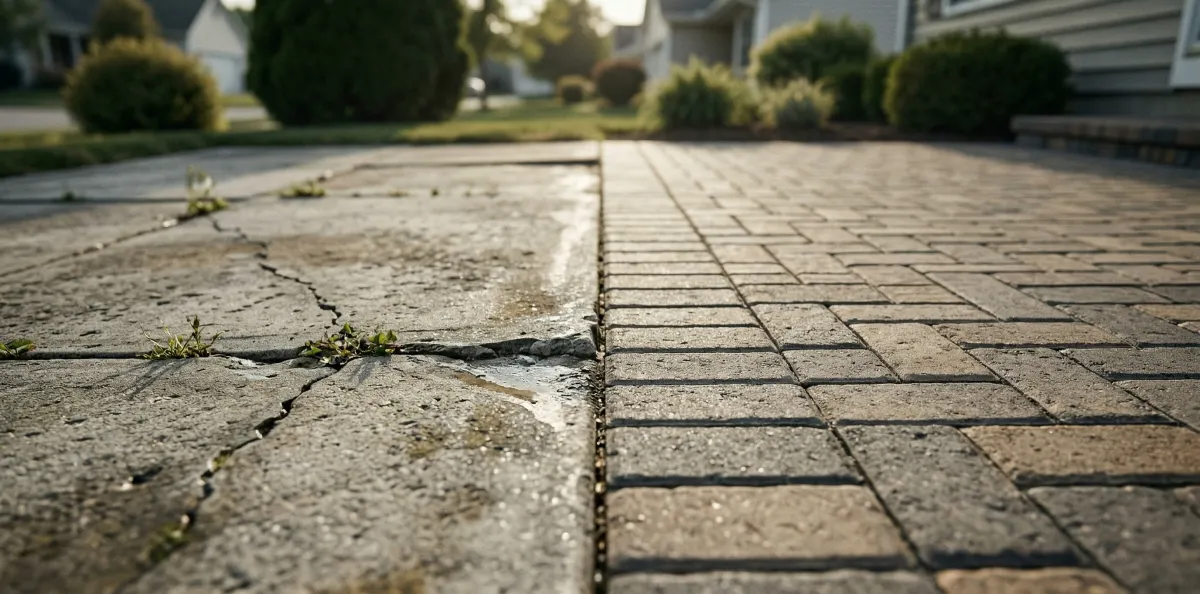
Cracked, Settled, and Sinking: The Silent Damage Happening Under Every Neglected Patio Surface
It starts with a line so thin you could miss it with your shoe. A hairline fracture in the concrete, running diagonally from the edge of the patio toward the center like a whisper that the ground beneath your feet has something to say. You notice it one morning while watering a plant, and your brain files it under the category of things that are fine. A cosmetic imperfection. A character mark. Something that happens to every patio eventually, the way paint fades or gutters collect leaves. You step over it. You forget about it. And then winter arrives, and the water finds the crack, and the freeze-thaw cycle begins its quiet, patient demolition.
By spring, the hairline is a crevice. By the following spring, it had friends. And somewhere in the third year, you are standing on a patio that has shifted, settled unevenly, and developed a network of fractures that can no longer be explained away as cosmetic. The surface that looked fine from a distance now feels unreliable underfoot. Water pools where it never pooled before. Weeds have found the gaps. And the homeowner who told themselves "we'll fix it next year" is now looking at a repair bill that is two or three times what it would have been if they had acted when the first line appeared.
This is the story of every neglected outdoor surface in North America. It is not dramatic. It is not sudden. It is slow, steady, and almost invisible until the day it becomes impossible to ignore. And the most frustrating part is that it was entirely preventable.
Explore outdoor living solutions at NextGen Screens
The Crack You Stopped Noticing
The human brain is remarkably good at normalizing deterioration. Psychologists call it habituation; the tendency to stop registering stimuli that remain constant in your environment. The crack in your patio is there every day, which means that after the first week, your brain effectively deletes it from your visual field. You walk over it without seeing it. Guests notice it immediately, but you have lived with it long enough that it has become part of the background, as unremarkable as the color of your garage door.
This is why patio resurfacing conversations so often begin with a triggering event rather than a gradual decision. A family member visits and mentions the uneven surface. A neighbor completes a stunning paver installation and the contrast becomes impossible to ignore. A real estate agent, gently or otherwise, suggests that the cracked patio repair situation should be addressed before listing the home. Or the homeowner trips on a raised edge and the safety dimension finally overrides the habituation.
The crack you stopped noticing has been busy the entire time you were not looking at it. Water infiltration has been softening the base material beneath the slab. Freeze-thaw cycles have been widening every fissure by fractions of an inch, season after season. Tree roots have been probing the path of least resistance. And the settling that produced the original crack has continued, because settling does not pause simply because no one is watching.
A cracked patio is not a stable imperfection. It is a surface in active decline.
See what your outdoor space could become at NextGen Screens
Concrete's Dirty Secret: Why It Fails in Every Climate
Concrete is the default outdoor surface for one reason, and it is not performance. It is cost. Poured concrete is the cheapest way to cover outdoor square footage at the point of installation, and in the short term, it looks clean, solid, and functional. What concrete does not advertise on day one is what it will look like on day seven hundred.
Here is what the concrete industry would prefer homeowners not calculate. Concrete is a rigid material poured as a single monolithic slab. It has no flexibility, no capacity to absorb ground movement, and no forgiveness for the natural shifting that every property experiences over time. In seasonal climate zones, the ground beneath a concrete slab expands when wet and contracts when dry, heaves when frozen and settles when thawed. The slab cannot flex with these movements. Instead, it cracks. This is not a defect in the concrete. This is what concrete does when the ground it sits on behaves like ground.
Pavers, by contrast, are engineered as individual interlocking units set on a compacted base of gravel and sand. When the ground shifts, the pavers shift with it, absorbing the movement through their joints rather than fracturing through their surface. A properly installed paver patio can accommodate seasonal ground movement for decades without developing the structural cracks that define concrete's aging process.
The comparison between concrete vs pavers extends beyond durability. Concrete stains permanently; pavers can be individually replaced if one is damaged. Concrete requires expansion joints that crack anyway; paver joints are designed to flex. Concrete surfaces become slippery when wet; textured pavers maintain traction. Concrete repairs are visible, mismatched patches that never blend with the original pour; paver repairs are invisible, because you are simply swapping one unit for an identical one.
The patio replacement options conversation should start with this question: do you want a surface that fights the ground it sits on, or one that moves with it?
Discover durable outdoor solutions at Onetrack Screens
The Compounding Cost of "We'll Fix It Next Year"
Delay has a price, and in outdoor hardscape, that price compounds with a speed that most homeowners do not appreciate until they receive a contractor's estimate. The crack that could have been addressed in year one with a modest patio resurfacing has, by year three, undermined the base material to the point where the entire slab needs to be removed before any new surface can be installed. What was a repair is now a demolition and rebuild. What was a two-thousand-dollar decision is now a ten-thousand-dollar commitment.
The compounding works like this. Water enters the crack and saturates the base material beneath the slab. Saturated base material loses its load-bearing capacity, which causes the slab to settle unevenly. Uneven settling creates more cracks, which admit more water, which further degrades the base. Each winter's freeze-thaw cycle accelerates the process. Tree roots, sensing moisture, grow toward the weakened zone and apply additional pressure from below. By the time the surface looks visibly broken, the damage beneath it is typically far more extensive than the surface suggests.
This is why the homeowners who act early pay less, wait less, and stress less than the homeowners who normalize the problem until it becomes an emergency. The first crack is not a cosmetic issue. It is a diagnostic signal. It is the surface telling you that the system beneath it is in motion, and that motion only moves in one direction.
The paver installation that replaces a failing concrete surface does not just solve today's visible problem. It replaces the system entirely; the surface, the base, the drainage, and the structural logic of how your outdoor flooring interacts with the ground beneath it.
Check out hurricane-rated outdoor solutions at Maxforce Screens
Pavers vs. Poured: The Engineering Argument Nobody Makes
Most articles comparing concrete vs pavers focus on aesthetics. The colors, the patterns, the design flexibility. Those are real advantages and they matter. But the engineering argument is more important, and almost nobody makes it clearly enough for homeowners to understand why it matters to their specific property.
A paver installation is not just a different-looking surface laid on the same base. It is a fundamentally different engineering approach to outdoor flooring. The system begins with excavation to a depth that most homeowners find surprising; often eight to twelve inches below the finished surface grade. Into that excavation goes a compacted gravel base, typically four to six inches of crushed stone compacted in lifts to create a load-bearing foundation that distributes weight evenly and allows water to drain through rather than pooling beneath the surface.
On top of the gravel base goes a one-inch layer of leveling sand, screeded to a precise grade that ensures water flows away from the home and toward designated drainage paths. The pavers themselves are then set into this sand bed in whatever pattern the design calls for; herringbone for maximum interlock strength, running bond for visual length, basketweave for a traditional feel. The joints between pavers are filled with polymeric sand, a specialized jointing material that hardens when activated with water and resists weed growth, insect infiltration, and washout.
The entire system is then compacted as a unit, driving the pavers into the sand bed and locking the assembly together. Edge restraints, often aluminum or concrete, border the installation to prevent lateral spreading over time.
This is not a decorative choice. This is a drainage system, a load distribution system, and a flexible surface system disguised as a patio. And it is the reason that a professionally installed paver surface outlasts poured concrete by a factor of two or three in most climates.
The engineering beneath the surface is what separates a paver installation that lasts five years from one that lasts twenty-five.
See how pavers create the foundation for motorized screen systems at Onetrack Screens
What Your Driveway Is Telling Every Person Who Pulls Up
Curb appeal is not a vanity metric. It is the first chapter of the story your home tells to every person who approaches it; guests, neighbors, delivery drivers, potential buyers. And the driveway is the opening sentence of that chapter. It is the largest single surface visible from the street, and it communicates more about the home's maintenance, care, and value than any other exterior element except the roof.
A cracked, stained, settling driveway tells a story that no amount of fresh paint on the front door can override. It says deferred maintenance. It says "good enough." It says the homeowner has either not noticed or not cared enough to address the most visible surface on the property. Whether that judgment is fair is beside the point. It is the judgment that visitors, neighbors, and especially potential buyers make within the first seven seconds of pulling into your driveway.
A driveway paver installation rewrites that opening sentence entirely. It communicates intention, investment, and attention to detail. It signals that this is a property where the owner cares about quality from the street to the backyard, from the ground up. And in real estate markets where outdoor presentation increasingly drives buyer decisions, that signal translates directly into perceived value.
The hardscape that surrounds your home is not separate from the home. It is the foundation, literally and figuratively, of how the property presents itself and how it functions for the people who live there. When the surface beneath your feet is solid, level, well-drained, and beautiful, everything that sits on top of it, the furniture, the grill, the pergola, the screens, functions the way it was designed to. When the surface is cracked, settling, and pooling water, nothing above it can fully compensate.
Your driveway is talking. The question is whether you are listening.
Explore the complete outdoor living ecosystem at NextGen Screens
The Foundation Conversation: Starting With What's Under Your Feet
There is a reason that every serious outdoor living transformation begins with the surface. You do not hang a chandelier before you build the ceiling. You do not frame a wall before you pour the foundation. And you do not install a pergola, mount motorized screens, or build an outdoor kitchen on a surface that is actively cracking, settling, and failing beneath the weight of your plans.
The paver installation is the first conversation, not because it is the most exciting part of the outdoor living vision, but because it is the part that makes every other part possible. A pergola's structural posts need a stable surface to anchor to. Motorized screen tracks require a level plane to operate properly. Outdoor furniture needs a flat, well-drained surface that will not shift and create wobble. The patio that serves as the floor of your future outdoor room needs to be as intentionally engineered as the floor of any room inside your house.
If your current surface is sending you signals, hairline cracks, uneven settling, water pooling in places it never did before, those signals are not going away. They are getting louder. And the cost of responding now is a fraction of the cost of responding after two more winters of freeze-thaw have finished what the first crack started.
The outdoor living space you have been imagining starts at the ground. The pavers are the floor of a room you have not built yet. The pergola is the ceiling. The screens are the walls. And the vision, the complete, year-round, comfortable outdoor room that makes you want to stay outside instead of retreating to the couch, that vision begins with the honest assessment of what is currently beneath your feet.
If you are ready to explore what a professional paver installation looks like for your specific property, or if you want to understand the patio replacement options available before making any commitments, the resource library at NextGen Screens provides the technical depth and design inspiration that informed homeowners expect. Because the surface you stand on should be as thoughtfully engineered as the structure you dream of building above it.
Start exploring the complete outdoor living ecosystem at NextGen Screens
Discover Onetrack's motorized screen systems at Onetrack Screens
Learn about hurricane-rated protection withMaxforce Screens
