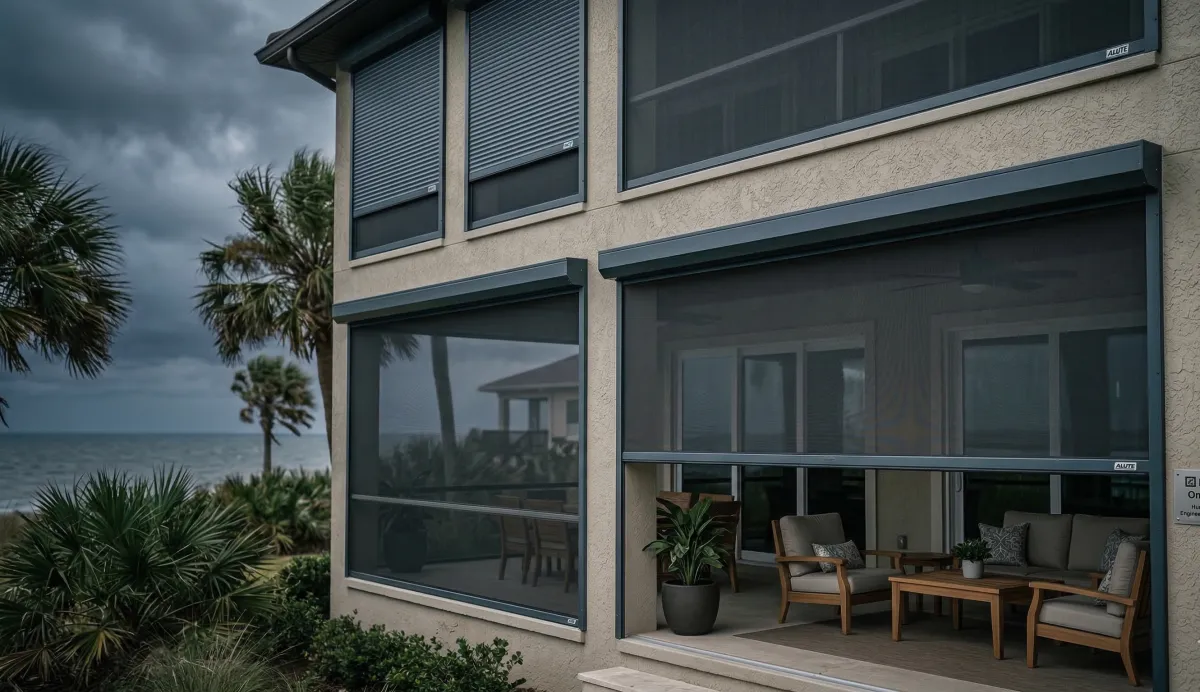
Do Motorized Screens Actually Protect Against Hurricanes? What Florida Homeowners Need to Know
Yes, motorized screens can provide meaningful hurricane protection for lanais, covered patios, pergola openings, and other large open-air areas on a Florida home — when they are engineered, rated, and installed to current Florida Building Code wind standards.
That is the direct answer. Here is the complete one.
Not all motorized screens are hurricane rated. The ones that are — including the Fenetex hurricane screen systems that Titan Outdoor Solutions installs across St. Augustine, Nocatee, Ponte Vedra Beach, and Northeast Florida — are built on engineering that is fundamentally different from a standard insect or solar screen. The fabric is different. The mounting system is different. The testing protocol is different. And the openings they are designed to protect are different from the openings aluminum shutters are designed to protect.
Understanding those differences honestly is the entire point of this post. If you are a homeowner searching for the truth about whether motorized screens protect against hurricanes, you deserve a straight answer — not a sales pitch and not a disclaimer. You deserve to know what these screens can do, what they cannot do, and when the smart decision is to install both screens and shutters on the same home.
What Hurricane-Rated Motorized Screens Actually Protect
The first thing to understand is that motorized hurricane screens are not designed to replace aluminum shutters on windows and primary entry doors. We covered aluminum hurricane shutters in detail in Week 2 — and that technology remains the gold standard for protecting the sealed openings that carry the highest structural risk during a storm.
What motorized screens protect are the openings that aluminum shutters were never designed for.
Lanais. Covered patios. StruXure pergola openings. Outdoor kitchen pass-throughs. Large screened-in areas with sliding glass doors behind them. Pool enclosure entries. Garage-to-patio transitions. Covered outdoor fireplace areas that open to the yard.
These are the spaces where a Northeast Florida home is most exposed — and most vulnerable — during a hurricane. They are also the spaces where homeowners have invested the most in outdoor living: the furniture, the kitchen, the travertine patio, the pergola, the entertainment systems, the fixtures. In a Category 2 or 3 event, everything in those spaces is at risk from wind-borne debris, rain infiltration, and structural pressure on the adjacent glass.
A rigid aluminum shutter cannot practically cover a 20-foot lanai opening or a multi-panel patio configuration. The geometry does not work. The weight does not work. The aesthetics do not work. And the homeowner would never retract a permanent aluminum wall every morning to enjoy coffee on the lanai.
A motorized screen does all of it. It deploys in seconds to create a hurricane-rated barrier across those openings. It retracts completely into a slim housing when the storm has passed — or when you simply want the breeze. That duality — protection when you need it, invisible when you do not — is the engineering proposition that makes hurricane-rated motorized screens fundamentally different from any other product in the market.
The Engineering Behind Fenetex OmegaTex Hurricane Fabric
The credibility of a hurricane-rated motorized screen lives or dies in the fabric. This is where the Fenetex system Titan installs separates itself from the commodity screen market — and where the question of whether motorized screens protect against hurricanes gets its most specific answer.
Fenetex's hurricane screen uses OmegaTex fabric — a woven material engineered from aramid fibers. If that term sounds familiar, it should. Aramid fibers are the same base technology used in body armor, ballistic vests, and aerospace applications where high-tensile-strength, low-weight materials must absorb extreme impact forces without failure.
OmegaTex is not a mesh in the conventional sense. It is an engineered textile designed to absorb and distribute the kinetic energy of wind-borne debris across its entire surface area rather than allowing penetration at the point of impact. When a piece of debris strikes the fabric at hurricane-force velocity, the energy dissipates through the weave rather than punching through — a behavior fundamentally different from standard screen mesh, fiberglass screen panels, or even heavy-duty solar fabrics.
The numbers behind this performance are specific and verifiable:
Wind Load Rating: Fenetex hurricane screens are tested and approved to withstand wind loads that meet Florida Building Code requirements for the specific wind zone where they are installed. In St. Johns and Flagler counties, this means performance ratings appropriate for the coastal and near-coastal wind speed designations assigned to Ponte Vedra Beach, St. Augustine Beach, Palm Coast, and the barrier islands along the First Coast.
Impact Resistance: The screens are tested under the ASTM large missile impact test protocol — the same standard applied to hurricane shutters and impact-rated windows. This test fires a 9-pound 2x4 lumber section at the screen at prescribed velocities to simulate the wind-borne debris conditions of a major hurricane. Fenetex OmegaTex passes this test.
Miami-Dade NOA Certification: Fenetex hurricane screens carry Miami-Dade County Notice of Acceptance — the most stringent hurricane product testing and certification protocol in the United States. Products that pass Miami-Dade NOA standards exceed the requirements of every other Florida county, including St. Johns, Duval, and Flagler. This is the same certification standard referenced for aluminum hurricane shutters, impact windows, and other permanent storm protection products.
When someone asks whether motorized screens are hurricane proof, the accurate answer is that Fenetex OmegaTex screens are tested to the same impact and wind load standards as the aluminum shutters protecting your windows. The difference is not in the level of protection — it is in the type of opening each product is designed to serve.
What Motorized Screens Cannot Do — And Why Honesty Matters Here
This is the section that most companies selling motorized screens in Florida would prefer to skip. We are including it because your trust is more valuable to us than a sale, and because the homeowners who understand these limitations make better decisions — and become better-protected homeowners.
Motorized hurricane screens are not a replacement for aluminum shutters on windows and primary entry doors.
Here is why. A window is a sealed opening in the building envelope. When it is breached — when the glass shatters — the pressure differential inside the home changes immediately. The roof experiences uplift. Interior walls experience lateral loads they were not designed for. The structural cascade that follows a single window breach is well-documented in hurricane damage assessments across Florida, including post-Matthew and post-Milton analyses in the Northeast Florida market.
An aluminum shutter prevents that breach with a rigid, impact-rated barrier bolted directly to the structural framing around the opening. The shutter absorbs the impact, deflects the debris, and maintains the integrity of the building envelope.
A motorized screen, by contrast, is a tensioned fabric system. It is extraordinary at absorbing and distributing impact energy across large surface areas — which is exactly what makes it ideal for wide lanai openings, patio spans, and pergola configurations. But on a small, pressure-critical opening like a window, the rigid shutter provides a more appropriate level of protection for the structural role that opening plays in the home's wind resistance system.
This is not a limitation of the screen. It is a recognition that different openings carry different structural risks and require different engineering solutions. The best hurricane protection plan for a Northeast Florida home uses both — shutters where shutters are needed, screens where screens are needed.
Titan installs both because we believe in that combination. We will never recommend screens where a shutter is the right answer. We will also never recommend that a homeowner leave a 20-foot lanai opening unprotected because aluminum shutters are the only product the contractor sells.
The Problem with Traditional Screen Enclosures in a Hurricane
To fully understand the value of hurricane-rated motorized screens, it helps to understand what happens to the screen system most Northeast Florida homes already have — the traditional fixed screen enclosure.
Standard screen enclosures — the aluminum-framed, full-cage structures that surround most pools, lanais, and covered patios in St. Augustine, Nocatee, Jacksonville, and across St. Johns County — are not hurricane rated. Their fiberglass or polyester mesh is stretched across a lightweight aluminum frame designed for insect protection and debris screening. It is not designed for wind loads.
In hurricane-force winds, that mesh acts as a sail. It catches wind and transfers enormous lateral force to the aluminum frame — force the frame was never engineered to absorb. The result, documented across thousands of Florida homes after every major storm, is structural failure: bent frames, torn mesh, collapsed enclosures, and damage to the adjacent structures they were attached to.
This is why most screen contractors in Florida advise homeowners to cut their screens before a major hurricane — intentionally slashing the mesh so it does not catch wind. After the storm, you call the contractor back to rescreen the entire enclosure. The cost for a full rescreening ranges from $2,000 to $8,000 depending on the size of the structure, and it can take weeks to schedule in the post-storm demand surge.
This cycle repeats every time a significant storm threatens the region.
A Fenetex motorized hurricane screen eliminates that cycle entirely. Before a storm, the screen is deployed — providing rated protection to the opening. After the storm, it retracts. The fabric is intact. The housing is undamaged. The outdoor space is usable again immediately.
And during the 300+ days per year when there is no hurricane, the same screen provides bug protection, UV blocking, solar shading, wind management, and privacy control. It earns its place in your life every day, not just during storm season.
The real comparison is not motorized screens versus hurricane shutters. It is motorized screens versus the fixed screen enclosure you already have — the one that provides zero hurricane protection, costs thousands to replace after every storm, and does nothing to block UV, control wind, or create privacy the rest of the year.
When You Need Both And Why One Contractor Matters
The hurricane protection strategy Titan recommends for most homes in Nocatee, Ponte Vedra Beach, and across Northeast Florida is not all shutters or all screens. It is a deliberate combination of both, designed opening by opening.
The approach looks like this:
AHT aluminum hurricane shutters on every window, entry door, and sliding glass door that forms part of the home's sealed building envelope. Roll-down for second-story openings and large glass panels. Accordion for standard ground-floor windows. Bahama or colonial for HOA-sensitive facades. These protect the structural integrity of the home.
Fenetex hurricane-rated motorized screens on every lanai opening, covered patio span, StruXure pergola configuration, outdoor kitchen pass-through, and any large open-air area where a rigid shutter is either impractical or architecturally incompatible. These protect the outdoor living investment and the adjacent glass behind the opening.
The combination delivers complete coverage — every opening on the home addressed with the right product for its specific structural role, exposure, and geometry.
Here is why one contractor matters. When two different companies install shutters and screens on the same home, you are managing two timelines, two permit processes, two installation crews, and two warranty structures. The screen installer does not coordinate with the shutter installer on mounting points, electrical routing for motorized systems, or aesthetic consistency. The result is often a protection plan that has gaps — openings that fell between the two scopes of work and ended up unprotected.
Because Titan Outdoor Solutions installs both AHT aluminum shutters and Fenetex motorized screens, we design one cohesive plan. Every opening is accounted for. The mounting systems are coordinated. The electrical for motorized shutters and motorized screens is routed together. The permits are filed as a single project. And you have one point of contact, one installation timeline, and one company standing behind the entire system.
You can see examples of our combined shutter-and-screen installations in our project gallery and video gallery.
The Daily Life of a Hurricane Screen Beyond Storm Season
The question that opens this post — do motorized screens protect against hurricanes — has a clear answer: yes, for the openings they are designed to serve. But the more revealing question might be this: what do hurricane-rated motorized screens do during the other 355 days of the year?
This is where the investment logic shifts from storm protection to lifestyle return — and where Fenetex hurricane screens differentiate themselves from every other hurricane product on the market, including the aluminum shutters we install and recommend.
An aluminum shutter is deployed before a storm and retracted after. It serves one purpose, and it serves that purpose exceptionally well. But between storms, it is either retracted in its housing or folded at the side of the window. It adds no daily value to your living experience.
A Fenetex motorized screen serves you every day.
At dusk in Nocatee, when the mosquitoes and no-see-ums arrive and your neighbors go inside, your screen deploys and your evening continues on the lanai. On a Saturday afternoon in Ponte Vedra Beach, when the Florida sun is driving the patio temperature past the point of comfort, the solar mesh option blocks 91 percent of UV rays and drops the perceived temperature meaningfully. When you want privacy from the golf course foot traffic behind your Silverleaf home, the screen creates a visual barrier without closing off airflow.
Bug protection. UV blocking. Solar shading. Wind management. Privacy control. Rain deflection. And when a named storm appears in the Atlantic, the same screen you used for coffee this morning becomes a tested, rated, certified hurricane barrier deployed at the press of a button.
No other product in the outdoor protection category delivers that combination. That is why the question is not whether motorized screens protect against hurricanes — the engineering answers that clearly. The question is why any Northeast Florida homeowner would choose a product that only works during a storm when they could have one that works every single day.
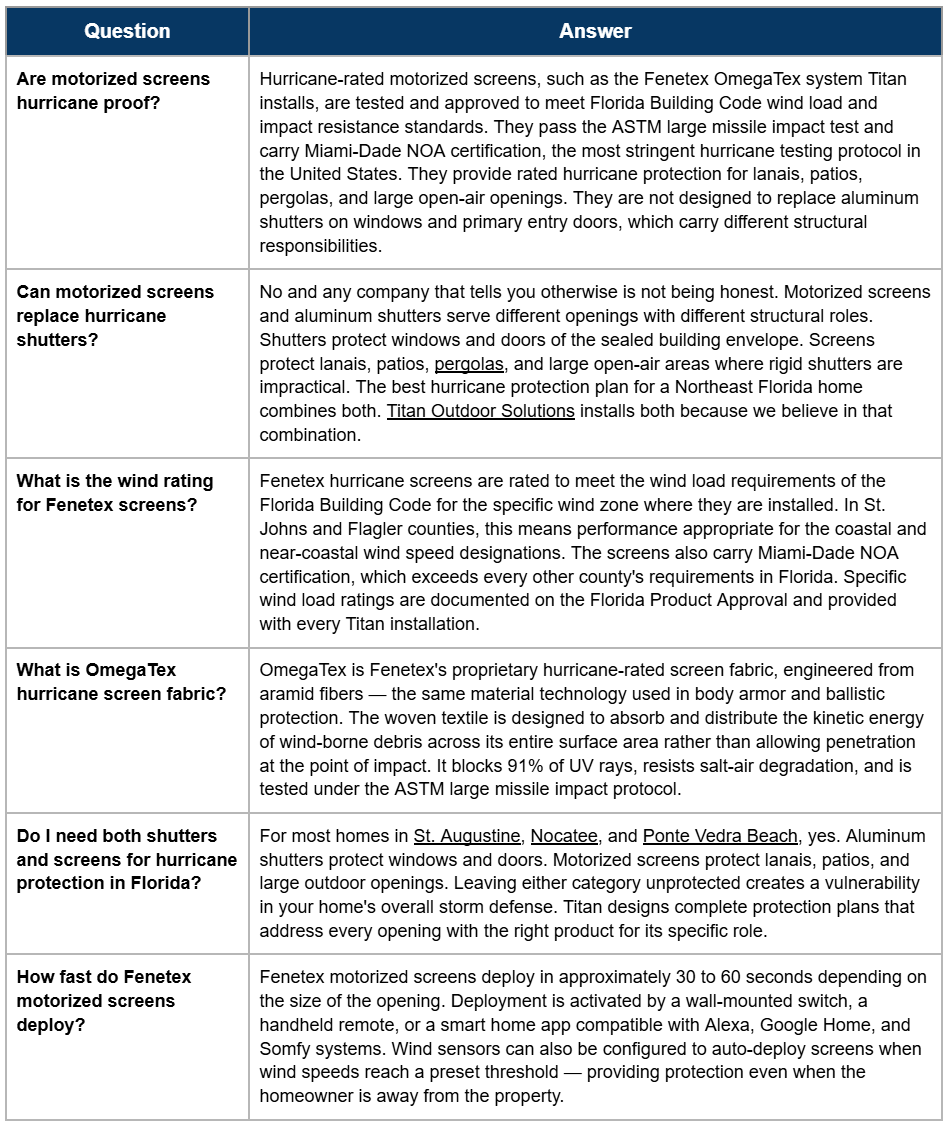
Frequently Asked Questions
Schedule Your Free Hurricane Protection Assessment
Serving St. Augustine · Nocatee · Ponte Vedra Beach · Palm Coast · Jacksonville · Northeast Florida
Talk to our team about the right combination for your home. We install both aluminum shutters and motorized screens — so we will tell you honestly what each opening actually needs. No pressure, no obligation.
Call or text: (904) 484-7580 | TitanOutdoorSolution.com
