
Fire Pit, Fireplace or Fire Table: Where to Put It When the North Wind Blows
On the cold days of the last two Januaries at Jacksonville International Airport, more than half had their strongest wind from the west, northwest or north. And last winter's coldest reading, 22°F, came twice: once in nearly still air on January 16, and again on February 1 in a northwest wind that made it feel close to 10. That's what a fire feature has to work with in Northeast Florida.
This is the third post in Lit Before the Cold. Here's what NOAA's daily records show about wind on cold days, what's different on the coast, and how that should shape where a fire pit, outdoor fireplace or heater goes.
Quick Answer
Where should I put a fire pit or outdoor fireplace so wind doesn't ruin it in Northeast Florida?
Shelter it on the west-to-north side. NOAA's daily records for Jacksonville International Airport show that of 39 days at or below 40°F in January 2025 and January 2026, 21 had their strongest sustained wind from between due west and due north, the direction cold fronts arrive from. Peak gusts on those cold days averaged about 22 to 25 mph and reached 48 mph on January 31, 2026. The coldest mornings can go either way: Jacksonville hit 22°F in nearly still air on January 16, 2026, and 22°F again on February 1, 2026, with northwest gusts to 36 mph and forecast wind chills near 10. Coastal homes also get wind off the ocean: on October 24, 2026, the National Weather Service issued a wind advisory for northeast winds gusting to 40 mph across coastal Duval and St. Johns counties. So put the house, a wall or a structure on the windward side, favor a sheltered corner on the coast, and remember that an outdoor fireplace's own mass blocks wind while an open fire pit is exposed on every side.
What the wind actually does on cold days
NOAA's Local Climatological Data records, for every day, the strongest sustained wind at Jacksonville International Airport and the direction it came from. We went through every day of January 2025 and January 2026 and counted the days that dropped to 40°F or below.
| Month | Days at 40°F or below | Strongest wind from W, NW or N | Coldest night | Wind on the coldest day |
|---|---|---|---|---|
| January 2025 | 23 | 13 | 26°F (Jan 25) | 10 mph, from the east-northeast |
| January 2026 | 16 | 8 | 22°F (Jan 16) | 10 mph, from the southeast |
Two patterns stand out. First, more than half of the cold days, 21 of 39 across the two months, had their strongest sustained wind from somewhere between due west and due north. That's the direction cold fronts push in from. Peak gusts on cold days averaged about 22 mph in January 2025 and 25 mph in January 2026. The strongest came on January 31, 2026, when a front brought a 48 mph gust from the northwest and a trace of snow.
Second, the coldest nights don't follow one script. In January 2025 the coldest morning, 26°F on January 25, came with light winds. Last winter, Jacksonville hit 22°F twice, and the two mornings could hardly have been more different.
| Date | Low | Average wind that day | Peak gust | The day before |
|---|---|---|---|---|
| January 16, 2026 | 22°F, tying a 1927 record | 2.9 mph | 13 mph | 40 mph gust from the west as a front passed |
| February 1, 2026 | 22°F, a record low | 12.1 mph | 36 mph from the northwest | 48 mph gust from the northwest and a trace of snow |
January 16 is the classic pattern: a front blows through, the wind drops, and the coldest air settles in under still, clear skies. February 1 is the other kind. The National Weather Service had issued a wind advisory for northwest gusts of 30 to 40 mph and its first-ever Extreme Cold Watch for the Jacksonville area, and forecasters expected wind chills near 10 that morning. Same temperature, very different night to be sitting outside.
One limit to keep in mind: these are the day's strongest winds, not a reading taken at 8 p.m. on the patio. Evenings are often calmer than the day's peak. But the pattern is consistent enough to plan around.
The coldest night of the winter can also be the windiest. Shelter is what makes a fire usable on both.
The coast gets its own wind
Coastal homes get more than the fronts. On October 24, 2026, the National Weather Service in Jacksonville issued a wind advisory for northeast winds of 15 to 25 mph, gusting to 40 mph, across coastal Duval County and coastal and inland St. Johns County. Even at the inland airport, several cold days in January 2025 had their strongest wind from the northeast or east, off the ocean.
If you're near the water, expect wind from two directions: the northwest after a front, and the east or northeast off the Atlantic.
Where to put a fire feature
Given that pattern, a few practical placement principles:
| Situation | What to do |
|---|---|
| Inland lots (Nocatee, Jacksonville neighborhoods away from the coast) | Put the house, a wall, a hedge or a structure on the west-to-north side of the seating area, so post-front winds hit the barrier rather than the fire. |
| Coastal lots (Ponte Vedra Beach, St. Augustine Beach, Anastasia Island) | Plan for both the northwest and the east-northeast. A corner location, or a fireplace with seating on its sheltered side, usually works better than an open spot in the yard. |
| Open fire pits and fire tables | Most exposed to wind on every side. A low seating wall or a sheltered corner makes a real difference. |
| Outdoor fireplaces | The firebox and chimney mass act as their own windbreak for whoever is sitting in front of it. |
| Gas features | Follow the manufacturer's installation instructions on wind guards and clearances; flame behavior in wind varies by model. |
| Infrared heaters | Titan's frequent recommendation for lanais. Radiant heat warms people directly rather than the air, so a breeze carries less of it away. Wall units can be 4 to 12 inches deep and built into a simple wall build-out. |
| Pergolas and covered roofs | Infrared ceiling heaters can mount overhead, but Titan puts them only on structural beams. Keep the manufacturer's clearances from the roof. |
Titan Outdoor Solutions' Bill Davis puts it simply: infrared heats the people, not the air. On a breezy lanai, and especially on a night like February 1, when the wind made 22°F feel close to 10, that's the difference between warmth you feel and warmth that blows past you. It's also why Titan often builds infrared into the structure rather than leaving a heat source out in the open.
That's less construction than it sounds. Titan's Melanie Fraser says an infrared fireplace can be as thin as 4 to 12 inches deep, so it usually takes only a simple wall build-out, or a framed surround covered in fiber cement board such as Hardie board, finished with whatever stone you choose. Under a pergola, she says, infrared ceiling heaters can go overhead, but only on the structural beams. Either way, follow the manufacturer's clearances, and if a heater needs a new hardwired circuit, that's electrical work, so check with your building department.
Covered structures help too, but any fire feature or heater near a roof, pergola or screened lanai has to meet the manufacturer's clearance requirements and local code. That's part of the design work, not an afterthought. The previous post in this series covers the local burning rules that apply alongside it.
The bottom line
In Northeast Florida, the wind on a cold day usually comes from the northwest, and on the coast it can come off the ocean as well. The coldest nights can be still or windy, and when they're windy, the wind comes from the northwest. Put the shelter on the windward side, choose the heat source for how exposed your spot is, and you'll get more evenings out of whatever you build. Titan Outdoor Solutions installs fire pits, outdoor fireplaces and infrared heaters, plans them around the lot they're going on, and can talk through where one would work on yours.
Next in this series, on Thursday: adding an outdoor fireplace in St. Augustine's historic district, and what the review board looks at.
Frequently Asked Questions
Which direction does the wind come from on cold days in Jacksonville?
Most often from the west through north. Across January 2025 and January 2026, 21 of 39 days at or below 40°F at Jacksonville International Airport had their strongest sustained wind from that direction, according to NOAA's daily records.
Are the coldest nights also the windiest?
Sometimes. Last winter Jacksonville hit 22°F twice. On January 16, 2026, the wind averaged under 3 mph. On February 1, 2026, it averaged 12 mph from the northwest with gusts to 36, and forecasters expected wind chills near 10. Fronts often bring the wind first and stiller cold after, but the coldest night can also be the windiest.
Is a fireplace better than a fire pit in the wind?
An outdoor fireplace's firebox and chimney act as a windbreak for people sitting in front of it, while an open fire pit or fire table is exposed on every side. A fire pit in a sheltered corner or behind a seating wall can work well too.
What's the best heat source for a windy lanai?
Titan Outdoor Solutions often recommends an infrared heater built into a lanai wall. It warms people directly rather than heating air the wind can carry away, and the structure around it already shelters it. Titan's Melanie Fraser says wall units can be as thin as 4 to 12 inches, so a simple build-out finished in stone is usually enough; under a pergola, ceiling heaters go on the structural beams.
Sources
- NOAA National Centers for Environmental Information. Local Climatological Data, Daily Summary: Jacksonville International Airport, January 2025 (hosted by the Florida Climate Center). Accessed November 2026. climatecenter.fsu.edu
- NOAA National Centers for Environmental Information. Local Climatological Data, Daily Summary: Jacksonville International Airport, January 2026 (hosted by the Florida Climate Center). Accessed November 2026. climatecenter.fsu.edu
- NOAA National Centers for Environmental Information. Local Climatological Data, Daily Summary: Jacksonville International Airport, February 2026 (hosted by the Florida Climate Center). Accessed November 2026. climatecenter.fsu.edu
- News4JAX. Jacksonville ties record low of 22 degrees set 99 years ago. January 16, 2026. news4jax.com
- News4JAX. Extreme Cold Watch, a first for the greater Jacksonville area. January 29, 2026. news4jax.com
- News4JAX. Weather Alert Day: Strong winds with potential for record low temperatures make for dangerously cold weather. February 1, 2026. news4jax.com
- National Weather Service Jacksonville. Wind Advisory for Coastal Duval and Coastal and Inland St. Johns Counties. October 24, 2026. weather.gov
- News4JAX. Wind, coastal flooding and dangerous surf expected through the weekend for Northeast Florida, Southeast Georgia. October 24, 2026. news4jax.com
- Titan Outdoor Solutions. Phone interview with Melanie Fraser, President, and William Davis, Vice President, on fire feature options and installation. November 5, 2026. titanoutdoorsolution.com
- Titan Outdoor Solutions. Outdoor Fireplaces and Fire Pits. Accessed November 2026. titanoutdoorsolution.com
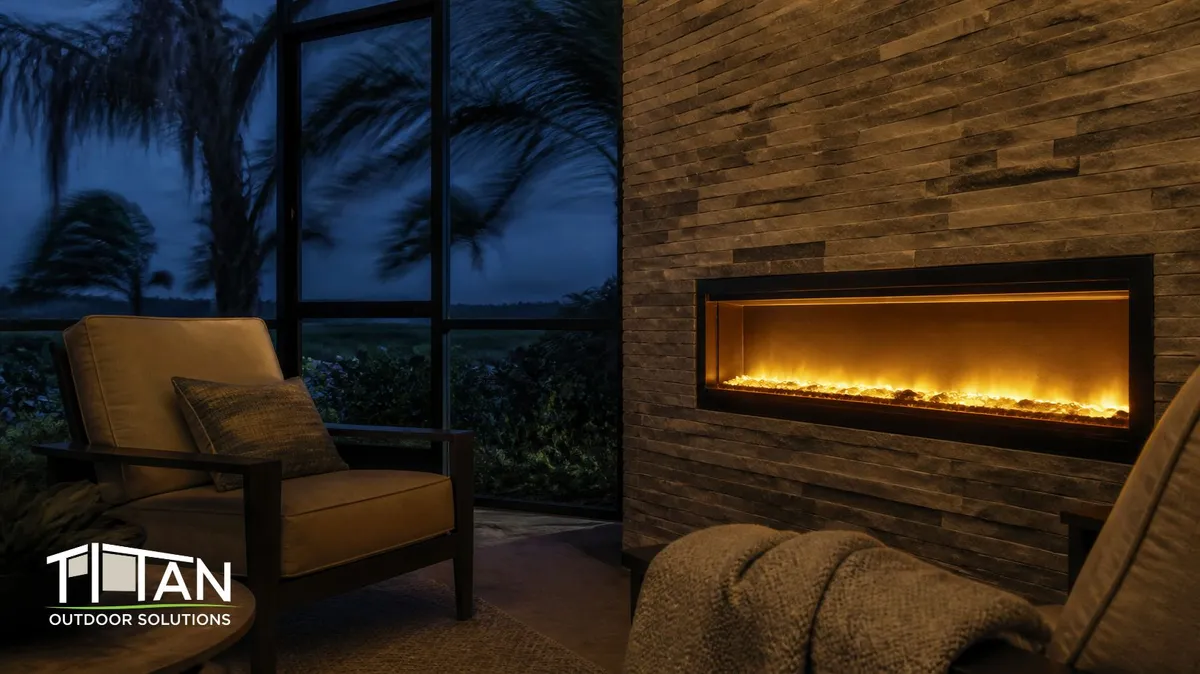
Cover image: AI-generated illustration. It does not show a Titan Outdoor Solutions installation.


