
Florida’s Pool Safety Law: The Five Ways a Plunge Pool Passes Final Inspection
Ask most people what Florida requires around a backyard pool and they will say a fence. That is close, but not quite right, and the difference matters when you are fitting a pool onto a small lot.
This is post 3 of Small Yard, Real Pool. Post 1 covered what counts as a plunge pool under Florida law, and post 2 compared plunge pools with cold plunges and swim spas. This one walks through the safety law every new residential pool in Florida has to meet, plunge pools included.
Quick Answer
Do I have to put a fence around a plunge pool in Florida?
Not necessarily. Florida Statutes §515.27 says a new residential pool must have at least one of five safety features to pass final inspection: a barrier that meets §515.29; an approved safety pool cover; exit alarms on every door and window that gives direct access from the home to the pool, rated at least 85 dB A at 10 feet; self-closing, self-latching devices on every door with direct access, with the release at least 54 inches above the floor; or an in-pool swimming pool alarm certified to ASTM F2208. A fence is one of those five, not a requirement on its own. Because a plunge pool holding more than 24 inches of water is legally a swimming pool, the same rule applies to it as to a full-size pool. Failing to equip a new residential pool with at least one feature is a second-degree misdemeanor. The statute sets the minimum: your HOA, or your own household, may want more than one.
Why this matters in Florida
The numbers are hard to read. The Florida Department of Children and Families says 119 children drowned in Florida in 2025, up from 106 the year before. Most were toddlers. In the DCF dashboard figures the Florida House cited in a January 2026 bill analysis, 73 of the 112 children counted at that point were between one and three years old, and 84% were five or younger.
This year looks worse. DCF had counted 91 child drownings statewide by the end of August, and the summer wasn’t over. By October, the department said Florida was on pace for a record year.
Some of those deaths happen in lakes, ponds and the ocean. Most don’t. State officials and Florida safety groups say the majority happen in residential swimming pools, the place parents tend to feel safest. The federal numbers agree. The U.S. Consumer Product Safety Commission found that 96% of pool and spa drownings of children under 15 nationwide from 2020 to 2022 were in pools, and just over half happened at the child’s own home. For children under 5, 62% of the reports described a gap in adult supervision, and 9% described a barrier that had failed or been gotten around.
It isn’t a downstate problem, either. DCF recorded three child drownings in Duval County in 2025. By late August 2026 Duval had five more: at least two in pools and two in retention ponds. That is the backdrop for the law below. Each of the five safety features exists to put something between a small child and the water.
Why the law applies to plunge pools
Florida’s Residential Swimming Pool Safety Act, Chapter 515 of the Florida Statutes, covers any residential structure intended for swimming or recreational bathing that holds water more than 24 inches deep. A plunge pool 5 to 6 feet deep is well inside that definition. The legislature’s stated intent, in §515.23, is that all new residential swimming pools, spas and hot tubs have at least one pool safety feature, while recognizing that constant adult supervision is the key to reducing submersion incidents.
1. A barrier
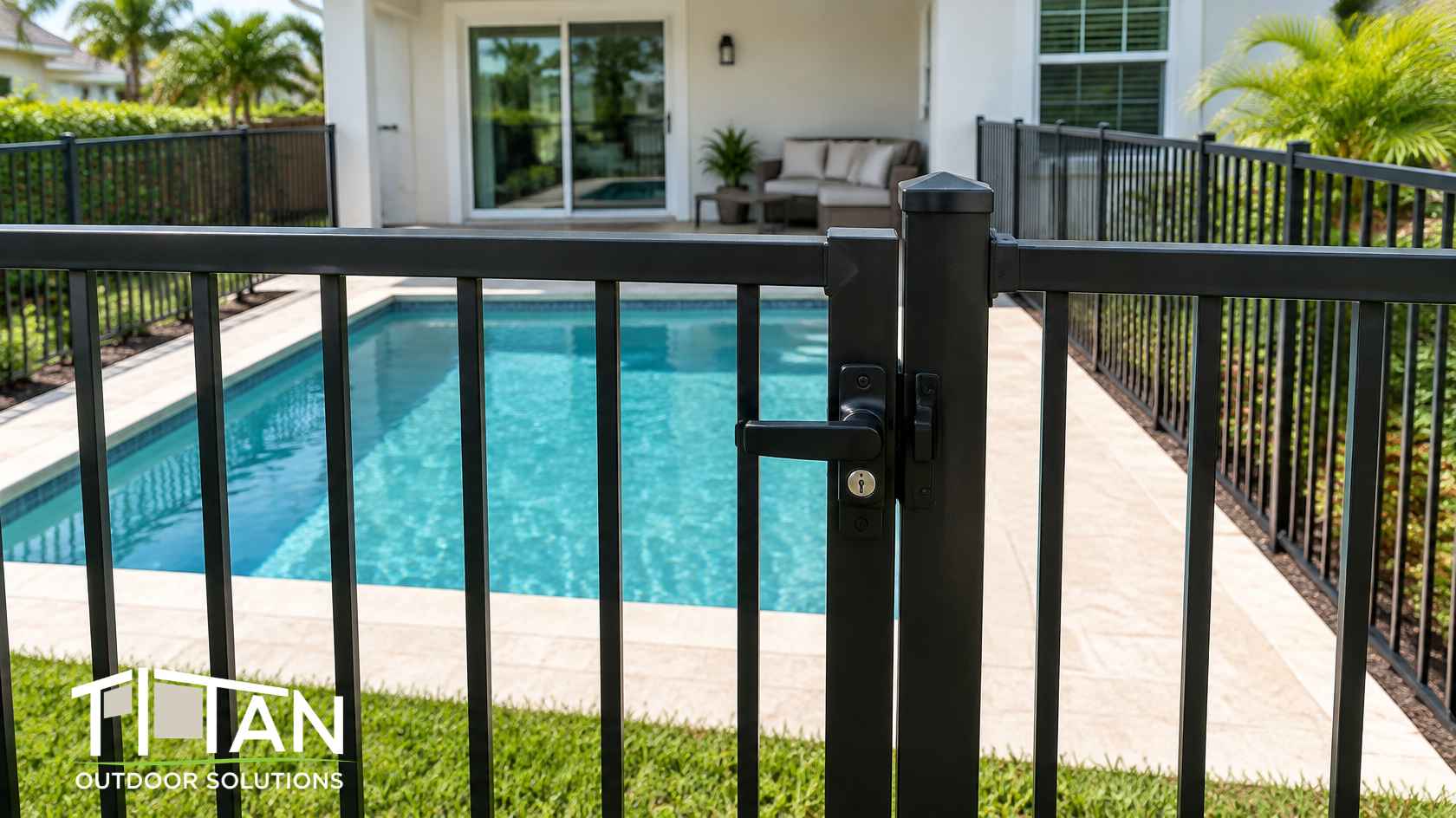
Pick a barrier and §515.29 decides what it has to be. Four feet tall, measured from outside. Nothing a toddler could slide under, squeeze through or climb. It has to wrap the pool itself, which usually means a fence of its own, unless your yard fence happens to run right along the pool. The back of the house can serve as one side, but only if nothing in that wall opens toward the water.
Small lots make two parts of it harder. The gate swings out, away from the water, and has to close and latch by itself. And the fence can’t hug the coping. The law wants enough room that a child, or a frail grandparent, who gets past the fence doesn’t go straight into the water. In a narrow yard you design that space in on day one, or you don’t get it.
Here in Florida, the barrier is often a screen enclosure. The Florida Building Code lets a screen enclosure that meets its barrier requirements count as part or all of the barrier. If you’re going that way, have your installer confirm the enclosure and its door meet those rules before final inspection.
The statute keeps it general. The Florida Building Code, which your permit is inspected against, gets specific. If you go with a fence and gate, this is what the inspector will be measuring:
Fence and gate checklist
- Height: 48 inches minimum, measured from the ground on the outside.
- Bottom gap: no more than 2 inches between the ground and the bottom of the fence.
- The 4-inch rule: nothing in the fence can let a 4-inch ball pass through.
- Vertical slats: no more than 4 inches apart.
- Horizontal rails: if the top rail and bottom rail are less than 45 inches apart, the rails have to face the pool side, and the slats tighten to 1¾ inches. Rails on the outside are a ladder for a toddler.
- Gate swing: outward, away from the pool, closing and latching on its own every time.
- Latch: on the pool side, at least 54 inches up, and no opening bigger than ½ inch within 18 inches of the release so a small hand can’t reach through.
One wrinkle on that latch. The building code lets a release sit on either side of the gate if it’s 54 inches or higher, but the statute says the release goes on the pool side, full stop. Put it on the pool side at 54 inches or higher and you’re right with both.
What most Titan customers choose
Most of the plunge pool owners we work with go with a fence. Usually it’s a 48-inch aluminum pool-code fence with gates that swing out, away from the water, and close on their own. Our latch of choice is a plunger latch, mounted so the part you pull to open it sits 54 inches above the ground.
A lot of back yards in Northeast Florida already have a wood or vinyl privacy fence. If that fence is what closes off the pool, we work with it instead of tearing it out. Every gate in it gets checked so it swings out and closes and latches by itself, and the latch moves up to 54 inches.
Slopes make it interesting. On one job the yard dropped away right where the gate had to go. A gate that swings out has to swing over the ground, and on that grade it would have hit dirt long before it opened. So the gate was designed around the slope and opens like a Lamborghini door instead of a garden gate.
Titan can handle basic barrier work, but for most fences we bring in a qualified local fence company. As Titan president Melanie Fraser puts it, “We specialize in plunge pools. Let the fence professional be the fence professional.”
2. An approved safety pool cover
The state’s term is “approved safety pool cover”: a manual or motorized cover built to the ASTM F1346-91 standard. Plunge pools suit it because the span is short, so the cover is smaller and lighter than one for a full-size pool. The catch is that it only works when it’s on, so somebody has to close it after every swim.
3. Exit alarms
If you go the alarm route, the rule covers every door and window in the house that gives access to the pool, and each one needs its own alarm. Each has to reach 85 dB A at 10 feet and keep sounding for as long as that door or window is open or left ajar. When customers ask us which kind of alarm to choose, this is the one we point them to.
4. Self-closing, self-latching doors
Same idea, different hardware. Each door from the house to the pool gets a closer and a latch that catches on its own, and the release sits at least 54 inches above the floor, too high for a toddler to reach.
5. A swimming pool alarm
In some cases you can use an alarm that sits in the pool instead, one that goes off when it senses a child going into the water. To count under Florida law it has to be independently certified to ASTM F2208. A wristband a child wears doesn’t qualify.
There are two main kinds. A surface alarm floats on the water and reacts to the waves a body makes. A subsurface alarm mounts to the pool wall below the waterline and reacts to the pressure change when something goes in. When the U.S. Consumer Product Safety Commission tested both kinds back in 2000, the subsurface units caught entries more consistently and gave fewer false alarms. One of the floating units went off in simulated wind, in simulated rain and again in a real rainstorm.
That lines up with what we see. “Quite frankly, Northeast Florida is a windy place,” Melanie says, “and floating alarms can create false alarms.” An alarm that goes off every time the wind picks up tends to get turned down or switched off, and then it isn’t protecting anybody. So our advice is to choose the door and window alarms.
One feature is the legal minimum. Melanie’s view is that, minimum or not, two layers of protection are better than one.
How the law is checked in practice
The safety feature gets checked at final inspection, before the pool earns its certificate of completion. Jacksonville’s Building Inspection Division has both the property owner and the contractor’s qualifier sign a Private Swimming Pool Safety Affirmation, with the qualifier’s license number on it.
In Palm Coast, the safety feature is settled before anyone digs. The city’s pool permit checklist asks for the type of barrier on the plans, screen enclosure doors that swing out from the pool and close and latch on their own with the handle at least 54 inches above the deck, and spec sheets showing any door and window alarms meet UL 2017 or any in-pool alarm meets ASTM F2208. If a fence is going up, the owner signs a fence acknowledgment before the pool application goes in.
In our experience, inspectors go straight to the gates and the overall height of the fence. Their own license is on the line, so most of them follow the pool code to the letter. They don’t want to add to Florida’s growing number of drowning deaths.
Fences and gates get checked after the pool is finished, too. In May 2017, Florida Department of Health inspectors cited 12 Duval County pools for fence or gate violations in a single month, most of them at apartment complexes and community pools, along with five in Clay County and four in St. Johns. Passing final inspection once doesn’t mean the fence passes forever.
The builder has homework too. Section 515.33 requires a licensed pool contractor to hand the buyer pool-safety information as part of the job.
What happens if a pool has none
Leave all five off and it’s a second-degree misdemeanor under §515.27(2). There is a way out. The penalty drops if, within 45 days of the arrest or summons, the owner adds a safety feature and completes a drowning prevention course.
Choosing the right feature for a plunge pool
The law gives you the list but leaves the choice to you. These questions usually settle it:
- Do children under 6 live with you or visit a lot? The statute calls them “young children,” and families with them usually end up with a fence.
- How is the pool reached: through one sliding door, several doors and windows, or from the yard?
- Does your HOA require a particular type of fence or enclosure?
- Be honest: will the cover go back on after every swim, even in August?
- Would door and window alarms make a useful second layer behind the fence?
Next in the series, post 4 covers the permit process, HOA review and contractor licensing in St. Johns, Duval and Flagler counties. To talk through which feature fits your yard, see Titan’s plunge pool models and schedule a free consultation.
Sources
- The Florida Legislature. Florida Statutes Chapter 515, Residential Swimming Pool Safety Act (§§515.23, 515.25, 515.27, 515.29, 515.33). 2026. flsenate.gov
- City of Palm Coast, Building Division. Swimming Pool permit requirements. accessed November 2026. palmcoast.gov
- City of Jacksonville, Building Inspection Division. Private Swimming Pool Safety Affirmation. accessed November 2026. jacksonville.gov
- Florida Department of Children and Families. Water Safety and Drowning Prevention. accessed November 2026. myflfamilies.com
- Florida House of Representatives. Bill Analysis, HB 85 (2026), citing the DCF Child Fatality Prevention Dashboard. accessed November 2026. flsenate.gov
- U.S. Consumer Product Safety Commission. Pool or Spa Submersion: Estimated Nonfatal Drowning Injuries and Reported Drownings, 2025 Report. accessed November 2026. cpsc.gov
- Jacksonville Today. City Council president establishes special committee on drowning prevention (Sept. 1, 2026). accessed November 2026. jaxtoday.org
- News4JAX. Jacksonville council member seeks retention-pond safety after 2 children with autism drown within weeks (Aug. 25, 2026). accessed November 2026. news4jax.com
- WFLX. Parents seek water safety lessons as Florida faces rising child drowning deaths (Oct. 1, 2026). accessed November 2026. wflx.com
- Florida Building Commission. Florida Building Code, Residential, Section R4501.17 Residential Swimming Barrier Requirement. 7th ed. (2020), text as published by Barfield Fence. accessed November 2026. barfieldfence.com
- Miami-Dade County. Florida Building Code Swimming Pool Barrier Requirements. accessed November 2026. miamidade.gov
- Action News Jax. Northeast Florida pool violations come with drowning risk for small children. May 2017. actionnewsjax.com
- U.S. Consumer Product Safety Commission. An Evaluation of Swimming Pool Alarms. May 2000. cpsc.gov
- Bay News 9. Working to prevent child drownings in Florida. April 2026. baynews9.com


