
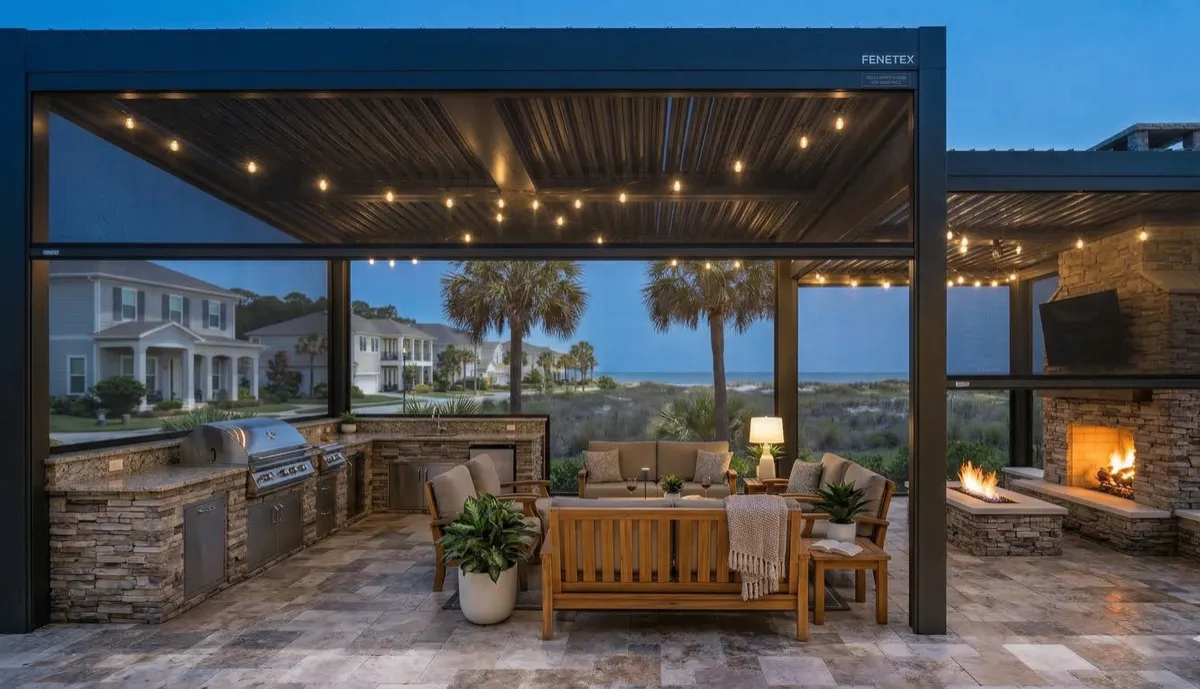
Your Lanai Is Your Fifth Room: How Motorized Screens Add Livable Space to Northeast Florida Homes
Hurricane season starts today.
If you followed this series from Week 1, your shutters are inspected, your motorized screens are tested, and your home has a protection plan for every opening. If you are just joining us, the previous eight posts cover everything you need — from aluminum shutters (Week 2) to hurricane-rated screens (Week 3) to the pre-season checklist that walks you through preparation step by step.
Your screens protect the home when storms approach. That is their storm-season job, and they do it well.
This post is about their other job — the one they do the remaining 355 days of the year. The job of turning the covered outdoor space you already have into something it has never been: a room.
Not an outdoor area. Not a patio you use when the weather cooperates. A room. Your fifth room. Usable in the morning with coffee. Usable at noon with lunch. Usable at dusk when the mosquitoes arrive and your neighbors disappear inside. Usable in the rain. Usable in the wind. Usable twelve months of the year.
That transformation — from seasonal amenity to year-round living space — is the single most valuable thing motorized screens do for a Northeast Florida home. And it is measurable in both lifestyle and dollars.
The Space You Already Have But Cannot Use
Most homes in Nocatee, Ponte Vedra Beach, and St. Augustine were designed with outdoor living in mind. The floor plans include covered lanais, extended patios, and rear living areas that open through sliding glass doors to the yard. In newer master-planned communities like Nocatee's Crosswater, Coastal Oaks, Twenty Mile, and Silverleaf, the outdoor space is often a defining feature of the home's design — representing 200 to 400 square feet of additional covered area beyond the conditioned interior.
That space is architecturally part of the home. It was designed to be lived in. It was sold as a lifestyle feature. And it has plumbing, electrical, and structural infrastructure that confirms its intended purpose as functional living space.
But without side enclosure, it is seasonal at best. The bugs claim it from April through November. The sun makes it unbearable from May through September. The afternoon thunderstorms make it unreliable on any given day from June through October. And hurricane season places everything in the space at risk for six months of the year.
The result is a paradox familiar to every homeowner in this market: the covered outdoor area is technically part of the home's livable footprint, but functionally, it is available only a fraction of the year. The square footage exists. The living does not.
When a real estate agent describes a Nocatee home as having "2,400 square feet plus a 300-square-foot covered lanai," the buyer hears 2,700 square feet of living space. The reality, without screens, is 2,400 square feet plus a space you can use three months of the year. Motorized screens close that gap — and convert the marketing language into lived experience.
What "Year-Round" Actually Means in Northeast Florida
The phrase "year-round outdoor living" gets used loosely in Florida marketing. Here is what it means specifically, with motorized screens deployed, across the actual conditions Northeast Florida produces month by month.
January through March. The most pleasant outdoor months. Mild temperatures, low humidity, minimal insect pressure. With screens retracted, the open-air experience is ideal. Screens deploy only if wind picks up or if privacy is desired. The lanai functions as an open-air room.
April. Bug season begins. Mosquitoes arrive at dusk. No-see-ums emerge. Without screens, the evening use window closes. With Fenetex insect mesh deployed at dusk, the lanai remains usable through the evening. Hurricane preparedness conversations begin — the screens are inspected and tested per the pre-season checklist.
May through June. Dual challenge: insects and heat. The afternoon sun drives patio temperatures past comfort thresholds. The bugs own the evenings. With solar mesh deployed during afternoon hours and insect mesh deployed at dusk, the lanai gains usable hours in both windows. When hurricane season opens June 1, the screens stand ready for storm deployment.
July through September. Peak summer. Daily afternoon thunderstorms. Maximum insect pressure. Highest UV exposure. This is the period when unscreened outdoor spaces are most severely abandoned. With screens deployed — solar mesh during the day, insect mesh in the evenings, wind/rain deflection during storms — the lanai remains functional through conditions that would otherwise make it uninhabitable. The outdoor kitchen gets used for dinner. The fireplace area hosts evening gatherings. The space works.
October through December. Hurricane season winds down November 30. Insect pressure decreases through October and November. By December, the cycle resets to the pleasant outdoor months. Screens retract. Open-air living resumes.
The difference between an unscreened outdoor space and a screened one in Northeast Florida is not marginal. It is the difference between three months of use and twelve. Between a seasonal amenity and a room.
The Square Footage Argument And Why It Matters for Home Value
Here is where the transformation becomes financial.
A covered lanai enclosed with motorized screens does not technically count as conditioned living space in a home appraisal — it is not air-conditioned, and it is not included in the home's heated square footage calculation. But it does add functional, livable square footage that buyers perceive as part of the home's living area. And in the Northeast Florida real estate market, that perception has measurable value.
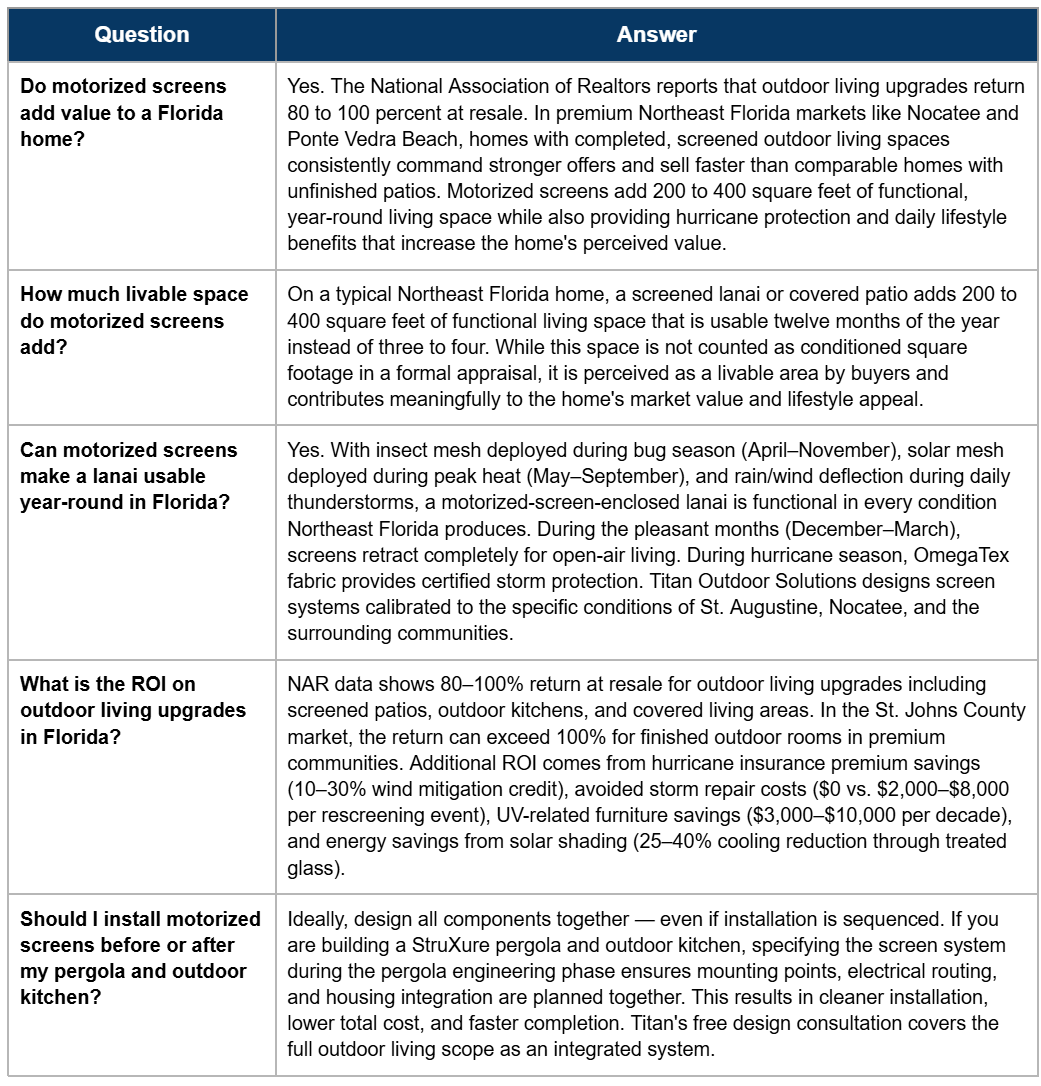
The National Association of Realtors (NAR) has consistently reported that outdoor living upgrades — including screened patios, outdoor kitchens, and covered living areas — return 80 to 100 percent of their investment at resale. In high-demand markets like Nocatee and Ponte Vedra Beach, where outdoor living is a defining lifestyle feature of the community, the return can exceed 100 percent because buyers are actively seeking homes with finished, usable outdoor spaces.
Consider the buyer's perspective. Two comparable homes in the same Nocatee neighborhood. Same interior square footage. Same lot size. Same price range. Home A has a bare covered patio — nice, but unusable half the year without screens. Home B has the same patio enclosed with Fenetex motorized screens, integrated with a StruXure pergola, and equipped with an outdoor kitchen and travertine hardscaping. Home B presents a finished, year-round outdoor room — a fifth living space that the buyer can use immediately, in every season, without additional investment.
Home B wins that comparison. Not close.
Real estate agents in the St. Augustine and Jacksonville markets consistently report that homes with completed, screened outdoor living spaces show faster, command stronger offers, and photograph better for listings than comparable homes with unfinished patios. The motorized screens — which retract for listing photos when the open-air view is most appealing and deploy for showings when the functional demonstration matters — give agents a story to tell and buyers a feature to value.
You are not buying a screen. You are adding a room to your home. A room that is usable twelve months of the year, protected during hurricane season, and valued by every future buyer who walks through the property.
The Transformation What It Looks and Feels Like
The data supports the investment. But the transformation is felt, not calculated.
It is the Saturday morning in July when you carry your coffee outside at 7 AM and the screens are already deployed from the night before. The lanai is cool. The bugs are on the other side of the mesh. The morning light comes through softened by the solar fabric. You sit down and read. For an hour. In July. Outside.
It is the Tuesday evening in August when you cook dinner on the outdoor kitchen grill and serve it at the patio table, and no one rushes. No one swats. No one checks the weather app for the afternoon thunderstorm window. The screens handle the bugs. The screens handle the rain if it comes. The evening lasts until you decide it is over — not until the mosquitoes decide for you.
It is the Sunday afternoon in September when a named storm is three days out in the Atlantic. Your neighbors are boarding up. You press a button. The OmegaTex hurricane screens deploy across every outdoor opening. The lanai furniture stays in place. The outdoor fireplace stays in place. The kitchen stays in place. You go inside and monitor the weather — knowing that when the storm passes, your outdoor space will be intact and your screens will retract. No rescreening bill. No contractor queue. No weeks of waiting.
It is the December evening when the screens are fully retracted, the Florida winter air is moving freely through the open lanai, the fireplace is lit, and the space feels exactly the way it did in the real estate listing that made you want this house.
That is what the fifth room feels like. You can see it in our project gallery and video gallery. And you can feel it the first evening your screens deploy.
For New Construction Homeowners: Build It Right the First Time
This section is for the homeowner who has recently moved into a new construction home in Nocatee, Silverleaf, World Golf Village, or one of the other growing St. Johns County master-planned communities — and who is now in "completion mode," deciding which outdoor upgrades to prioritize.
The builder gave you a nice home and a covered patio. You are sequencing the additions: pergola, outdoor kitchen, patio hardscaping, screens, landscaping. The temptation is to do screens last — after the more visible, more dramatic projects are complete.
We recommend the opposite. Or at minimum, design the screen integration from the beginning — even if the installation is sequenced later.
Here is why. Every outdoor project you complete before the screens are in place is a project that sits exposed to bugs, UV, rain, and storms until the screens arrive. The travertine sealant begins degrading in direct sun from day one. The outdoor kitchen cushions begin fading. The pergola's overhead protection is incomplete without side enclosure. And every evening, you go inside because the bugs arrived before the screens did.
If you design the screen system during the StruXure pergola specification phase, the mounting points, electrical routing, and housing integration are planned together — resulting in a cleaner installation, a lower total cost, and a faster path to a usable outdoor room.
Titan's design consultation for new outdoor spaces is free and covers the full scope — pergola, screens, kitchen, hardscaping, and fireplace — as an integrated system. Starting that conversation early saves money, time, and the frustration of realizing six months into your outdoor investment that the screens should have been first, not last.
The Numbers: What the ROI Looks Like
For the homeowner making the financial case — to themselves, to a spouse, or to a lender — here is the ROI framework for motorized screens as a livable space addition in Northeast Florida.
Added functional space: 200 to 400 square feet on a typical Nocatee or Ponte Vedra Beach home, usable twelve months of the year instead of three to four.
Resale value contribution: NAR data shows 80 to 100 percent return on outdoor living upgrades at resale. In premium Northeast Florida markets, the return can exceed 100 percent for finished, screened outdoor rooms.
Insurance premium savings: Hurricane-rated screens qualify for wind mitigation credits under Florida Statute §627.0629, contributing 10 to 30 percent reduction on the wind and hurricane portion of your premium (detailed in the ROI analysis coming in Week 11).
Avoided costs: Zero rescreening after storms (vs. $2,000–$8,000 per event with screen enclosures). Extended furniture and cushion lifespan from UV protection (savings of $3,000–$10,000 per decade, as documented in Week 6). Reduced energy costs from solar shading on adjacent glass (25–40% cooling reduction through treated openings).
Daily value: 210+ additional usable outdoor evenings per year during insect season. Usable outdoor afternoons from solar shading May through September. Rain protection during daily summer thunderstorms. Privacy on demand. Wind management.
The financial return is real and measurable. But the lived return — the evenings, the mornings, the gatherings, the quiet hours in a space that finally works the way you imagined — is the return most homeowners remember.
Frequently Asked Questions
Schedule Your Free Design Consultation
Serving St. Augustine · Nocatee · Ponte Vedra Beach · Palm Coast · Jacksonville · Northeast Florida
See how Titan has transformed patios across Nocatee, Ponte Vedra, and St. Augustine. Browse the project gallery and book a design call. We will walk your existing outdoor space or help you design a new one — one team, one plan, one installation.
Call or text: (904) 484-7580 | TitanOutdoorSolution.com


