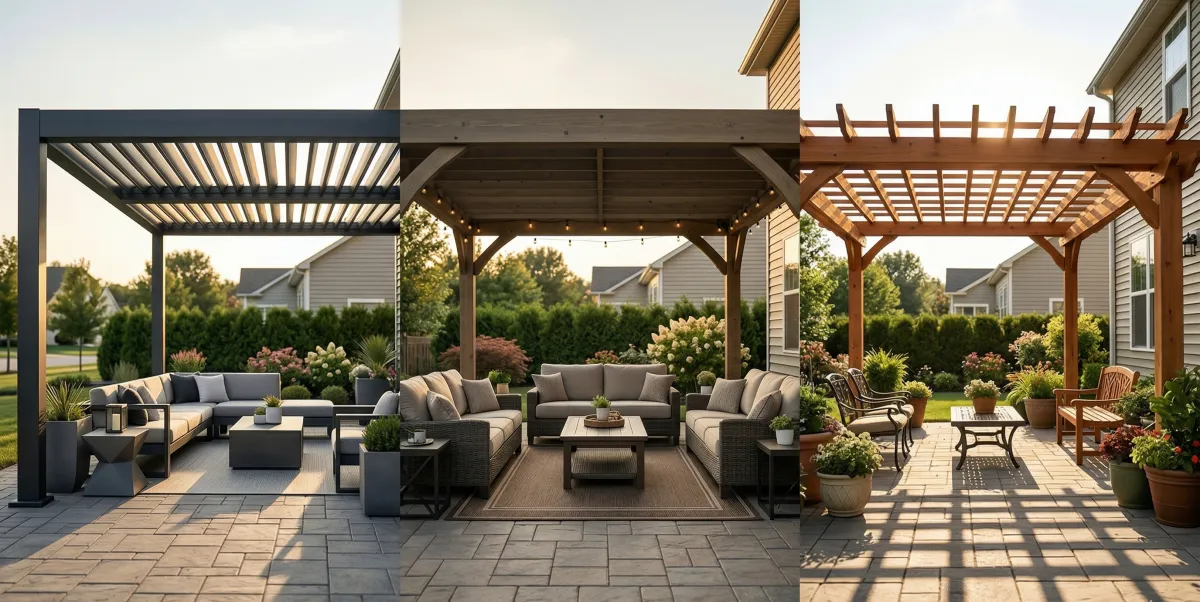
Louvered, Solid, or Open-Beam: Choosing the Pergola That Actually Matches How You Live
You have decided you want a pergola. Congratulations. That was the hard part; admitting that the bare patio is not going to fix itself, that the umbrella was never really the answer, and that the outdoor room you have been imagining for two summers requires a structural commitment, not another accessory purchase. The decision to build is behind you. The decision about what to build is the one that is currently keeping you on seventeen browser tabs at two in the morning, trying to figure out whether the louvered system you saw on Instagram is worth three times the price of the solid roof your neighbor installed, or whether the traditional open-beam design your architect friend suggested is actually the right move, or whether the entire category of pergola roof options contains a perfect answer that you just have not found yet.
This is the moment where most homeowners stall. Not because they lack information, but because they have too much of it. Every manufacturer's website tells you their product is the best. Every contractor recommends the system they are most comfortable installing. Every YouTube review focuses on the specific model the reviewer was paid to promote. And the homeowner sitting in the middle of all this noise is left with a decision that feels both critically important and maddeningly unclear.
So let us be honest about what each pergola type actually does, what it does not do, and who it is genuinely built for. Not the marketing version. The real one.
Explore the full outdoor living ecosystem at NextGen Screens
The Question Nobody Answers Honestly
The outdoor living industry has a transparency problem when it comes to the pergola types comparison conversation. Manufacturers want to sell you their specific product, so they emphasize the advantages and gloss over the tradeoffs. Contractors want to install the system they know best, so their recommendation often aligns more with their comfort zone than your needs. And the homeowner, who is making this decision for the first time, has no frame of reference to distinguish between genuine guidance and self-interested selling.
Here is the honest framework. There are three fundamental pergola categories, and each one is designed around a different philosophy of how outdoor space should function. The louvered pergola prioritizes control. The solid-roof pergola prioritizes protection. The open-beam pergola prioritizes aesthetics. None of them is universally "best." Each of them is the right answer for a specific homeowner with specific priorities living in a specific climate.
The mistake is choosing based on what looks good in a photograph rather than what functions well in your life. A louvered system that costs twice as much as a solid roof is not a better purchase if you never adjust the louvers. A solid roof that blocks all rain is not the right choice if you love stargazing. And an open-beam pergola that filters beautiful dappled light is not going to protect your outdoor dinner party when an afternoon thunderstorm rolls through.
The pergola for patio that will make you happiest five years from now is the one that matches how you actually live, not how you imagine you might live on your most optimistic Saturday afternoon.
Learn about motorized screen systems that integrate with every pergola type at Onetrack Screens
Open-Beam Pergolas: When Aesthetic Outweighs Protection
The traditional open-beam pergola is the oldest, simplest, and most architecturally iconic form. It is the structure you picture when someone says the word "pergola" without any qualifier; parallel beams running across the top, open to the sky between them, casting patterns of light and shadow across the surface below. It is the design you see draped in wisteria on a Tuscan terrace, covered in climbing roses in an English garden, or framing a walkway in a Mediterranean courtyard. And it is beautiful. Genuinely, arrestingly beautiful.
What the open-beam pergola provides is spatial definition, vertical presence, and an overhead framework that transforms a flat patio into an architecturally defined outdoor room. It changes the proportion of the space. It gives you something to hang lights from, something to train vines on, something that tells the brain "this is a place, not a passageway." The filtered light that passes through the open beams creates a visual texture that no solid surface can replicate.
What the open-beam pergola does not provide is weather protection. Rain falls through. Full sun passes through, softened but not blocked. Wind is unimpeded. If your primary motivation is shade during the peak afternoon hours, an open-beam pergola will reduce the intensity but will not eliminate it. If your primary concern is rain protection for outdoor dining, an open-beam design is not your answer.
The homeowner who thrives with an open-beam pergola is someone whose climate cooperates most of the time, whose primary goal is beauty and spatial definition rather than environmental control, and who plans to add fabric shade or a retractable canopy later if more coverage becomes necessary. This is the pergola for the homeowner who values the feel of outdoor living more than the engineering of outdoor protection.
It is also, importantly, the most affordable entry point. If budget is a genuine constraint and the goal is to create a defined outdoor room that can be enhanced over time, the open-beam pergola provides the foundational structure at a lower investment than the other two categories.
Discover how open-beam pergolas pair with motorized screens for added protection at NextGen Screens
Solid-Roof Pergolas: The "Never Worry" Approach
The solid-roof pergola is the pragmatist's answer to outdoor living. It does not adjust. It does not modulate. It simply protects. A solid insulated panel or a tongue-and-groove ceiling overhead, and what you get in return is absolute rain protection, significant heat reduction, and the confidence that your outdoor plans will not be canceled by weather. The afternoon thunderstorm that sends the open-beam homeowner scrambling for the back door is a non-event under a solid roof. You hear the rain. You do not feel it. Dinner continues.
This is the pergola roof option for homeowners who live in climates where afternoon rain is a near-daily occurrence during certain seasons, where UV intensity makes unfiltered sun genuinely punishing, or where the outdoor space needs to function as reliably as an indoor room. In the American Southeast, the Gulf Coast, and much of the Sun Belt, the solid-roof pergola is the most popular choice for exactly this reason; the weather in these regions is aggressive enough that partial shade solutions feel like partial answers.
The tradeoff is flexibility. A solid roof is permanent shade. On a cool March morning when you want full sun to warm the space, the solid roof is still there, doing its job whether you want it to or not. On a clear October evening when you want to see the stars, the solid roof is between you and the sky. You cannot open it. You cannot adjust it. It protects, always. And for many homeowners, that is exactly the point.
The solid-roof pergola also provides the best thermal performance. The insulated panel versions reduce radiated heat significantly, which means the space beneath stays cooler than it would under a non-insulated cover or a louvered system with gaps between the slats. If the primary goal is creating the coolest possible outdoor environment during peak summer, the insulated solid roof delivers the strongest thermal result.
One honest note about aesthetics: the solid-roof pergola looks more like an extension of the house and less like a freestanding outdoor structure. Some homeowners love this; it feels integrated, permanent, like a natural addition. Others feel it looks too much like a carport or a covered porch, lacking the architectural character of beams and rafters. This is a genuine aesthetic preference, and it matters. The pergola you look at every day should be one you find beautiful, not just functional.
See how solid-roof pergolas support hurricane-rated screen installations at Maxforce Screens
Louvered Pergolas: Control Freaks, This One Is for You
The louvered pergola is the newest, most technologically sophisticated, and most expensive entry in the pergola types comparison. It is also, for a specific type of homeowner, the most satisfying outdoor investment they will ever make. Because what a louvered pergola sells is not shade, not rain protection, not aesthetics. It sells control.
The adjustable pergola with motorized louvers allows the homeowner to modulate their overhead environment in real time. Full sun for morning coffee. Angled at forty-five degrees to track the noon sun while maintaining airflow. Fully closed for afternoon shade. Open again at sunset for an unobstructed view of the sky. Closed tight when rain arrives, with integrated gutters channeling water to downspouts at the corners. Then open again fifteen minutes later when the shower passes. All of this from a remote, a wall switch, or a smartphone. Some systems integrate with smart home platforms, allowing voice commands or automated schedules that adjust the louvers based on time of day, sun angle, or weather sensor data.
This is the best pergola for patio situations where the homeowner's needs change throughout the day and throughout the seasons. It is the answer for the family that wants full sun for the kids' pool party at noon and full shade for the adults' dinner party at six. It is the solution for the homeowner who wants rain protection when it rains and open sky when it does not, without having to choose one or the other permanently.
The louvered pergola is also the strongest platform for motorized screen integration. The precision engineering of the louver system, the integrated gutters, the structural aluminum framework; these elements create a mounting platform that supports retractable screens, lighting, fans, heaters, and audio with a level of integration that other pergola types cannot match. When the louvers close and the screens drop, you are standing in a fully enclosed outdoor room that can handle virtually any weather condition short of a severe storm.
The tradeoff is price. A motorized louvered system typically costs two to three times what a comparable solid-roof pergola costs, and three to five times what a basic open-beam structure costs. The question is not whether the louvered pergola is "better" in some abstract sense. The question is whether you will use the control it provides often enough to justify the premium. If you are the homeowner who will adjust the louvers every day, who values the ability to shift between full sun and full shade at the press of a button, who plans to integrate screens and smart home automation into a complete outdoor living system; then the louvered pergola is worth every dollar. If you are the homeowner who wants shade and rain protection and is perfectly happy with a fixed solution that requires no thought, the solid roof delivers ninety percent of the function at fifty percent of the cost.
Explore louvered pergola and screen integration options at Onetrack Screens
Climate, Budget, and Vision: The Three-Filter Decision
If you are still unsure which pergola type is right for your situation, run your decision through three filters. These are the questions that cut through the noise and lead to a clear answer.
Filter one: climate. What does the weather actually do where you live? If you are in a region with aggressive afternoon rain, intense UV, or long stretches of extreme heat, protection matters more than flexibility. The solid-roof pergola is your strongest play. If your climate is moderate, with pleasant conditions most of the year and only occasional weather disruption, the open-beam pergola gives you beauty and definition without over-engineering for problems you rarely face. If your climate is variable, with dramatic shifts between seasons or even within a single day, the louvered system's adaptability justifies its premium.
Filter two: budget. Be honest with yourself about what you are willing to invest, and understand that the pergola is the beginning of the outdoor living conversation, not the end of it. If your total outdoor transformation budget is thirty thousand dollars and the louvered pergola alone costs twenty-five, you have left no room for the screens, lighting, fans, and furnishings that complete the experience. A twelve-thousand-dollar solid-roof pergola that leaves budget for a motorized screen system and integrated lighting may deliver more total outdoor satisfaction than a twenty-five-thousand-dollar louvered system standing alone in an otherwise unfinished space.
Filter three: vision. What is the complete picture you are building toward? If you envision a fully integrated outdoor room with motorized screens, smart home controls, adjustable shade, and the ability to use the space in virtually any weather, the louvered pergola is the natural platform. If you envision a protected outdoor dining area where the family gathers for meals without worrying about rain, the solid roof delivers that vision cleanly and reliably. If you envision a beautiful architectural feature that defines the space and creates ambiance with lights and climbing plants, the open-beam pergola is the honest answer.
The best pergola for patio living is not the most expensive one. It is the one that serves your climate, fits your budget, and delivers the vision you will actually live with every day.
Compare your options with the full resource library at NextGen Screens
The Structure Is Just the Beginning: What Comes Next
Whichever pergola type you choose, understand that the structure itself is only the first layer of the outdoor living experience. It is the most important layer, because everything else depends on it; but it is not the complete picture.
What comes next is what transforms a covered patio into a true outdoor room. Motorized screens that drop down to eliminate insects, block wind, and create privacy without sacrificing the view. Ceiling fans that circulate air and make August evenings tolerable. Integrated lighting that shifts the space from daytime function to evening ambiance. Heaters that extend your outdoor season by two or three months in either direction. Audio systems that provide background music for dinner or a podcast while you cook on the grill.
Every one of these additions mounts to, hangs from, or integrates with the pergola structure. The pergola is not the destination. It is the platform. And the choice you make now, between louvered, solid, and open-beam, determines which of those future additions are possible, practical, or optimal for your specific system.
A louvered pergola with integrated gutters provides the cleanest platform for retractable screen housing. A solid-roof pergola provides the most stable mounting surface for fans and heavy fixtures. An open-beam pergola provides the most design flexibility for hanging lights and training plants. Each choice opens certain doors and narrows others. There is no wrong answer, only a better-informed one.
The pergola types comparison is not really about the pergola. It is about the outdoor room you are building, the life you intend to live in it, and the sequence of improvements that will get you from where you are now to the Saturday evening you have been imagining for two years.
If you are ready to understand how motorized screen systems integrate with each pergola type, or if you want to explore the complete outdoor living ecosystem before making your structural decision, the resources are waiting.
Start exploring the complete outdoor living ecosystem at NextGen Screens
Discover Onetrack's motorized screen systems at Onetrack Screens
Learn about hurricane-rated protection with Maxforce Screens
