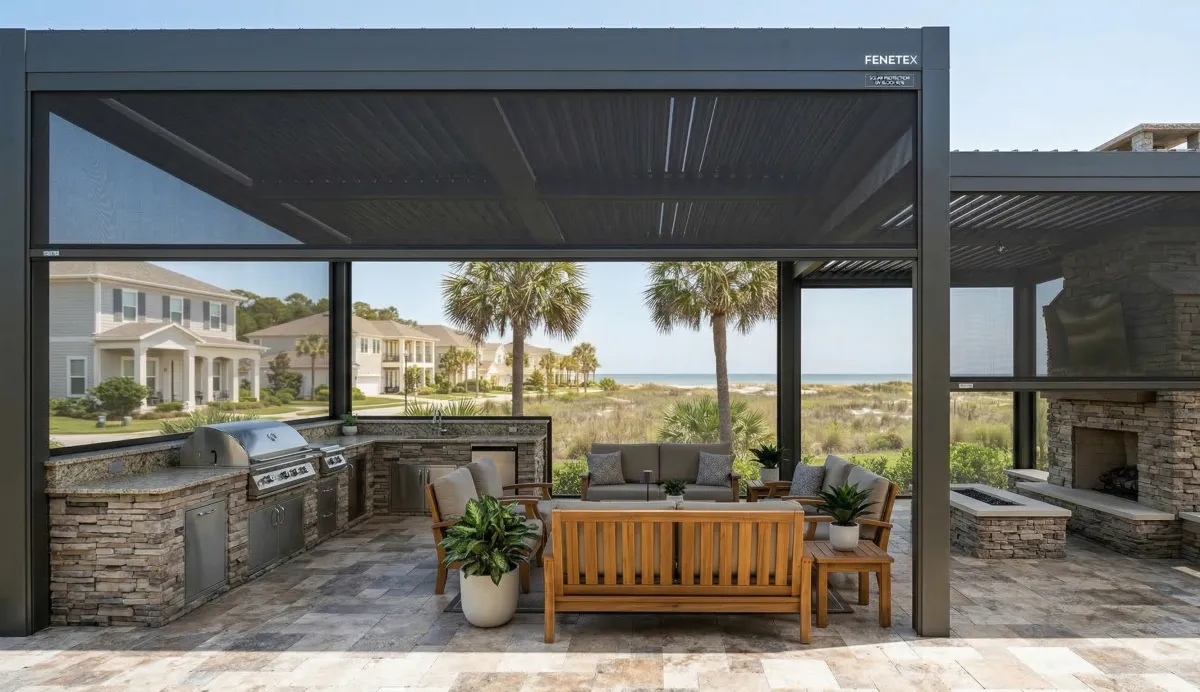
Motorized Screens vs. Screen Enclosures vs. Fixed Screens: An Honest Florida Comparison
If you are a homeowner in St. Augustine, Nocatee, Ponte Vedra Beach, or anywhere across Northeast Florida researching patio screen options, you have probably encountered three distinct categories of products — and a great deal of marketing language designed to make each sound like the only right answer.
Motorized retractable screens. Traditional screen enclosures. Fixed screen panels.
They are not the same product. They serve different purposes, carry different capabilities, and perform very differently in the conditions Northeast Florida actually produces — including the one condition that matters most in this market: a hurricane.
This post compares all three honestly. We install motorized screens. We believe they are the best solution for most outdoor living applications in this region. But we are not going to pretend there are no situations where a traditional screen enclosure is the right choice — because there are. And the homeowners who understand the real differences make better decisions than the ones who hear only one side of the story.
Here is every side.
The Three Products: What Each Actually Is
Before comparing performance, it helps to understand what each product physically is and how it works.
Traditional Screen Enclosures (Screen Cages)
A screen enclosure — often called a screen cage, pool cage, or screen room — is a permanent, full-perimeter aluminum structure with fiberglass or polyester mesh panels stretched across the frame. It encloses an outdoor space completely: roof, walls, and typically a screen door entry. Most pool areas, lanais, and covered patios in Northeast Florida are surrounded by this type of structure.
Screen enclosures are designed for insect protection and debris screening. They keep leaves, bugs, and larger debris out of the enclosed space. They are not designed for wind loads, impact resistance, or hurricane conditions.
Fixed Screen Panels
Fixed screen panels are individual screen sections — typically aluminum-framed — that mount permanently to a patio, porch, or lanai opening. Unlike a full enclosure, they cover specific openings rather than enclosing the entire perimeter. They are common on porches, breezeways, and smaller covered areas.
Fixed panels provide insect protection for the openings they cover. Like full enclosures, they are not engineered for hurricane wind loads.
Motorized Retractable Screens
Motorized retractable screens — such as the Fenetex system Titan Outdoor Solutions installs — are engineered screen systems that deploy from a housing above the opening and track through side channels to create a sealed barrier. They retract completely into the housing when not in use, becoming nearly invisible.
Depending on the fabric selected, motorized screens provide insect protection, UV and solar shading, privacy, wind management, and — in the hurricane-rated OmegaTex configuration — certified storm protection that meets Florida Building Code wind load and impact resistance standards.
The Comparison Table: Seven Criteria That Matter
This table compares the three screen types across the criteria that matter most to Northeast Florida homeowners. It is designed to be read as a decision tool, not a sales sheet.
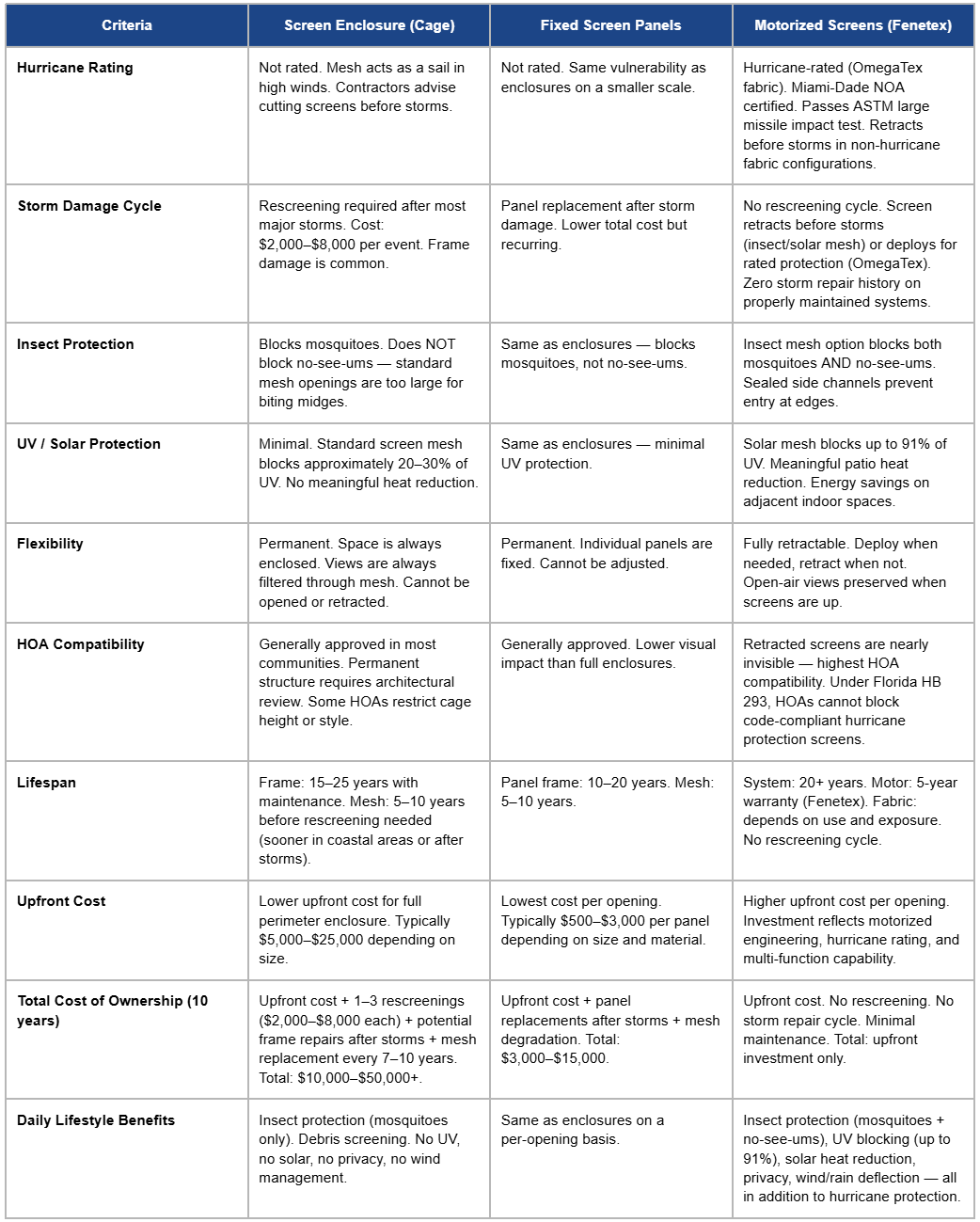
The comparison table tells the story the marketing language from each product category leaves out. Screen enclosures cost less upfront — but their total cost of ownership in a hurricane-prone market often exceeds the upfront investment in motorized screens. And the daily lifestyle benefits are not comparable.
When a Screen Enclosure Is the Right Choice
We promised honesty. Here it is.
A traditional screen enclosure is the right choice in specific situations — and we would rather tell you that directly than have you discover it after buying a product you did not need.
Full pool enclosures. If your primary need is a complete perimeter barrier around a pool for child safety, pet containment, and debris screening, a full screen cage is the established solution. Motorized screens are designed for individual openings — lanai spans, patio faces, pergola configurations — not for enclosing an entire freestanding pool. If you need a pool cage, get a pool cage.
Budget-constrained whole-perimeter coverage. If you have a large outdoor space with six or more open faces and your budget cannot accommodate motorized screens on every opening, a screen enclosure provides insect protection for the entire perimeter at a lower upfront cost. The trade-off is zero hurricane protection, no UV or solar benefit, no privacy, and the recurring rescreening costs we have documented. But if the budget is the constraint, the enclosure gets you insect coverage today.
Structures where retractability is not valued. Some homeowners want a permanently enclosed space — a Florida room, a sunroom, a three-season room. They do not want the option to retract the screens. They want a permanent barrier that is always there. For those homeowners, a fixed enclosure or fixed panels make more sense than a motorized system they will never retract.
In any of these scenarios, the enclosure is not a compromise. It is the right tool for the specific job.
What it is not — and this is the distinction that matters most in St. Augustine, Nocatee, and Ponte Vedra Beach — is hurricane protection. That is a separate need, and it requires a separate product: either aluminum shutters for windows and doors (covered in Week 2) or hurricane-rated motorized screens for large outdoor openings (covered in Week 3).
When Motorized Screens Are the Better Investment
For the majority of homeowners in Northeast Florida who are investing in outdoor living comfort and storm preparedness simultaneously, motorized screens are the stronger long-term investment. Here is when and why.
When hurricane protection matters. No screen enclosure on the market is hurricane rated. Fenetex OmegaTex motorized screens carry Miami-Dade NOA certification and pass the ASTM large missile impact test. If you live in a region where hurricanes are a reality — and every homeowner reading this in St. Johns, Duval, or Flagler County does — the ability to deploy certified storm protection across your lanai and outdoor living spaces is a capability that a screen enclosure cannot provide at any price.
When no-see-ums are the problem. As we covered in Week 5, standard screen enclosure mesh does not block no-see-ums. If your primary insect frustration is the biting midges that arrive at dusk in Nocatee, Ponte Vedra, and coastal St. Johns County — and for most homeowners in this market, it is — a standard screen cage will not solve it. Fenetex insect mesh will.
When you value the open view. A screen enclosure is always there. The mesh is always between you and the yard. On a cool December morning when the bugs are dormant and the sun is gentle, you are still looking through a screen cage. Motorized screens retract completely. When you do not need them, they are invisible. Your view is unobstructed. Your architectural lines are preserved. This matters especially in Ponte Vedra Beach and Nocatee communities where homes overlook golf courses, preserves, or water features.
When UV and heat management matter. Screen enclosures block approximately 20–30% of UV. Fenetex solar mesh blocks up to 91%. As we documented in Week 6, the furniture protection, patio temperature reduction, and energy savings from solar-grade motorized screens far exceed what any standard enclosure delivers.
When your outdoor space already has structure. If you have a StruXure pergola, a covered lanai, or a roofed patio, the overhead structure is already in place. A full screen enclosure would add redundant framing around a space that is already covered. Motorized screens mount directly to the existing structure — the pergola beams, the fascia, the header — adding side enclosure without duplicating the overhead framing.
When you are planning an outdoor kitchen, fireplace, or travertine patio. The investment protection case is strongest when the outdoor space contains high-value elements that need bug protection, UV protection, and storm protection. A screen cage provides one of the three. Motorized screens provide all three.
The Hurricane Question: What Happens to Each During a Storm
This is the section that separates the products most definitively. Because in Northeast Florida, the question is not if a hurricane will threaten your area — it is when.
What Happens to a Screen Enclosure During a Hurricane
The fiberglass or polyester mesh catches wind. The lightweight aluminum frame absorbs lateral forces it was never designed to resist. The mesh acts as a sail — a large, taught surface that converts wind energy into structural load on every connection point in the frame.
In moderate tropical storm conditions, the mesh may tear or detach from the frame, releasing the wind load but leaving the enclosure damaged and requiring full rescreening. In hurricane-force conditions, the frame itself can buckle, twist, or collapse — sometimes damaging the roof, fascia, or structure it is attached to. The enclosure becomes a liability rather than a protection.
This is why screen contractors across Florida advise homeowners to cut their screen mesh before a major storm. The recommendation is to physically slash the panels so they do not catch wind. After the storm, you call the contractor to rescreen. The cost: $2,000 to $8,000 depending on the size of the enclosure. The wait: weeks, sometimes months, during the post-storm demand surge when every screen company in the region is overwhelmed.
What Happens to Fixed Screen Panels During a Hurricane
Individual panels are vulnerable to the same forces on a smaller scale. The mesh catches wind. The frame bends. Panels can detach from their mountings and become airborne debris themselves — a secondary hazard during a storm.
What Happens to Motorized Screens During a Hurricane
If the motorized screens are equipped with insect or solar mesh (non-hurricane-rated fabric), the homeowner retracts the screens before the storm. The fabric rolls into the housing. The housing is flush-mounted and low-profile — it does not catch wind. The screens ride out the storm safely retracted, and they deploy immediately after the storm passes. No damage. No rescreening. No repair costs.
If the motorized screens are equipped with hurricane-rated OmegaTex fabric, the homeowner deploys the screens before the storm. The aramid fiber fabric absorbs wind and debris impact. The screens provide rated protection to the lanai, the outdoor living investment, and the adjacent glass behind the opening — the same protection documented in Week 3 of this series.
In either configuration, the motorized screen emerges from hurricane season intact. The screen enclosure does not.
Over a 20-year ownership period in Northeast Florida, a homeowner with a standard screen enclosure can reasonably expect two to four significant storm events requiring rescreening — a total storm repair cost of $4,000 to $32,000. A homeowner with motorized screens can reasonably expect zero storm repair costs from the screen system itself. That difference alone narrows the upfront cost gap between the two products significantly.
The HOA Factor: Visibility, Approval, and Florida Law
For homeowners in Nocatee, Ponte Vedra Beach, World Golf Village, Silverleaf, and other HOA-governed communities across St. Johns County, the aesthetic dimension of the screen choice matters.
A traditional screen enclosure is a permanent, visible structure. The aluminum framing and mesh panels are always present — they define the visual profile of the outdoor space from every angle. Most HOAs in St. Johns County allow screen enclosures, but architectural review committees evaluate the height, footprint, color, and framing style for consistency with community standards.
Fixed screen panels are less visually intrusive than a full cage but are still permanently visible.
Motorized screens, when retracted, are nearly invisible. The housing is a slim profile that mounts above the opening — under the fascia, along the beam, or within the pergola structure. When the screens are up, no one can see them. The architectural lines of the home are fully preserved. When the screens deploy, they are visible but low-profile — a clean fabric plane rather than an aluminum cage.
This retractability gives motorized screens the highest HOA compatibility of the three options. And under Florida HB 293 (2024), hurricane-rated motorized screens receive additional legal protection — HOAs cannot block code-compliant hurricane protection installations, regardless of aesthetic preferences. They can regulate color matching. They cannot deny the installation.
Titan provides complete HOA documentation packages for all screen installations in St. Johns County communities. We have navigated the architectural review process in the major Nocatee and Ponte Vedra neighborhoods and can streamline yours.
Making the Decision: A Framework for Your Home
Rather than telling you which product to buy, here is a framework for making the decision based on your specific situation.
Start with your primary need. If it is pool safety and debris screening → screen enclosure. If it is insect protection that includes no-see-ums → motorized screens. If it is hurricane protection for outdoor living areas → motorized screens (OmegaTex). If it is UV and heat management → motorized screens (solar mesh).
Then consider total cost of ownership. Add the upfront cost plus the projected rescreening, storm repair, and replacement costs over 10 and 20 years. In a hurricane market like Northeast Florida, the total cost of ownership for a screen enclosure often approaches or exceeds the upfront cost of motorized screens — with fewer capabilities.
Then consider what you are protecting. If your outdoor space contains a StruXure pergola, an outdoor kitchen, travertine hardscaping, an outdoor fireplace, and premium furniture — assets worth $50,000 to $150,000 — the protection calculus favors the product that provides bug protection, UV protection, and hurricane protection simultaneously.
Then consider your view. If you chose your home for the view — the golf course, the preserve, the water — and you do not want to look through a permanent cage for the next 20 years, retractability matters.
Titan's free in-home assessment walks through all of these factors with you, specific to your property, your openings, and your priorities. We sell motorized screens — but we will tell you honestly if a screen enclosure is the better fit for your situation. Our project gallery and video gallery show what each solution looks like installed across Jacksonville, St. Augustine, and the surrounding communities.
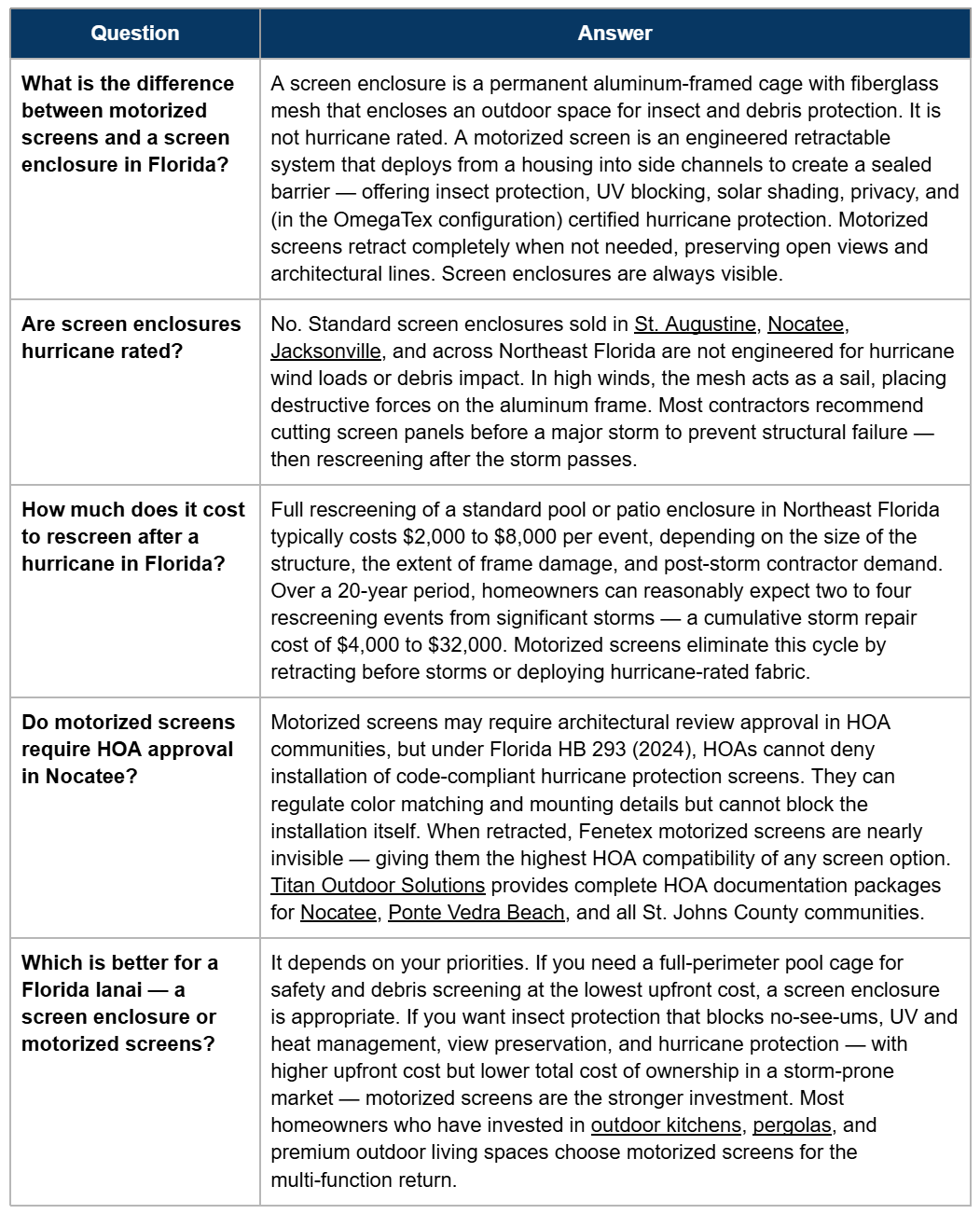
Frequently Asked Questions
Schedule Your Free Honest Assessment
Serving St. Augustine · Nocatee · Ponte Vedra Beach · Palm Coast · Jacksonville · Northeast Florida
Not sure which is right for your space? We will give you an honest assessment — no pressure, just answers. We walk your property, evaluate each opening, and tell you what makes sense for your specific situation, your priorities, and your budget.
Call or text: (904) 484-7580 | TitanOutdoorSolution.com
