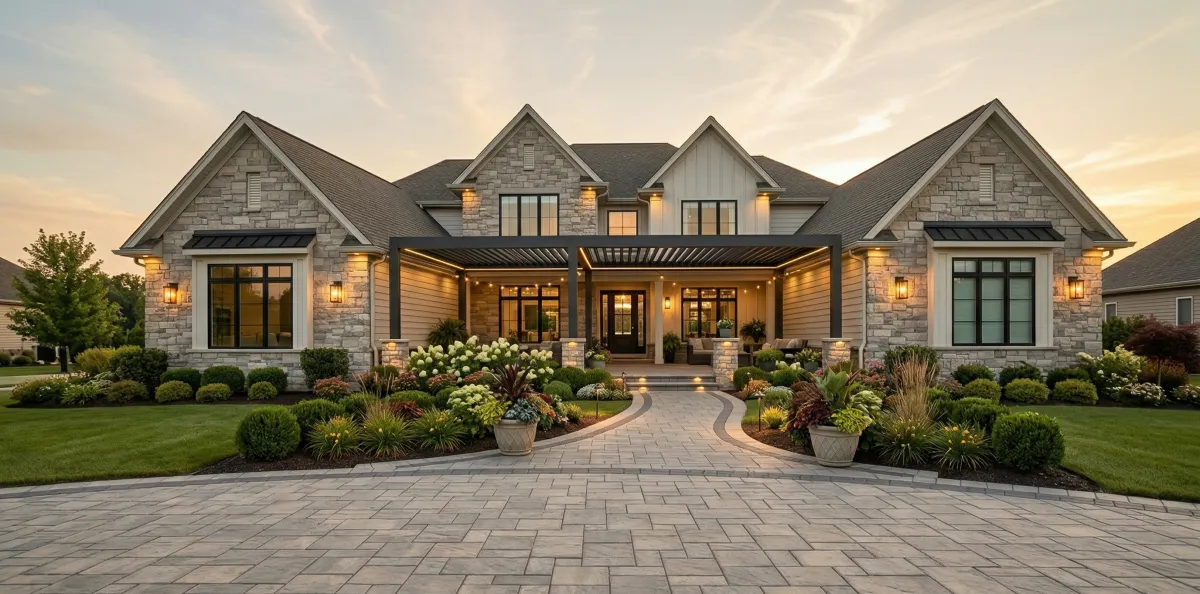
Beyond the Patio: How Paver Design Transforms Driveways, Walkways, and the Way Your Home Greets the World
There is a conversation that happens in every real estate agent's car, somewhere between the third and fourth showing, when the buyer leans over to their partner and says something that has nothing to do with the floor plan, the kitchen countertops, or the number of bedrooms. They say, "I liked the driveway at that first house." It is not the kind of statement that makes it into the negotiation. Nobody writes an offer because of a driveway. But the impression it created, the sense of arrival, the feeling that someone cared about every inch of the property from the street to the back fence; that impression shaped everything that followed. The house with the beautiful paver driveway installation felt more expensive, more maintained, more worth the asking price before the front door even opened.
This is the power of hardscape design, and it is the part of the outdoor living conversation that most homeowners completely overlook. When people think about pavers, they think about patios. They picture the backyard, the space behind the house where the grill lives and the kids play. And patios are important. But the paver story does not begin at the back door. It begins at the street. The driveway, the front walkway, the entryway, the side paths, the pool deck, the fire pit pad, the transition zones between lawn and structure; every one of these surfaces is an opportunity to create cohesion, communicate value, and transform the way a property feels from the moment someone arrives.
The homeowner who limits the paver conversation to the patio is leaving eighty percent of the opportunity on the table.
Explore the complete outdoor living ecosystem at NextGen Screens
The Seven-Second Judgment: What Your Driveway Says Before You Do
Psychological research on first impressions consistently shows that people form judgments about environments within the first seven seconds of exposure. In residential contexts, those seven seconds begin at the curb. The driveway is the first designed surface a visitor encounters, and it communicates volumes before a single word is exchanged.
A poured concrete driveway with oil stains and hairline cracks communicates one thing. A professionally installed brick paver driveway with a herringbone pattern, clean joints, and a defined border communicates something entirely different. The first says "functional, aging, ordinary." The second says "intentional, maintained, invested." Neither statement is fair, necessarily. The home behind the cracked concrete might be immaculately maintained inside. But fairness is not how first impressions work. Curb appeal pavers rewrite the opening sentence of your home's story, and they do it in a material that ages gracefully rather than deteriorating visibly.
The paver driveway installation is not a vanity project. It is the single largest surface improvement visible from the street, and in real estate markets where buyers make drive-by decisions about whether to schedule a showing, it is the improvement that determines whether they slow down or keep driving.
For homeowners who are not planning to sell, the curb appeal argument still holds. You arrive at your own home every day. Your neighbors see your driveway every day. Your guests form their first impression of your home from this surface every time they visit. The way your property greets the world is not a detail. It is the frame that everything else sits inside.
Discover outdoor screening solutions at Onetrack Screens
Driveways That Work as Hard as They Look
The aesthetic argument for paver driveway installation is easy to make. The variety of colors, patterns, textures, and materials available in modern paver systems gives homeowners a design palette that poured concrete simply cannot match. Herringbone patterns create visual energy and maximum interlock strength. Running bond patterns elongate the visual line and create a sense of approach. Basketweave patterns offer a traditional, stately feel. And the color range extends from cool grays and charcoals to warm sandstones and terracottas, allowing the driveway to complement the home's architecture rather than defaulting to the same flat gray as every other house on the block.
But the performance argument is equally compelling and far less frequently made. A properly installed paver driveway is an engineered surface that manages water, distributes load, and withstands vehicular traffic in ways that poured concrete cannot sustain over time. The interlocking joint system allows the surface to flex with ground movement rather than cracking under stress. The permeable joint material allows water infiltration rather than creating sheet runoff that overwhelms storm drains and erodes adjacent landscaping.
In climates with freeze-thaw cycles, the engineering advantage becomes decisive. Concrete driveways in northern states and seasonal climate zones develop cracks within the first three to five winters. Those cracks admit water, which freezes, expands, and widens the damage exponentially. Paver driveways absorb the same freeze-thaw stress through their joints, distributing the movement across thousands of individual units rather than concentrating it in fracture points.
The paver driveway that looks beautiful on day one continues to perform on day three thousand. The concrete driveway that looks clean on day one is often showing structural fatigue by day seven hundred.
Explore hurricane-rated outdoor protection at Maxforce Screens
Walkways as Design Language: Connecting Every Outdoor Moment
If the driveway is the first sentence of your home's story, the walkway is the narrative thread that connects every chapter. The front walkway pavers that lead from the driveway to the front door, the side path that connects the front yard to the back, the stepping stone trail from the patio to the garden, the transition pad from the pool deck to the pergola; each of these surfaces is an opportunity to create design continuity across the entire property.
Most homes treat walkways as afterthoughts. A strip of concrete poured as a utility path. A row of stepping stones set loosely in the grass. A patch of gravel that seemed practical at the time. These functional solutions get you from point A to point B, but they do nothing to connect the design language of the property. They are interruptions in the visual narrative rather than extensions of it.
Professional paver walkway design treats every path as a design element. The material matches or complements the driveway pavers, creating visual cohesion from the street to the backyard. The width expands and contracts to signal importance; wider at the front entrance, narrower along the side yard, widening again where it meets the back patio. Borders define the edges, and the pattern can shift between zones to subtly indicate transitions between public space and private space, between arrival and living, between formal and relaxed.
This is landscape architecture at the residential scale, and it is the kind of design thinking that separates a property that feels like a collection of disconnected outdoor zones from a property that feels like a unified, intentional environment.
See how hardscape design integrates with the full outdoor living system at NextGen Screens
Pool Decks, Fire Pit Pads, and the Spaces in Between
The patio is the obvious paver application. The driveway is the high-impact one. But the spaces in between are where paver design truly demonstrates its versatility, and where most homeowners discover possibilities they had not considered.
Pool decks are among the most demanding outdoor surfaces. They must be slip-resistant when wet, cool enough to walk on barefoot in direct sun, resistant to chemical exposure from pool water, and durable enough to withstand heavy foot traffic and the occasional dropped piece of patio furniture. Concrete pool decks check some of these boxes and fail others. They crack, they stain from chlorine, they absorb heat and become uncomfortably hot, and they become slippery when wet unless a textured coating is applied that eventually wears off. Pavers, selected from textured profiles with appropriate thermal properties, address every one of these requirements simultaneously.
Fire pit pads create a defined gathering zone within the larger patio, a visual and functional signal that says "this is where we gather in the evening." The paver material around a fire feature can be selected for heat resistance, and the pattern can shift from the surrounding patio material to create an intentional design boundary. This is not just a surface under a fire pit. It is a room within a room, defined entirely by the floor beneath it.
Transition zones between different outdoor areas, the strip between the patio and the lawn, the threshold between the pool deck and the pergola, the border between the driveway and the front garden; these are the surfaces where cohesive hardscape design ties the entire property together. When every transition is intentional, every surface material is coordinated, and every edge is defined, the property stops feeling like a collection of outdoor projects and starts feeling like a designed environment.
Discover how these outdoor zones integrate with motorized screen systems at Onetrack Screens
Patterns, Colors, and the Art of Cohesive Hardscape Design
The best paver designs for front of house installations share a common principle: restraint. The most visually powerful hardscape designs are not the most complex. They are the most cohesive. A single paver color with a contrasting border. A herringbone field with a soldier-course edge. A warm sandstone that echoes the tone of the home's exterior stone or brick.
The temptation for homeowners choosing paver patterns for driveways and walkways is to select the most interesting option in the showroom. The fan pattern that caught their eye. The multi-color blend that seemed exciting on the sample board. The complex inlay design that looks stunning in the manufacturer's photography. But complexity in isolation and complexity in context are very different things. The showroom presents pavers against a neutral background. Your driveway will present pavers against the visual context of your home's architecture, your landscaping, your neighbor's properties, and the street.
The paver patterns that age best, impress most, and add the most property value are the ones that complement rather than compete. They work with the home's existing palette rather than introducing an entirely new one. They use pattern to create movement and interest without overwhelming the eye. And they maintain consistency across the property, so the driveway, walkway, and patio feel like chapters of the same story rather than pages from different books.
If you are unsure where to begin with design decisions, start with your home's existing materials. What color is the roof? What tone is the brick or siding? What color are the exterior trim elements? The paver palette that harmonizes with these existing materials will always outperform the palette that ignores them, regardless of how attractive the pavers look in isolation.
Explore the complete outdoor living resource library at NextGen Screens
The Ground-Up Approach: Starting Your Outdoor Transformation at the Foundation
There is a reason that architects design from the foundation up and not from the roofline down. There is a reason that builders excavate and pour before they frame and finish. And there is a reason that the most successful outdoor living transformations begin with the surface beneath everything else.
The paver installation is not the glamorous part of the outdoor living vision. Nobody posts an Instagram reel of a compacted gravel base or a screeded sand bed. The pergola gets the "after" photo. The motorized screens get the video. The fire pit gets the evening ambiance shot. But every one of those elements is only as permanent, as level, as reliable, and as beautiful as the surface it sits on.
A pergola's structural posts need a stable, level surface to anchor to. Motorized screen tracks require precise alignment that only a properly graded surface can support. Outdoor furniture needs a flat, well-drained floor that will not shift seasonally and create wobble. The outdoor dining table that seats eight needs the same foundation quality as the dining room floor inside the house, because it is a dining room; it just happens to have the sky for a ceiling.
The homeowner who starts with the foundation and builds upward creates an outdoor living space where every subsequent addition performs exactly as designed. The homeowner who skips the foundation and starts with the structure above it is building a vision on a surface that may not support it for the long term.
Do paver driveways increase home value? The data says yes, consistently. But the value increase is not just about the driveway. It is about what the driveway signals; that this is a property where every surface, every transition, and every detail has been considered. And that signal extends from the street, through the front walkway, past the side path, across the patio, under the pergola, and behind the screens that make the entire space livable year-round.
Start exploring the complete outdoor living ecosystem at NextGen Screens
Discover Onetrack's motorized screen systems at Onetrack Screens
Learn about hurricane-rated protection with Maxforce Screens
