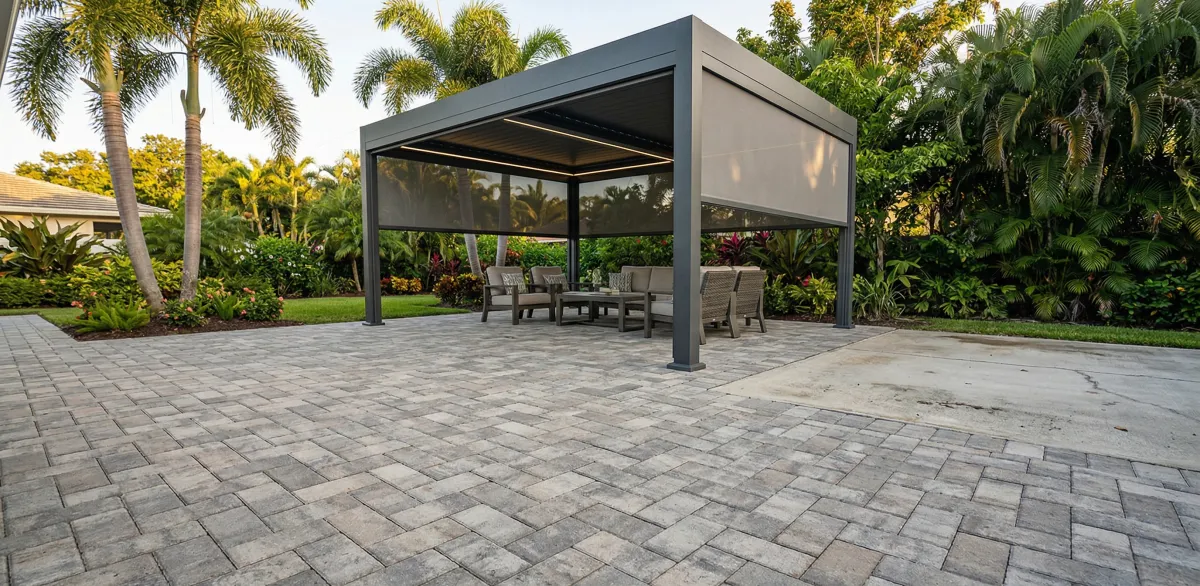
Pavers vs. Concrete: The Foundation Decision That Shapes Everything Above It
Somewhere in the stack of quotes on your kitchen counter, there are two numbers that don't make sense together. One is from the concrete company: $8 to $12 per square foot, poured in a day, finished in a week, and you're grilling by Saturday. The other is from the paver installer: $18 to $35 per square foot, depending on material, a process that involves excavation and compaction and something called a "geotextile barrier" that sounds more like aerospace engineering than backyard renovation. The difference between those two quotes is not just money. It is the difference between a foundation that determines what your outdoor room can become and a surface that quietly limits everything you will build above it for the next two decades.
Most homeowners make the pavers vs concrete patio decision based on one variable: price. And most homeowners who choose based on price alone will, within five to seven years, understand exactly what that savings cost them. Not because concrete is a bad product. Concrete is a perfectly serviceable material for sidewalks, driveways, and utility slabs where aesthetics and long-term adaptability are not priorities. But for the foundation of an outdoor living space that will support a pergola overhead, motorized retractable screens on the perimeter, and a family's worth of memories over two decades of Florida weather, the pavers vs concrete patio decision is the first and most consequential choice in the entire project. Everything above the foundation inherits its strengths or its weaknesses. There is no exception to this rule.
[Explore Go-Fenetex Residential Solutions → https://gofenetex.com/residential]
The Decision Nobody Explains Honestly
Here is what the concrete company's quote does not include: a conversation about what happens to poured concrete in a climate where the temperature swings 40 degrees between January and August, where afternoon thunderstorms deliver two inches of rain in twenty minutes, and where the sandy soil beneath the slab has a memory shorter than a single wet season. Concrete is rigid. It does not flex, it does not drain through its surface, and it does not forgive the ground movement that Florida's geology guarantees. When the substrate shifts, as it inevitably does in sandy, water-saturated soil, the concrete does not settle gracefully. It cracks. It heaves at expansion joints. It tilts in sections that create visible lips where water pools and algae grows.
The paver installer's quote, by contrast, typically includes the one conversation that changes the entire decision: what happens beneath the surface. A properly installed paver patio begins not with the pavers themselves but with the engineering of the base. Excavation to the correct depth. Installation of a geotextile fabric barrier that prevents the sandy substrate from migrating upward into the aggregate layer. Compaction of a crushed limestone or aggregate base to a specification that distributes load evenly and allows water to drain vertically rather than pooling horizontally. Edge restraint systems that prevent lateral movement. And only then, after the invisible infrastructure is complete, do the pavers go down.
This is why paver patio cost is higher at the point of installation. You are not paying for prettier tiles. You are paying for engineering. And that engineering is what makes the difference between a surface that lasts seven years and a foundation that lasts thirty.
[See Why Homeowners Choose Go-Fenetex → https://gofenetex.com/why-go-fenetex]
The Engineering Beneath Your Feet
The best patio material for pergola installation is the one that can bear structural load, maintain precise levelness over time, and allow water to manage itself without pooling, eroding, or undermining the footings of the overhead structure. This is where the pavers vs concrete patio decision becomes an engineering conversation rather than a cosmetic one.
A pergola's columns exert point loads on the surface beneath them. These loads are concentrated, not distributed, which means the foundation must be capable of bearing significant downward force at specific locations without settling, shifting, or cracking. In a paver system, the compacted aggregate base distributes that load across a broad area, functioning like a shock absorber between the column footing and the soil beneath. The load travels from the column through a concrete footing or post bracket, into the paver surface, through the bedding layer, across the compacted aggregate base, through the geotextile barrier, and into the native soil. Each layer attenuates the force. Each layer contributes to stability.
In a poured concrete slab, the load path is shorter but less forgiving. The column footing bears directly on the slab, which bears directly on the soil with only a thin gravel base (if any) between them. If the soil shifts, the slab shifts, the footing shifts, and the column shifts. This is particularly critical for the installation of Go-Fenetex motorized retractable screens, which mount to the pergola structure and require precise track alignment to function correctly. The Keder track retention system and One-Track spring tensioning technology that enable smooth, reliable deployment depend on the structural geometry remaining stable over time. A foundation that moves is a foundation that eventually compromises the performance of every system mounted to the structure above it.
Drainage compounds the issue. Concrete is impervious; water sits on its surface until it evaporates, drains to a slope, or finds a crack to exploit. In Florida, where afternoon storms deliver intense rainfall with little warning, impervious surfaces create pooling, erosion along edges, and hydrostatic pressure against foundations and footings. Pavers, depending on the installation method and joint material, can be configured to allow water to percolate through the joints and into the aggregate base below, where it disperses naturally into the soil. This is not a minor advantage. It is a fundamental difference in how the foundation interacts with the climate it is built within.
[Find a Go-Fenetex Dealer Near You → https://gofenetex.com/dealership]
Total Cost of Ownership Over Fifteen Years
The paver patio cost conversation changes dramatically when you extend the timeline beyond installation day. Concrete is cheaper to install. This is indisputable. But the question that matters for an outdoor living investment is not "What does it cost to pour?" but "What does it cost to own?"
Concrete patios in Florida develop hairline cracks within three to five years with near certainty. These cracks are cosmetic at first, fine lines that you convince yourself are "normal settling." Within another two to three years, those lines widen. Water infiltrates. The rebar, if any was used, begins to corrode. The sub-base erodes unevenly beneath the slab, creating voids that cause sections to settle at different rates. By year seven to ten, the surface that was poured in a day and cost $8 per square foot now has visible cracks, uneven sections, pooling water, and the kind of aesthetic deterioration that makes you avoid looking at the patio when you have guests over.
Repair options for concrete are limited. Cracks can be filled, but the fill is always visible, a scar that announces itself against the original surface. Sections can be mudjacked to level them, but the process is temporary and does not address the underlying soil instability that caused the settling. And when the slab reaches the point of replacement, the cost is extraordinary: demolition of the existing concrete (which cannot simply be removed; it must be broken, hauled, and disposed of), re-grading of the site, and a new pour. Total replacement of a 500-square-foot concrete patio costs between $5,000 and $10,000, and you are back to year zero with the same material limitations.
Pavers, by contrast, are individually replaceable. If a single unit cracks, chips, or stains irreparably, that one unit can be lifted and replaced without disturbing the surrounding surface. If a section settles due to localized soil movement, the pavers in that section can be removed, the base re-compacted, and the pavers re-laid with no visible evidence of the repair. The maintenance cycle for pavers involves periodic resealing (every three to five years, depending on the material and climate) and occasional joint sand replenishment. These are surface-level maintenance tasks, not structural interventions.
Over fifteen years, the concrete vs paver durability calculation favors pavers by a significant margin in climates with thermal cycling, moisture exposure, and expansive soils. The material that costs more on day one costs less per year of useful life. The material that costs less on day one costs more when it fails.
[Explore Commercial Solutions by Go-Fenetex → https://gofenetex.com/commercial]
What You Build Above the Foundation
The foundation of an outdoor living space is not an aesthetic choice made in isolation. It is the first structural decision in a sequence of decisions that determines what the finished room can do, how long it performs, and how much you spend maintaining it over the life of your home.
The best patio material for pergola installation is the material that maintains dimensional stability under load, allows water to manage itself without human intervention, resists the thermal cycling of subtropical climates, and provides the precision surface that overhead systems require. For homeowners planning to complete the outdoor room with Go-Fenetex retractable motorized screens, the foundation choice has direct implications for screen performance. The Keder track retention system requires the pergola columns to maintain their engineered spacing over time, because the tracks must remain parallel and plumb for the fabric to deploy and retract smoothly through the One-Track tensioning system. A foundation that settles unevenly disrupts the pergola geometry, which disrupts the track alignment, which compromises screen performance.
This is not a theoretical concern. It is the most common source of post-installation service calls in the outdoor living industry: screen systems that worked perfectly at installation but developed deployment issues two or three years later because the foundation beneath the pergola shifted and the column geometry changed. The screen didn't fail. The motor didn't fail. The fabric didn't fail. The ground moved, and everything above it inherited the movement.
Investing in the right foundation is not spending more on the floor. It is protecting every dollar you spend on the structure above it and the completion system around it.
[See Go-Fenetex Home Page → https://gofenetex.com/home-page]
Making the Right Decision for Your Home
The pavers vs concrete patio decision is not about choosing the most expensive option. It is about choosing the option that aligns with your long-term vision for the space. If the patio is a utility surface, a place to park a grill and set up a folding table for an occasional cookout, concrete may be perfectly adequate. If the patio is the foundation of an outdoor room that will include a pergola overhead and retractable screens on the perimeter, the decision deserves the same engineering consideration you would give to the foundation of any room in your home.
Ask yourself four questions before signing a quote. First: what do I want to build above this surface in the next five years? If the answer includes any overhead structure, the foundation must support concentrated column loads. Second: how long do I plan to live in this home? If the answer is more than five years, total cost of ownership matters more than installation cost. Third: what is the soil condition on my property? If you are in Florida or any region with sandy, expansive, or moisture-sensitive soils, the base preparation beneath the surface is more important than the surface material itself. Fourth: am I building this space once, or am I willing to rebuild it?
The answers to those questions will make the decision for you. They always do.
[Explore Residential Retractable Screens → https://gofenetex.com/residential]
The Foundation Sets the Tone for Everything
You have the two quotes on the counter. One is half the price of the other. One will cost less over fifteen years. One will support the pergola, the screens, the fans, the lights, and the life you intend to live in that space without asking you to compromise. The other may cost you more than the difference in remediation, replacement, and the invisible tax of a space that works almost well enough.
The ground beneath your feet is where the outdoor room begins. Choose it with the same intentionality you would bring to the foundation of any structure you expect to last.
But choosing the material is only part of the equation. Florida soil has its own plans for your patio, and they are not the same as yours. Before you break ground, before you sign the paver quote, before the first shovel enters the earth, you need to understand what is happening beneath the surface, because what Florida soil does to outdoor spaces is a story that most homeowners only learn after the damage is done.
Start exploring the complete outdoor living ecosystem at NextGen Screens
Discover Onetrack's motorized screen systems at Onetrack Screens
Learn about hurricane-rated protection with Maxforce Screens
