What Does a Pergola Actually Cost, and What Are You Really Paying For
The first thing every homeowner does after deciding they want a pergola is type "how much does a pergola cost" into a search engine. And the first thing that search engine returns is a range so wide it is almost useless. Three thousand dollars to sixty thousand dollars. The helpful articles that follow explain that "it depends" on size, material, design, and location, which is true but functionally meaningless to a homeowner trying to build a budget.
The reason the pergola cost conversation is so frustrating is that the outdoor living industry treats pricing as a competitive secret rather than a transparency exercise. Manufacturers publish MSRP ranges that vary by dealer margin. Contractors provide estimates that bundle labor, material, permitting, and engineering into a single number without itemizing what drives each cost component. And the homeowner, sitting at the kitchen table with three wildly different quotes for what appears to be the same project, has no framework for understanding why one contractor quoted twelve thousand, another quoted twenty-five, and a third quoted forty-two.
This article is that framework. Not a price list, because prices change and vary by region. But a clear explanation of what you are actually paying for when you invest in a pergola, what drives the cost variation between quotes, and how to evaluate whether a given pergola installation price represents genuine value or inflated margin.
Explore the complete outdoor living resource library at NextGen Screens
The Price Range That Confuses Everyone
The pergola cost per square foot for a professionally installed residential structure in North America ranges from roughly thirty dollars to over two hundred dollars, depending on material, design complexity, engineering requirements, and the degree of customization involved. For a typical sixteen-by-twelve-foot patio coverage, that translates to a total project investment of approximately five thousand dollars at the entry level and forty thousand or more at the premium level.
That is a range wide enough to make anyone's head spin. And the temptation is to assume that the difference between five thousand and forty thousand is pure markup, that the expensive option is the same thing as the cheap option with a bigger profit margin attached. This assumption is understandable. It is also wrong.
The five-thousand-dollar pergola and the forty-thousand-dollar pergola are not the same product at different price points. They are fundamentally different products in the same category, the way a pre-fabricated shed and a custom-built guest house are both "outdoor structures" but share almost nothing in common beyond the fact that they exist outside.
Understanding what drives the spread is the first step toward making a pergola investment that matches your needs, your climate, and your long-term outdoor living vision.
Learn about screen systems that complement every pergola budget at Onetrack Screens
Materials, Engineering, and Labor: Where the Money Actually Goes
The three primary cost drivers in a custom pergola price are materials, engineering, and labor. Each one varies independently, and the relationship between them determines both the total cost and the long-term value of the installation.
Materials represent the largest single cost component. Pressure-treated wood is the least expensive structural material, offering a natural aesthetic at a moderate price point but requiring ongoing maintenance, staining, and eventual replacement of components as the wood degrades over time. Aluminum is the mid-to-premium tier, offering exceptional durability, zero maintenance, powder-coated color options, and the structural rigidity required for motorized louver and screen integration. Steel provides the highest strength-to-weight ratio and enables the largest unsupported spans but adds fabrication cost and requires corrosion protection. Vinyl is a budget-friendly option that resists rot but lacks the structural strength for large spans or heavy accessory mounting.
Engineering is the cost component most homeowners overlook and most budget contractors eliminate. A site-specific engineering package includes structural calculations for wind load, snow load, and seismic requirements specific to your geographic zone; connection details for post-to-beam, beam-to-rafter, and post-to-footing interfaces; and a stamped drawing from a licensed professional engineer that satisfies permitting requirements. This package typically costs between one and three thousand dollars, and it is the component that ensures the structure is safe, code-compliant, and warranted.
Labor costs vary by region, complexity, and contractor specialization. A general contractor who occasionally installs pergolas brings different capabilities and pricing than a company that installs outdoor structures exclusively. The specialist typically charges more per hour but completes the project in fewer hours, with fewer callbacks, and with a warranty backed by category expertise.
Discover hurricane-rated engineered protection at Maxforce Screens
Kit Pergola vs. Custom Build: The Comparison That Matters
The question of how much should I budget for a pergola often leads homeowners to consider kit pergolas as a cost-saving alternative. And for certain applications, kit pergolas represent a legitimate option. But the comparison between a kit and a custom build must be made on equivalent terms, or the cost savings become an illusion.
A kit pergola is a pre-engineered, pre-cut structure shipped to the homeowner's property and assembled on site. The design is fixed. The dimensions are standard. The material is typically aluminum or vinyl. The price is lower because the manufacturer achieves economies of scale through standardization, and the installation labor is reduced because the components are designed for efficient assembly.
The custom pergola price reflects a structure designed specifically for the homeowner's property, climate zone, architectural style, and functional requirements. The dimensions are tailored to the space. The material and finish are selected to complement the home. The engineering is site-specific. The installation is custom.
Where the comparison breaks down is in the details that do not appear on the spec sheet. Kit pergolas are engineered to a generic wind load standard that may or may not match your local requirements. They offer limited mounting options for accessories like motorized screens, fans, and lighting. They are designed for standard footprint sizes that may not align with your patio dimensions. And their warranty terms often require installation by a certified installer, which adds labor cost that was not included in the kit price.
A kit pergola that costs eight thousand dollars and requires three thousand in installation labor, plus fifteen hundred for footings that were not included, plus eight hundred for a permit that the kit manufacturer did not mention, totals thirteen thousand three hundred. A custom pergola that costs fifteen thousand all-inclusive may represent the better value, not because it is cheaper, but because the price includes everything the kit price excluded.
Is a louvered pergola worth the extra cost? The answer depends entirely on whether you will use the adjustability that justifies the premium. If you will, the daily satisfaction of environmental control makes the investment feel modest within the first season. If you will not, you are paying for a capability you are not consuming, and the solid-roof alternative delivers most of the function at a meaningful savings.
Compare options in the complete resource library at NextGen Screens
The Per-Square-Foot Reframe: Cheaper Than the Room You Would Add Inside
The pergola cost conversation changes entirely when the homeowner shifts the frame of reference from "how much does this outdoor product cost" to "how much would it cost to add this much livable space to my home."
A twelve-by-sixteen-foot pergola covers one hundred ninety-two square feet. In most markets, a room addition of equivalent size costs between two hundred and four hundred dollars per square foot for fully finished interior space. That translates to a total investment of thirty-eight thousand to seventy-six thousand dollars for a conventional room addition, before accounting for the extended timeline, the construction disruption, and the permitting complexity.
A custom pergola covering the same footprint, fully engineered, properly installed, and ready for screen and accessory integration, typically costs between fifteen and forty thousand dollars. It is completed in days rather than months. It does not require interior finishing, HVAC extension, or electrical panel upgrades. And it produces a space that is, for most of the year, more pleasant than an indoor room because it is connected to the outdoors, to the breeze, to the light, to the experience of being outside without being exposed.
The outdoor living investment reframe is not a sales trick. It is a financial reality. The pergola is the least expensive way to add livable, functional, enjoyable square footage to a residential property. The room it creates may not have drywall, but it has something better: the sky. And with the addition of motorized screens, it has walls that appear on demand and disappear when they are not needed.
The return on investment extends beyond the daily lifestyle value. Real estate data consistently shows that outdoor living structures are among the highest-ROI home improvements, returning sixty to eighty percent of the installation cost in increased property value. The pergola is an investment that pays the homeowner twice; once in years of daily enjoyment and again in enhanced resale value when the time comes.
See how pergolas integrate with the complete screen ecosystem at Onetrack Screens
How to Compare Quotes Without Comparing Apples to Oranges
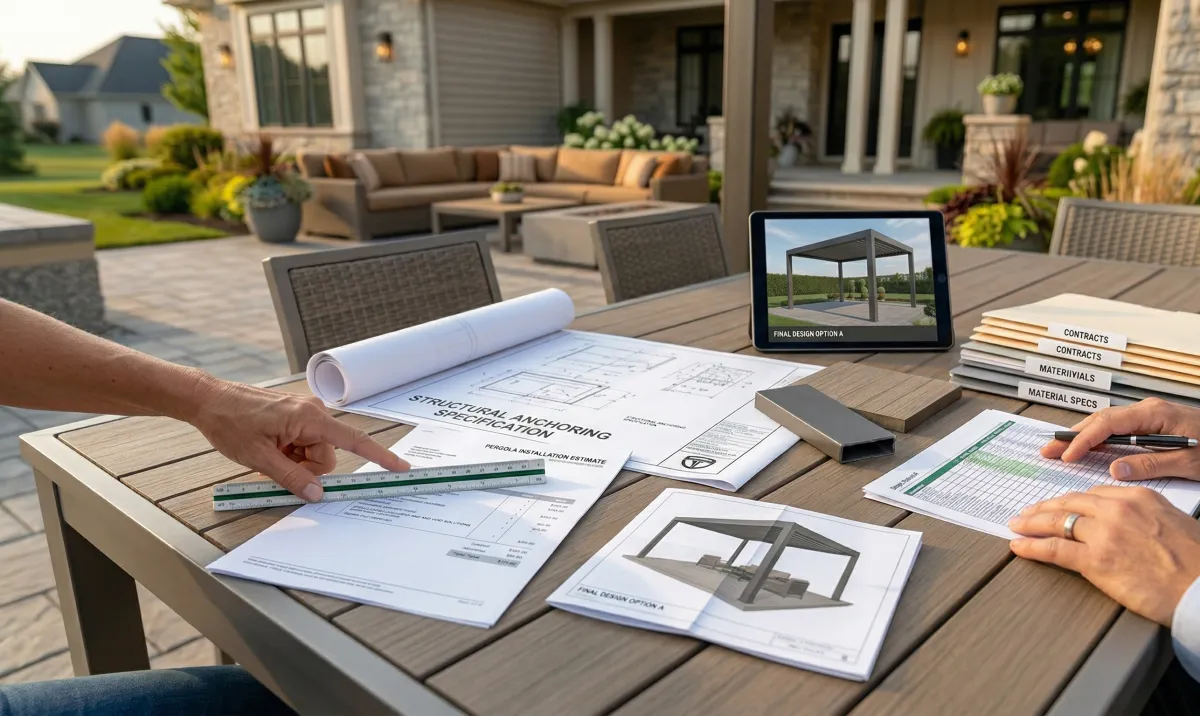
The homeowner sitting at the kitchen table with three pergola estimates needs a framework for comparison that goes beyond the bottom-line number. Because the bottom-line number, without context, is meaningless. A twelve-thousand-dollar quote that excludes engineering, permitting, and footings is not cheaper than a twenty-thousand-dollar quote that includes all three. It is the same price with hidden costs deferred to the installation phase.
When comparing pergola installation price quotes, demand an itemized breakdown that separates materials, engineering, permitting, foundation work, installation labor, and warranty terms. Then compare each line item across the bids. If one contractor's material cost is dramatically lower, ask what material they are specifying and whether it matches the other bids. If one contractor's engineering line is zero, ask who is responsible for the structural calculations and whether the design has been reviewed by a licensed professional engineer.
Ask about the warranty. What does it cover? How long does it last? Does it cover labor, or only materials? Does it require proof of permitting and code compliance to be valid? The warranty that seems generous on paper may contain exclusions that make it functionally worthless if the installation was not performed to specification.
Ask about the timeline. A contractor who promises installation in two days for a project that other contractors estimate at four days is either significantly more efficient or significantly less thorough. Both possibilities should be explored with specific questions about crew size, equipment, and construction sequence.
The pergola quote that represents the best value is rarely the lowest number. It is the number that includes everything, explains everything, and warrants everything.
Explore the full outdoor living resource library at NextGen Screens
The Investment That Pays You Back in Weekends
Here is the calculation that no pergola cost article ever makes, and it is the one that matters most. Not the return on investment at resale. Not the per-square-foot comparison to a room addition. The calculation that matters is the one measured in weekends.
How many weekends per year does your outdoor space currently deliver genuine enjoyment? If the answer is twenty, and a pergola with screens extends that to forty, the structure has doubled the lifestyle return on the most expensive and least renewable resource you own; your time.
You cannot buy more Saturdays. You cannot manufacture more Sunday afternoons in October. You cannot create more evenings where the temperature is perfect and the company is good and the only thing between you and a memory worth making is the fact that the bugs are unbearable or the sun is punishing or the rain is falling on the dinner you planned.
A pergola eliminates those barriers. Screens eliminate the rest. And the investment that seemed significant when measured in dollars feels modest when measured in the weekends it returns.
How much does a pergola cost? It costs less than the room addition that does the same job. It costs less per year than the vacations you take to sit under someone else's covered patio. And it costs nothing compared to the summers you will spend wishing you had built it sooner.
Start exploring the complete outdoor living ecosystem at NextGen Screens
Discover Onetrack's motorized screen systems at Onetrack Screens
Learn about hurricane-rated protection with Maxforce Screens
