
What Actually Keeps You Warm Outside Once the Wind Turns Cold: the Roof, or the Fireplace Underneath It?
What Actually Keeps You Warm Outside Once the Wind Turns Cold: the Roof, or the Fireplace Underneath It?
This series opened with a calendar problem: Northeast Florida heads into the busiest weeks of hurricane season right as most of the country closes up for winter, and cold, wet months follow close behind with almost no gap. Along the way, we've covered how a weather-responsive pergola actually works, why it stays useful once storm season ends, what approval and cost look like, and now, the question this whole series has been building toward. Once the wind actually turns cold, what's really keeping you warm out there?
The honest answer isn't the roof. See the previous post in this series for cost and timeline, if you're weighing the pergola itself.
Two different jobs, not one
This series has been careful about this distinction from the second post onward, and it's worth restating plainly here at the end. A pergola's louvers close against rain and open at high wind to relieve pressure on the structure itself. That's real engineering, and it's genuinely useful. It is not a heat source. Sitting under a closed, sheltered pergola on a 50 degree evening keeps the wind and any drizzle off you. It does not warm you up.
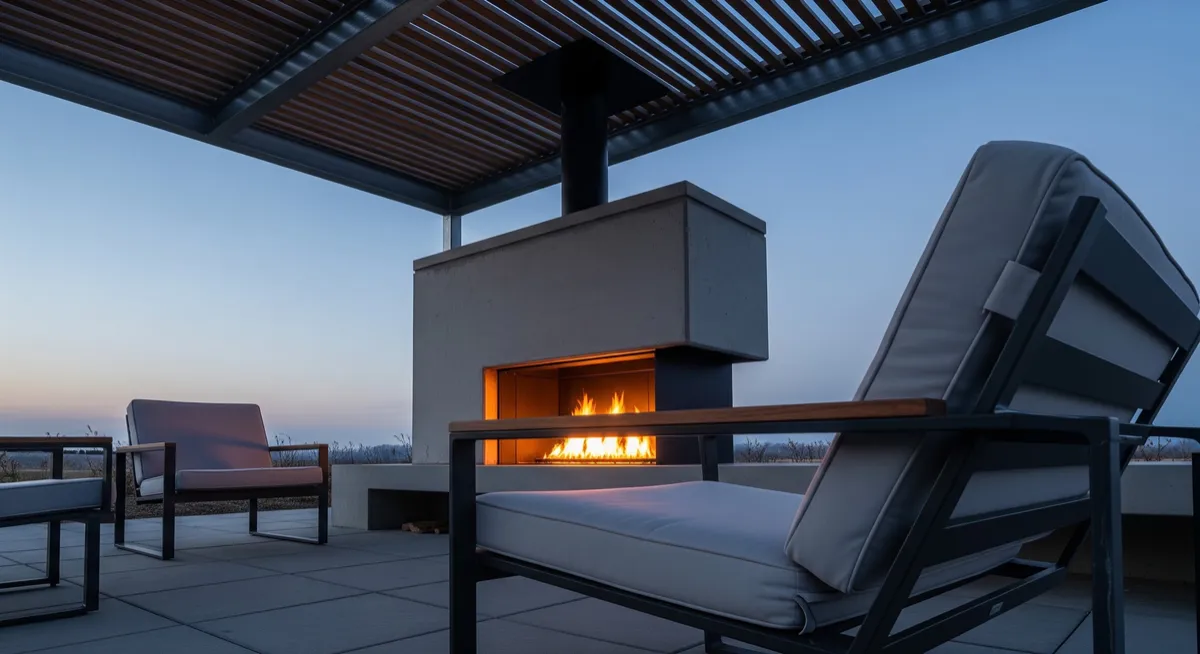
A fireplace is a heat source. Putting the two together, shelter from the structure above and heat from underneath it, is what actually closes the gap between "technically outside" and "comfortable outside" once the temperature drops.
What "extending the season" actually means
Titan Outdoor Solutions frames its fireplace and fire pit line around a specific, concrete claim: a typical Northeast Florida outdoor space gets used about 8 months a year without one, and closer to all 12 months with one. That's a direct, testable version of the argument this entire series has been making in more general terms since the first post. The structure handles the storms. The fireplace handles the cold. Together, they're what actually closes the gap the calendar leaves open.
The real range: $3,000 basic fire pit to $60,000 or more
Titan states four rough tiers. A basic gas fire pit starts around $3,000 to $8,000. A gas fireplace insert with a stone surround typically runs $8,000 to $15,000. A custom wood-burning masonry fireplace ranges $15,000 to $30,000. A grand outdoor living fireplace with seating walls and full integration into the patio can exceed $30,000 to $60,000 or more. As with the pergola pricing covered in the previous post, these are the company's own published figures, not an independently audited sample, and should be treated as a planning range rather than a guaranteed quote.
Design and permitting for a fireplace is stated at 1 to 2 weeks, notably faster than the pergola's 2 to 4 week permitting window covered in the last post, since a fireplace typically involves a smaller structural footprint even at the higher end of the price range.
How much warmth are we actually talking about
Worth being direct about this rather than overselling it. Outdoor fireplaces and fire pits generally provide real, radiant warmth for people sitting close to them, not ambient heating for an entire patio or yard. That's a normal, well understood characteristic of outdoor heating generally, not a limitation specific to any one product. It's also exactly why pairing a fireplace with a sheltered, wind-blocking structure matters so much: the fireplace supplies the heat, and the structure keeps that heat, and the people near it, from being undercut by wind and rain at the same time.
Closing the loop
This series started with a simple observation: while most of the country winterizes, Northeast Florida heads into the busiest weeks of hurricane season, with cold, wet months following right behind. Along the way, we've looked at how a weather-responsive structure actually handles rain and wind, why that structure keeps working once storm season ends, what approval and lot fit look like in Nocatee and Ponte Vedra Beach specifically, and what the real cost and timeline picture looks like. This last post closes the loop on the calendar problem itself. A pergola handles the storms and the rain. A fireplace handles the cold. Neither one does the other's job, and that's exactly why the two together, not either alone, are what actually gets a Northeast Florida backyard through both seasons.
Frequently Asked Questions
Does the pergola roof itself provide any warmth?
No. It shelters you from rain and wind, which makes a cold evening more bearable, but it does not generate heat. A separate heat source like a fireplace is what actually warms you.
Do I need a full masonry fireplace, or is a gas fire pit enough?
Depends on the space and budget. A basic gas fire pit starting around $3,000 provides genuine radiant warmth for a small seating area. A full masonry fireplace is a bigger investment aimed more at a permanent focal point than at warmth alone.
Does adding a fireplace take as long as the pergola itself?
Generally faster on the permitting side. Titan states 1 to 2 weeks for fireplace design and permitting, compared with 2 to 4 weeks for the pergola, since the structural footprint is typically smaller.
Sources
Titan Outdoor Solutions. Outdoor Fireplaces and Fire Pits page: cost tiers, season-extension claim, and design and permitting timeline. Accessed August 2026. titanoutdoorsolution.com
Modern Blaze. Outdoor Gas Fireplaces collection page: general industry note on radiant versus ambient outdoor heating. Accessed August 2026. modernblaze.com


