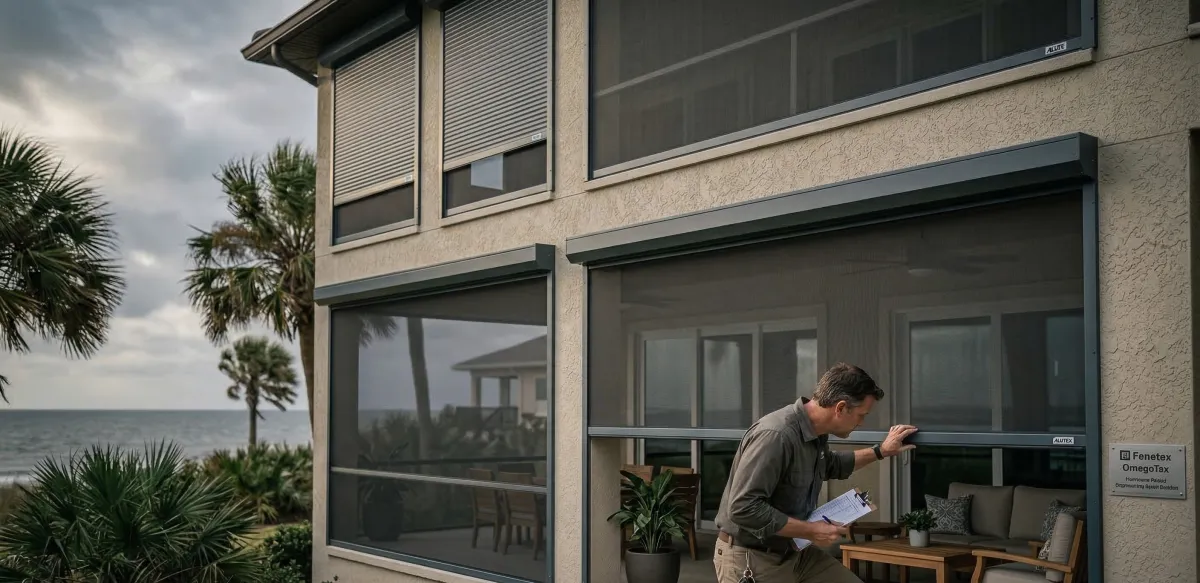
The Pre-Season Hurricane Checklist for Northeast Florida Homeowners (Shutters, Screens & What to Do Now)
There are 40 days between the day this is published and the day hurricane season begins.
Forty days sounds like plenty of time. It is not — if you need custom hurricane protection installed. As we covered in Week 1 of this series, aluminum shutters carry lead times of 60 to 90 days. Motorized screen systems carry approximately 90 days. Those numbers do not compress because the calendar is short. They are supply chain realities that define whether you are protected when June 1 arrives — or still waiting.
This checklist is designed to be the most useful thing you read this month. It is organized by priority. It covers every step a homeowner in St. Augustine, Nocatee, Ponte Vedra Beach, Jacksonville, or Palm Coast should take before the season opens. And it is built so you can work through it this weekend — not next month.
Print it. Download the PDF. Walk your property with it in hand. Then call us with whatever questions remain.
Step 1: Walk Your Property and Assess Every Opening
Start outside. Walk the full perimeter of your home with a notepad or your phone's camera. The goal is to categorize every opening into one of three groups.
Group A — Protected openings. These have functioning aluminum hurricane shutters already installed and operational. Roll-down, accordion, Bahama, colonial, or storm panels with tracks in place. These openings need inspection and maintenance (Step 2), but the protection exists.
Group B — Partially protected openings. These are covered by a standard screen enclosure, fixed screen panels, or some form of non-hurricane-rated barrier. This includes the aluminum-framed screen cages that surround most Northeast Florida pools and lanais. As we detailed in Week 3, these enclosures are not hurricane rated — their mesh acts as a sail in high winds, and most contractors recommend cutting the screens before a storm. These openings are functionally unprotected for hurricane purposes.
Group C — Unprotected openings. No shutters. No screens. No barrier of any kind. Every window, door, lanai opening, patio span, pergola configuration, and outdoor kitchen pass-through in this group is fully exposed to wind-borne debris, wind pressure, and rain infiltration during a hurricane.
Be thorough. Walk all four sides. Check the garage. Check second-story windows — the ones that are easy to forget because they are hard to reach. Check the lanai from inside, looking outward through every opening. Check any covered area where you have invested in outdoor living — the fireplace, the kitchen, the travertine patio — and ask what happens to that investment in a Category 2 event with no protection deployed.
Write down the count. Group A, Group B, Group C. That inventory is the starting point for every decision that follows.
Most homeowners who complete this walk-through are surprised by how many openings fall into Group B or Group C. The home feels protected from inside. It looks different from outside, with a checklist and honest eyes.
Step 2: Inspect and Test Your Existing Hurricane Protection
If you already have aluminum shutters or motorized screens installed, April is the time to confirm they are operational — not August, when a named storm is three days from landfall and the adrenaline makes everything harder.
For Aluminum Hurricane Shutters
Roll-down shutters: Deploy every unit fully. Watch for hesitation, grinding, or uneven descent. Lubricate the tracks with a silicone-based spray — never use WD-40 or petroleum-based lubricants on aluminum shutter tracks, as they attract dirt and degrade the track finish. Check the housing for wasp nests, spider webs, and debris accumulation. If motorized, confirm the motor drives the shutter fully down and fully up without stalling. Test the manual override crank in case of power loss during a storm.
Accordion shutters: Slide each unit fully closed and lock it at the center. Check for resistance, binding, or misalignment in the tracks. Lubricate the bottom track. Confirm the locking mechanism engages securely. Look for corrosion on the hinges and connecting hardware — salt-air environments in Ponte Vedra Beach, St. Augustine Beach, and along the A1A corridor accelerate oxidation on unprotected metal components.
Bahama and colonial shutters: Check the prop arms and hinge bolts. Close each shutter flat against the window and confirm the locking latches engage. Inspect the mounting screws that anchor the shutter to the structural framing — any looseness here compromises the shutter's ability to resist wind loads during a storm.
Storm panels: Locate your panels. Confirm you have a complete set — every opening accounted for, every panel labeled or matched to its track. Check for dents, warping, or corrosion. Replace any damaged panels now, while the supply chain is not under storm-season demand pressure. Confirm you still have the wing nuts, bolts, and track hardware for installation.
For Motorized Screens
Fenetex or similar motorized systems: Deploy every screen fully. Watch the fabric as it descends — it should track evenly in the side channels without bunching, catching, or leaving gaps at the edges. Listen to the motor. A smooth, consistent hum is normal. Grinding, clicking, or hesitation suggests a motor issue that should be serviced before the season. Retract the screen fully and confirm it seats cleanly in the housing.
Test the control system. If your screens are wall-switch operated, test every switch. If they are remote-controlled, confirm the remotes have fresh batteries and are paired. If they are integrated with a smart home system — Alexa, Google Home, Somfy, or the Bond Pro app — run a deployment cycle from the app to confirm connectivity.
If anything is not functioning correctly, schedule service now. Titan provides pre-season maintenance and inspection for all Fenetex motorized screen systems we have installed across St. Augustine, Nocatee, and the surrounding service area. The call you make in April is answered immediately. The call you make in August, during a storm watch, joins a queue.
Step 3: Identify What Is Missing — And Understand the Timeline
Now look at your Group B and Group C lists from Step 1. These are the openings that need new protection before hurricane season opens on June 1.
Here is the lead time reality — unchanged from the Week 1 analysis and worth repeating because it governs every decision you make from this point forward:
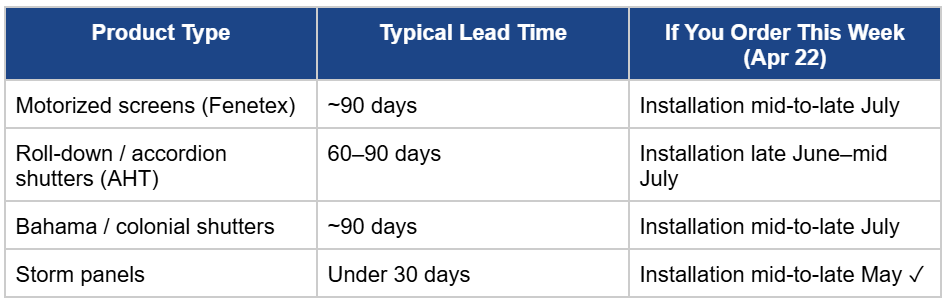
The honest assessment: if you are ordering motorized screens or permanent shutters today — April 22 — you will likely have them installed during the early part of hurricane season, not before it opens. That is still meaningfully better than ordering in June and being unprotected through the peak months of August and September. But if your goal was full protection by June 1, the optimal order window was early March.
Storm panels remain the exception. With lead times under 30 days, they are the fallback option that can still be in place before the season opens — and they carry the same Florida Building Code wind and impact ratings as their permanent counterparts.
We are not telling you this to create pressure. We are telling you because most homeowners do not learn about these lead times until they call in May and discover the window has closed. Knowing the timeline now — even if it is later than ideal — gives you real options. Not knowing it leaves you with none.
Step 4: Review Your Insurance Policy — Before You Need It
This is the step most homeowners skip until a storm is approaching and the anxiety has already set in. Do it now, on a calm April afternoon, when you can read clearly and ask questions without urgency.
Pull your homeowner's insurance policy and find three things:
Your hurricane deductible. In Florida, this is typically a separate, higher deductible that applies only to hurricane damage claims. It is usually expressed as a percentage of your home's insured value — commonly 2%, 5%, or 10%. On a home insured for $500,000 in Nocatee or Ponte Vedra Beach, a 5% hurricane deductible means you absorb the first $25,000 of hurricane damage out of pocket before insurance begins to pay. Understanding this number changes how you think about the investment in protection.
Your wind mitigation credit status. If you have hurricane shutters or motorized screens already installed, check whether a wind mitigation inspection has been completed and submitted to your carrier. Under Florida Statute §627.0629, verified wind mitigation features qualify you for premium discounts of 10 to 30 percent on the wind and hurricane portion of your policy. If you have the protection but have never had the inspection, you are leaving money on the table every year.
Your coverage for outdoor structures and contents. Many standard homeowner's policies provide limited or no coverage for detached outdoor structures — pergolas, outdoor kitchens, freestanding fireplaces — and the personal property inside them. The furniture on your lanai, the grill, the electronics, the cushions — confirm how they are covered and at what limits. This is relevant to the protection calculation for motorized screens: if your outdoor contents are underinsured or excluded, protecting them with a deployable screen system becomes an even more compelling financial decision.
If you do not currently have a wind mitigation inspection on file and you have qualifying protection installed, schedule one. Titan provides all product documentation, Florida Product Approval numbers, and permit records that the inspector will need to verify your shutter and screen installations.
Step 5: Check Your HOA Status — The Law Has Changed
If you live in Nocatee, Ponte Vedra Beach, World Golf Village, Silverleaf, Coastal Oaks, or any other HOA-governed community in St. Johns County, this step is specifically for you.
Florida House Bill 293, effective 2024, requires HOAs to adopt hurricane protection specifications and prohibits them from denying installation of code-compliant hurricane protection products. This includes aluminum hurricane shutters, motorized screens, and other Florida Product Approved systems.
Here is what to do now:
Request a copy of your HOA's current hurricane protection specifications. If they have not adopted them yet, they are required to under state law — and the absence of specifications means they cannot impose restrictions on your installation.
If you previously submitted an application for shutters or screens and were denied, resubmit. The legal basis for that denial no longer exists under HB 293.
If you are planning a new installation, Titan provides complete HOA documentation packages — product specs, color samples matched to community standards, Florida Product Approval numbers, and installation drawings. We have navigated the approval processes for the major St. Johns County communities and can help streamline yours.
The HOA approval timeline adds days to your overall installation schedule. Starting the process in April keeps it from becoming a bottleneck in May.
Step 6: Make the Call — Here Is Exactly What Happens Next
You have walked your property. You have categorized your openings. You have inspected your existing protection. You have reviewed your insurance. You have checked your HOA status. Now the question is: what do you do about the openings that are still unprotected?
Here is exactly what happens when you contact Titan Outdoor Solutions:
The Free Home Assessment (30–45 minutes). One of our installation specialists meets you at your property. We walk the perimeter together — the same walk-through you just did, but with a trained eye that has assessed hundreds of Northeast Florida homes. We measure every unprotected opening. We evaluate exposure, accessibility, and architectural constraints. We discuss your priorities — storm protection, outdoor living comfort, insurance optimization, or all three.
The Custom Protection Plan. Within days of the assessment, you receive a detailed proposal. It specifies the recommended product for each opening — AHT aluminum shutters on windows and doors, Fenetex motorized screens on lanais and outdoor living areas — with pricing, lead times, and a projected installation timeline. If your home includes a StruXure pergola, outdoor kitchen, or other outdoor structure that needs integrated screen protection, the plan addresses it.
Permitting and HOA Coordination. Titan handles the full permitting process with your local building department in St. Johns, Duval, or Flagler County. If you are in an HOA community, we manage the architectural review submission with the documentation package described in Step 5.
Fabrication and Installation. Once approved, your shutters and screens are fabricated to the exact specifications of your home. Installation is scheduled within the lead time window outlined in Step 3. A typical whole-home installation takes one to three days.
Documentation and Inspection. After installation, the work is inspected by the local building department. We provide all documentation for your wind mitigation inspection and insurance filing. You can see examples of our completed installations in our project gallery and video gallery.
The homeowners who call in April are the ones who face June 1 with their homes protected. The homeowners who call in May get installed during the season. The homeowners who call in June get a quote and a wait. We are here for all three — but the first group sleeps best.
The Downloadable Checklist
Everything in this post is also available as a one-page printable PDF — designed to take on your property walk-through this weekend.
Download the Free Pre-Season Hurricane Checklist for Northeast Florida Homeowners →
(Email capture: first name, email address, ZIP code. Triggers Iris email nurture sequence — pre-season urgency flow.)
The checklist includes: the opening assessment framework (Group A/B/C), the shutter and screen inspection steps, the lead time table, the insurance review prompts, and the HOA action items. It is free, it is useful, and it exists so you have a clear plan — whether you call us or not.
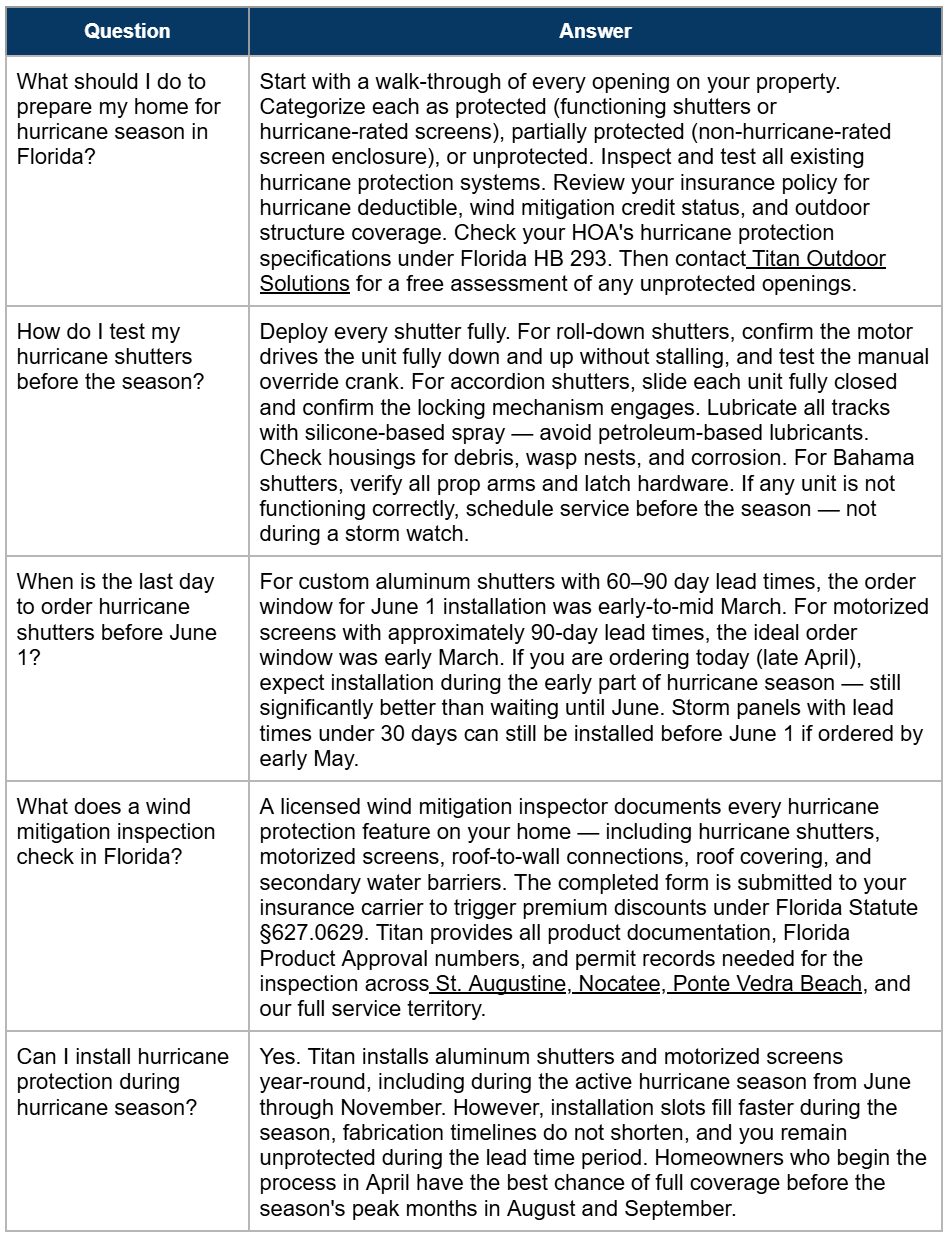
Frequently Asked Questions
Schedule Your Free Pre-Season Home Assessment
Serving St. Augustine · Nocatee · Ponte Vedra Beach · Palm Coast · Jacksonville · Northeast Florida
We walk through your property, identify every unprotected opening, and build a custom plan — at no cost, no obligation. Installation slots are filling for May and June. The homeowners who act this week are the ones who face the season protected.
Call or text: (904) 484-7580 | TitanOutdoorSolution.com
