Smart Home, Smart Outdoors: Controlling Your Motorized Screens with Alexa, Google & Somfy
Your thermostat adjusts the temperature before you walk through the door. Your doorbell identifies who is standing on the porch before you look up from the couch. Your lights dim on schedule, your locks engage remotely, and your irrigation runs on weather data you never check.
Your outdoor space still operates manually. And in a region where the difference between a usable evening and an abandoned one is a 30-second screen deployment, that gap between indoor smart and outdoor manual is costing you time, comfort, and protection.
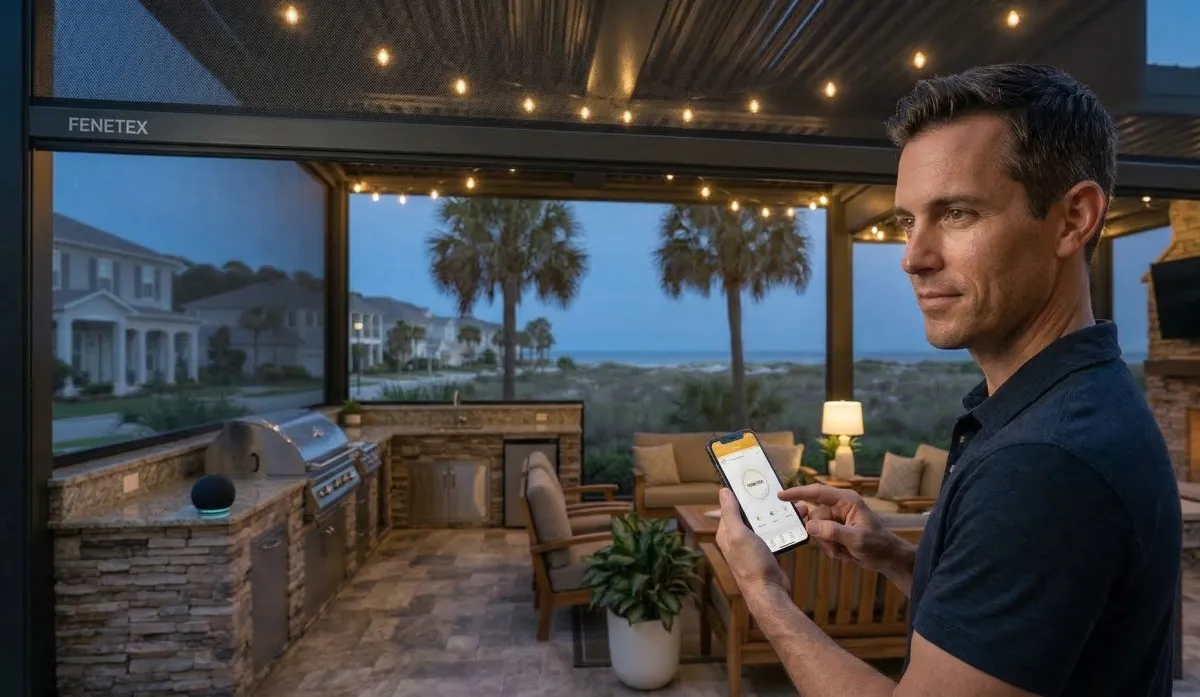
Fenetex motorized screens — the system Titan Outdoor Solutions installs across Nocatee, Ponte Vedra Beach, and Northeast Florida — integrate with the smart home ecosystem you already own. Alexa. Google Home. Somfy. The Bond Pro app. Wind sensors. Timers. Geofencing. The screens become part of your home's intelligent infrastructure — deploying on command, on schedule, or automatically when conditions demand it.
This is not a novelty feature. For homeowners in St. Augustine and across St. Johns County who have invested in smart home technology throughout their interior, extending that intelligence to their outdoor living space is the logical next step. And for homeowners who want hurricane protection that activates even when they are not home, smart motor integration is the difference between preparedness and exposure.
The Smart Home You Already Have And the Gap Outside the Sliding Glass Door
The average homeowner in Nocatee has already invested in a meaningful smart home ecosystem. Athena's market research shows that 66 percent of Nocatee residents hold a bachelor's degree or higher. The median household income is $131,000. These are homeowners who adopt technology early, integrate it thoughtfully, and expect their home systems to communicate with each other.
The typical smart home stack in a Nocatee or Ponte Vedra Beach home includes some combination of the following: a Nest or Ecobee smart thermostat, a Ring or Arlo doorbell and security camera system, Lutron or Leviton smart lighting with dimming and scheduling, a Chamberlain or LiftMaster smart garage door opener, an Amazon Echo or Google Nest Hub serving as the voice command hub, and increasingly, smart irrigation controllers and pool automation.
Every one of those systems shares a common design principle: the homeowner controls the environment without physical effort. The thermostat adjusts before they feel uncomfortable. The lights follow a schedule without switches. The garage door opens as the car approaches.
Then they walk to the lanai. And they manually press a wall switch to deploy the screens. Or they forget to deploy them, and the mosquitoes arrive before the screens do. Or a storm approaches while they are away, and the screens that could protect their outdoor kitchen and outdoor fireplace investment sit retracted in their housing because no one was home to press the button.
Smart motor integration eliminates that gap. It brings the outdoor space into the same intelligent ecosystem that governs the rest of the home.
How Fenetex Smart Motor Integration Works
The Fenetex motorized screen system supports smart home integration through Somfy motor technology — the global standard for motorized shade, screen, and awning control. Here is how the integration works at each level, from basic to fully automated.
Level 1: Wall Switch and Handheld Remote
Every Fenetex motorized screen installation includes a wall-mounted control switch and a handheld RF remote. These are the baseline controls. Press the button, the screen deploys. Press it again, it retracts. Each screen operates independently — you can deploy the west-facing solar screen while leaving the north-facing opening open.
This level requires no smart home infrastructure. It works out of the box on every Titan installation across St. Augustine, Jacksonville, and the surrounding service area.
Level 2: Smartphone App Control (Bond Pro or Somfy myLink)
The Bond Pro bridge or Somfy myLink hub connects to your home WiFi network and communicates with the Fenetex motors via RF signal. Once paired, you control every screen from your smartphone — from the couch, from the outdoor kitchen, from the office, or from anywhere with an internet connection.
The Bond Pro app is particularly valuable because it unifies control of motorized screens alongside other RF devices — ceiling fans, lighting, and motorized shades — in a single interface. Instead of switching between four apps to manage your outdoor environment, Bond Pro puts everything in one place.
Somfy myLink offers similar functionality within the Somfy ecosystem, with additional features for grouping screens into zones (deploy all lanai screens with one tap) and scheduling deployment times.
This level requires a Bond Pro bridge (~$100) or Somfy myLink hub and a stable WiFi signal reaching the screen locations.
Level 3: Voice Control (Alexa, Google Home, Siri Shortcuts)
Once the Bond Pro bridge or Somfy hub is connected to your home network, the screens integrate with Amazon Alexa, Google Home, and Apple Siri Shortcuts through their respective smart home platforms.
The commands are natural language:
"Alexa, deploy the lanai screens."
"Hey Google, close the patio screens."
"Alexa, retract all outdoor screens."
You can group screens by zone — "lanai screens," "pergola screens," "west side screens" — and deploy or retract entire zones with a single command. You can include screen deployment in Alexa Routines or Google Home automations — for example, a "Good Evening" routine that dims the outdoor lights, turns on the ceiling fan, and deploys the insect screens simultaneously.
For homeowners in Nocatee and Ponte Vedra Beach who already use voice commands to manage their interior environment, extending that control to the outdoor space is seamless. The screens become part of the vocabulary of the home.
Level 4: Automated Scheduling and Timers
Somfy motors support time-based scheduling — the screens deploy and retract on a preset schedule without any command at all.
The most powerful application in Northeast Florida: scheduling insect screens to deploy automatically at 6:30 PM during mosquito season. As we documented in Week 5, the mosquito and no-see-um peak in St. Johns County begins at dusk — precisely when outdoor living is most desirable. A scheduled deployment means the screens are sealed before the bugs arrive, every evening, without the homeowner remembering to press a button.
Solar screens can be scheduled to deploy in the late morning when the west-facing patio begins receiving direct sun, and retract in the late afternoon when the sun moves past the exposure angle — as detailed in Week 6.
Schedules can be adjusted seasonally, by day of the week, or overridden manually at any time.
Level 5: Wind Sensor Auto-Deployment — The Storm Protection Layer
This is the integration level that transforms motorized screens from a convenience product into a true storm protection system.
Fenetex screens can be paired with external wind sensors that monitor wind speed in real time. When wind speeds reach a preset threshold — configurable by the homeowner and installer — the sensors trigger automatic deployment of the hurricane-rated OmegaTex screens.
The implication is significant: if a storm approaches while the homeowner is at work, traveling, or simply inside and unaware of the wind conditions, the screens deploy themselves. No button pressed. No app opened. No human intervention required.
For homeowners along the Ponte Vedra Beach coastline, on Anastasia Island, or in the storm-exposed communities of Palm Coast and Flagler Beach — where sudden squalls and tropical storm-force gusts can arrive with limited warning — wind sensor auto-deployment provides a level of protection that no manual system can match.
This is also the feature that resonates most powerfully with the Active Retiree persona from Athena's research — homeowners who want storm protection that does not require them to physically deploy heavy shutters or remember to press a button before every storm. One setup. Automatic protection. Genuine peace of mind.
The homeowners who live here do not do things manually. Their home anticipates their needs — adjusting temperature, lighting, security, and irrigation without being asked. Smart motorized screens extend that same intelligence to the outdoor space. The bugs arrive at 6:30. The screens deployed at 6:29. The storm builds at 3 AM. The screens deployed at 2:47. That is what smart outdoor living means.
The Scenes and Routines That Change Daily Life
Smart home platforms are most powerful when multiple devices work together in automated routines. Here is how Fenetex motorized screens fit into the scenes and routines that Northeast Florida homeowners are already building.
"Good Evening" Routine (Alexa or Google Home): Trigger: Voice command or scheduled at 6:15 PM Actions: Deploy lanai insect screens → dim outdoor string lights to 40% → turn on lanai ceiling fan → set outdoor speaker to jazz playlist Result: The outdoor space is sealed, lit, cooled, and ready before you carry the first drink outside.
"Storm Prep" Routine: Trigger: Voice command Actions: Deploy all hurricane-rated OmegaTex screens → close StruXure pergola louvers → turn off outdoor electrical circuits → send confirmation notification to phone Result: Complete outdoor protection activated in under 60 seconds, from anywhere.
"Weekend Morning" Routine: Trigger: Scheduled at 7:00 AM Saturday/Sunday Actions: Retract all screens → open StruXure louvers to 45 degrees → turn on outdoor coffee station outlet Result: Open-air morning on the lanai — no screens, full view, fresh air — ready when you walk outside with coffee.
"Away Mode" Routine: Trigger: Geofencing or manual activation when leaving for travel Actions: Deploy solar screens on sun-exposed faces → arm wind sensor auto-deployment on hurricane screens → activate security cameras on outdoor zones Result: The outdoor space is protected from UV, wind, and storms while the homeowner is away. No neighbor asked to press a button. No exposure during absence.
These routines take five minutes to configure. They execute automatically, every day, for the life of the system. And they represent the kind of intelligent, low-friction outdoor living that the Nocatee and Ponte Vedra demographic expects from their home.
What Smart Integration Costs And What It Does Not
Smart motor integration is not a luxury add-on with a luxury price tag. Here is the practical cost breakdown.
Included in every Titan Fenetex installation: Somfy smart motor, wall-mounted control switch, handheld RF remote. These are standard. There is no upgrade fee for the smart-capable motor.
Bond Pro bridge: Approximately $100. One bridge controls all RF motorized devices in the home — screens, fans, shades. Single purchase.
Somfy myLink hub: Similar price range. Preferred for homeowners already in the Somfy ecosystem for interior motorized shades or awnings.
Wind sensors: Price varies by configuration. Typically installed as part of hurricane-rated screen systems where automatic storm deployment is desired. Titan includes wind sensor options in proposals for coastal and high-exposure installations.
Alexa, Google Home, Siri: If you already own an Echo, Google Nest, or Apple HomePod, the integration is free — it is a software connection through the Bond Pro or Somfy bridge, not an additional hardware purchase.
The total smart integration cost above the base screen installation is typically $100 to $300 — a fraction of the screen system investment that unlocks voice control, app control, scheduling, automation, and wind sensor capability.
For homeowners who have already spent $500 on a Nest thermostat and $300 on smart lighting, spending $100–$300 to bring their outdoor screens into the same ecosystem is not an upgrade. It is a completion.
The Security Dimension Screens as Smart Perimeter Protection
There is a secondary benefit to smart motorized screens that extends beyond comfort and storm protection: perimeter security.
Deployed screens create a physical and visual barrier around the outdoor living space. From outside the screen, visibility into the screened area is significantly reduced — particularly with solar mesh or privacy mesh fabrics. From inside, visibility outward is maintained.
In communities like Nocatee, Ponte Vedra Beach, and the St. Augustine historic district, where outdoor living spaces contain high-value furniture, electronics, grills, and entertainment systems, the visual deterrent of a deployed screen is meaningful. The items are not visible from the street or the yard. The space appears enclosed and occupied.
When integrated with a smart home security system, screen deployment can be included in "Away" or "Night" modes — automatically sealing the outdoor perimeter alongside locking doors, arming cameras, and activating motion sensors. The screens become part of the home's security envelope, not just its comfort envelope.
For Homeowners Who Are Not Tech-Savvy It Still Works Simply
Not every homeowner in Titan's service territory wants voice commands and automated routines. The Active Retiree in Palm Coast. The homeowner who prefers simplicity. The buyer who wants the screen to work and does not care about Alexa.
The Fenetex system works perfectly at Level 1 — the wall switch and handheld remote. Press the button. The screen deploys. Press it again. It retracts. No app. No WiFi. No voice commands. No setup.
The smart integration is available, not required. It is there for the homeowners who want it, invisible to the homeowners who do not. Titan configures the system to match your comfort level during installation. If you want full Alexa integration with wind sensors and scheduling, we set it up. If you want a button on the wall and a remote in the drawer, that works perfectly too.
The screen is the investment. The smart integration is the option. Both deliver the same core value: bug protection, UV protection, storm protection, and the outdoor living transformation we have documented throughout this series. You can see both configurations — simple and fully automated — in our project gallery and video gallery.
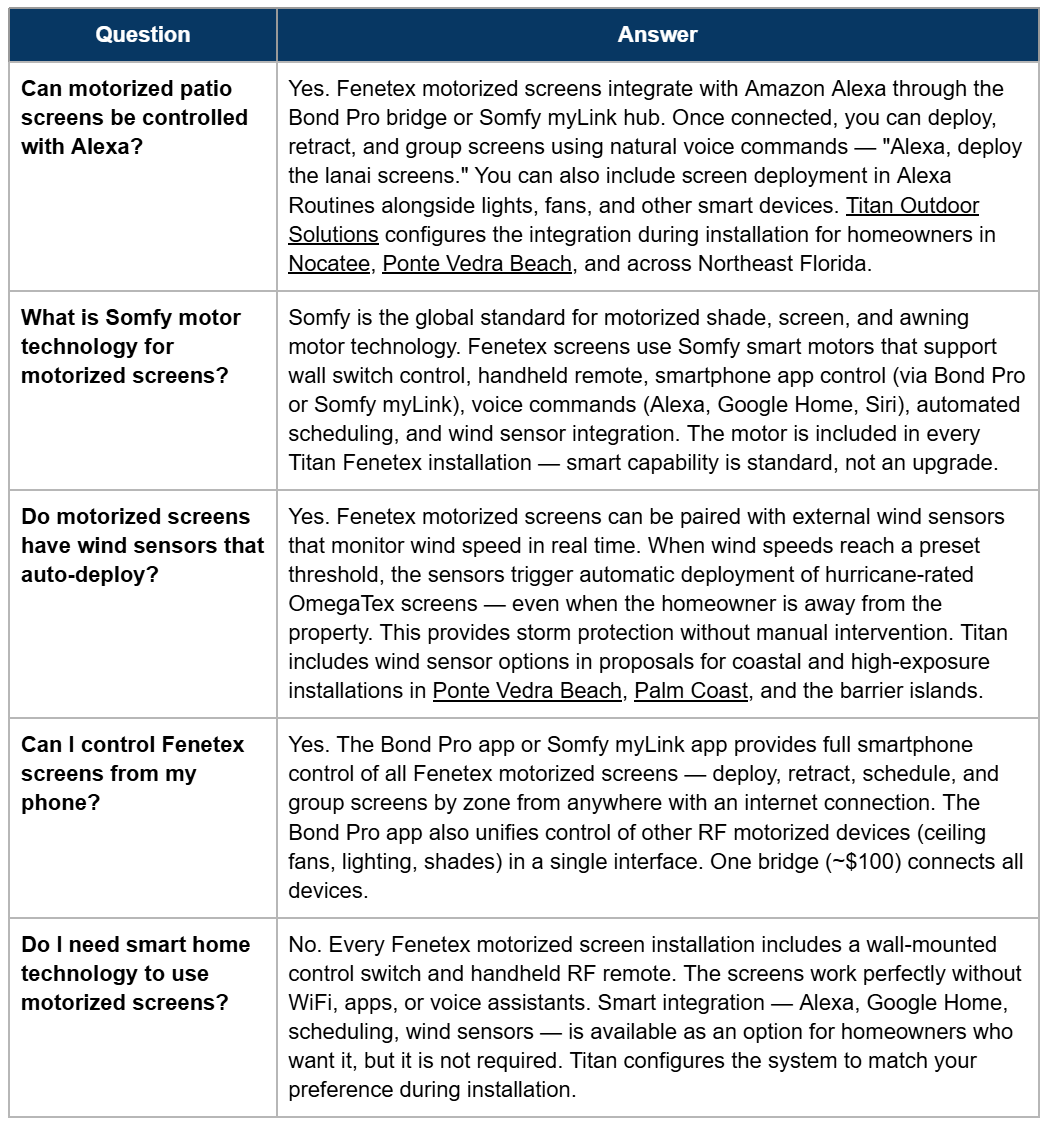
Frequently Asked Questions
Schedule Your Free Smart Outdoor Living Consultation
Serving St. Augustine · Nocatee · Ponte Vedra Beach · Palm Coast · Jacksonville · Northeast Florida
Ask about smart motor options when you request your free quote. We will spec your system for how you actually live — from a simple wall switch to full Alexa integration with wind sensors and automated scheduling.
Call or text: (904) 484-7580 | TitanOutdoorSolution.com
