
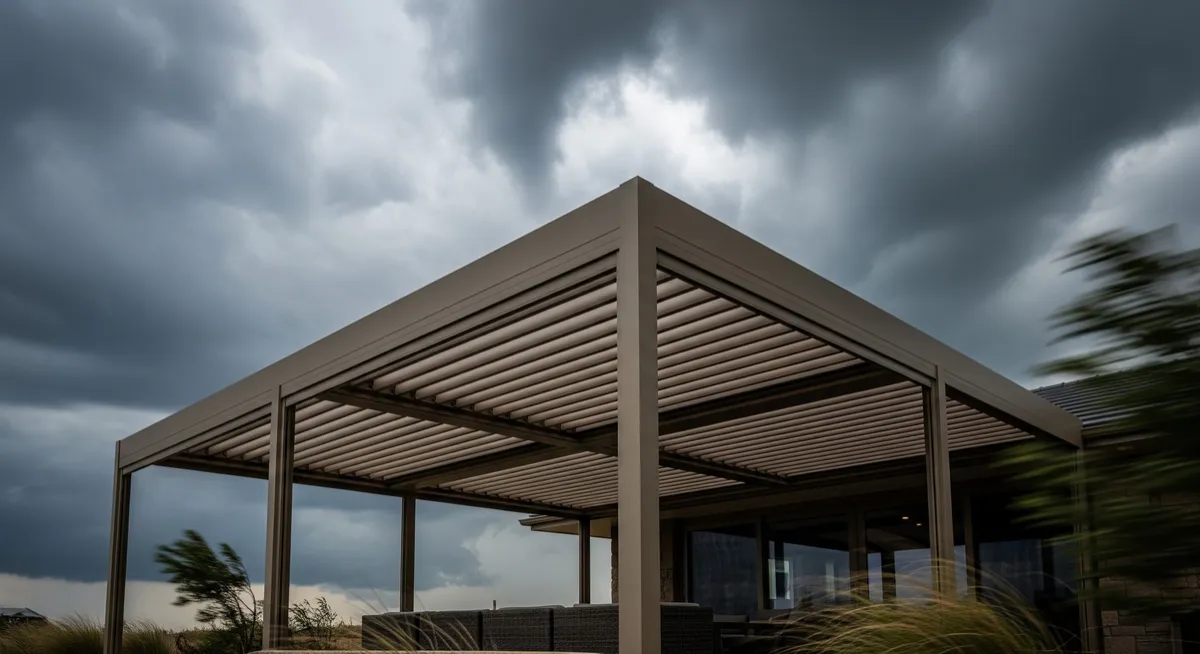
What Actually Happens When a StruXure Pergola Senses Rain or High Wind
What Actually Happens When a StruXure Pergola Senses Rain or High Wind
Our last post laid out the calendar problem: Northeast Florida heads into the busiest weeks of hurricane season right as most of the country is closing up for the year, and cold, wet months follow close behind. This post is about the part of that story that actually matters once a storm — or just a bad afternoon — shows up: what a weather-responsive structure actually does in the moment, not what the brochure says it does.
A StruXure pergola isn't a fixed roof that happens to look nice. It's a system with two sensors doing real work, and understanding what they actually do, and don't do matters more than any wind-speed number printed on a spec sheet. See the first post in this series for the seasonal context this one builds on.
The two sensors doing the work
A StruXure pergola's louvers aren't just decorative or manually operated. They're read by two independent sensors that respond automatically, without anyone touching a remote. The rain sensor detects the first drops and closes the louvers immediately, before a downpour has a chance to reach the furniture underneath. The system is engineered to be genuinely watertight in that closed position: water is directed into built-in gutters along the outside edges and channeled away, rather than dripping through gaps the way a lot of fixed patio covers eventually do.
The wind sensor works on a completely different logic, and it's the one that trips people up.
Why "opens" sounds backwards (but isn't)
Most people assume a storm-ready structure should close up tight and hold the line against wind. A StruXure pergola does the opposite once wind hits 60mph: the sensor triggers the louvers to open. That's not a malfunction, and it's not the system giving up — it's the entire point.
A closed, flat roof surface under high wind behaves like a wing or a sail. Wind pressure builds underneath it and creates uplift, the same force that can peel a roof off a house or launch an unanchored patio umbrella across a yard. Opening the louvers lets that pressure pass through instead of building up against a solid surface. It's a deliberate structural safety response, engineered specifically to protect the pergola itself from wind-load failure.
That distinction matters for anyone picturing what this structure actually does for them in a storm: it isn't a wind shield for the people underneath it. It's rain protection, shade, and a structure engineered not to become storm debris itself. Three genuinely valuable things, just not the same thing as "blocks the wind."
What "ICC certified" actually means here
"Wind-rated" gets printed on a lot of pergola spec sheets with no real evidence behind the number. StruXure is currently the only louvered pergola manufacturer to hold International Code Council (ICC) certification — independent, third-party validation that covers the entire system, not just the louvers, but the supporting beams, columns, and connections tested together under real wind and snow load combinations. The evaluation was developed with Engineering Express, a licensed structural engineering firm, and supports a rating engineered up to 150mph, calculated per project rather than as a single blanket number.
Independent industry comparisons of pergola manufacturers have specifically flagged this distinction: a wind-speed number on a product page isn't the same thing as a published structural report from a licensed engineer, and not every brand claiming a comparable rating can produce one on request.
What this means if you're comparing pergola options
This isn't a pitch to pick StruXure over anything else. It's a suggestion for how to actually evaluate any louvered pergola you're considering. Ask for the structural report behind the wind-speed number, not just the number itself. A real engineered rating traces to a specific document from a licensed engineer. A marketing claim usually doesn't.
Frequently Asked Questions
Does the pergola protect me from wind?
Not directly. The wind sensor's job is to protect the structure itself by relieving pressure, not to shield the people underneath from wind. Any wind-blocking effect you feel while sitting under it is a side benefit of the shade and structure, not the sensor's engineered purpose.
What happens if it starts raining while I'm not home?
The rain sensor closes the louvers automatically regardless of whether anyone's there to trigger it manually — that's the entire point of an automated system rather than a manually operated cover.
Is a "150mph rating" the same for every pergola brand that claims one?
No. Independent industry comparisons have noted that published wind ratings vary widely in the evidence behind them — some trace to a full structural report from a licensed engineer, others appear on a product page with no supporting document at all. The number alone doesn't tell you which is which.
Sources
StruXure. ICC Certification for Commercial Pergolas. Accessed August 2026. struxure.com
StruXure by Blue Sky. Product specifications page — wind sensor and rain sensor behavior. Accessed August 2026. struxurebybluesky.com
Engineering Express. StruXure Outdoorclient page — ICC Evaluation Report partnership. Accessed August 2026. engineeringexpress.com
Hansø.Best Pergola Company 2026: Engineering vs Marketing— independent comparison of published wind-rating evidence across pergola manufacturers. Accessed August 2026. hansohome.com
Titan Outdoor Solutions. Homepage — StruXure Certified Dealer credential. Accessed August 2026. titanoutdoorsolution.com


