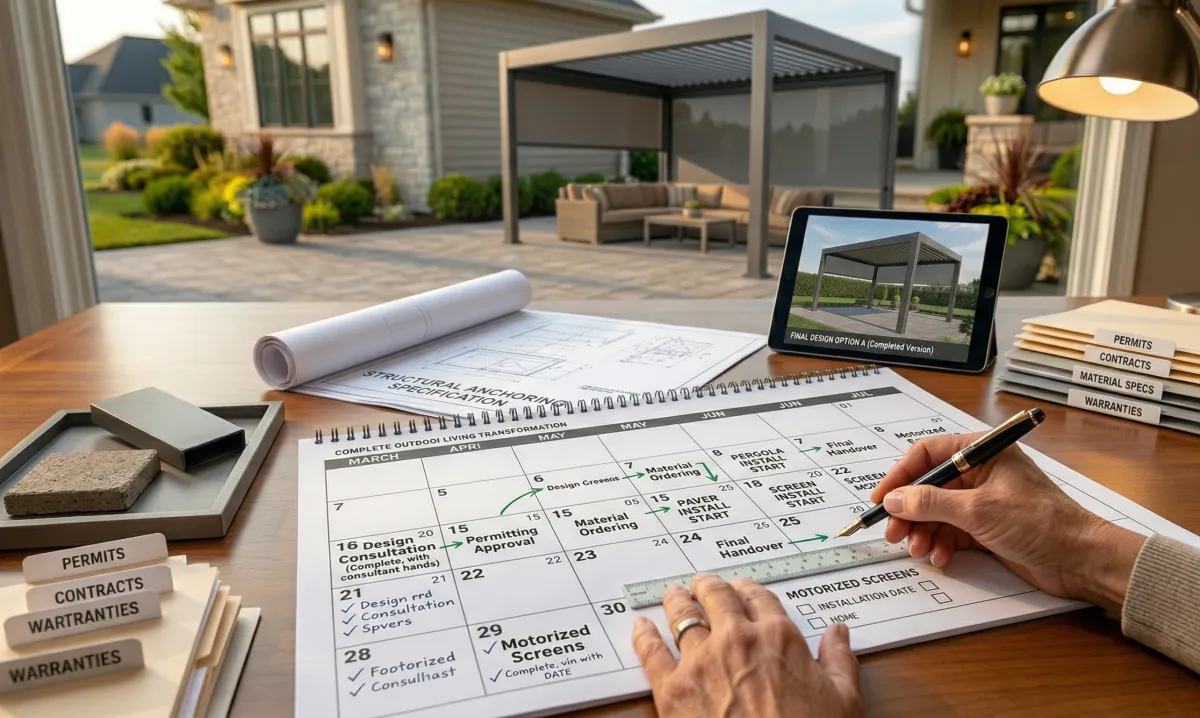
The Summer You Have Been Planning in Your Head: Turning the Outdoor Vision Into a Scheduled Reality
There is a summer living in your head. You have visited it dozens of times, usually on a cold Tuesday evening when the windows are dark by five and the backyard is a silhouette you cannot see and would not want to visit anyway. In this imagined summer, the patio looks different. There is structure overhead. The lighting is warm. The screens are down and the bugs are someone else's problem. Your family is outside, not because the weather cooperated, but because the space was built to handle whatever the weather decided to do. In this imagined summer, you are not planning the backyard project. You are living in the finished result.
That summer is possible. It is entirely, practically, realistically possible. But it requires something that imagined summers do not; a calendar. Because the outdoor living installation timeline that separates the homeowners who enjoy their summer from the homeowners who spend another season planning it is measured not in enthusiasm but in weeks. And those weeks are disappearing faster than the homeowner who is "still thinking about it" realizes.
This is not manufactured urgency. This is logistics. And the logistics of seasonal home improvement have a rhythm that rewards early action and punishes procrastination with a penalty measured in months.
Explore the complete outdoor living ecosystem at NextGen Screens
The Vision That Lives in Your Head, and the Calendar That Does Not Care
The outdoor living vision is patient. It can live in your imagination for years, growing more detailed with every resort visit, every dinner at a restaurant with a beautiful covered patio, every Saturday spent inside because the sun made the backyard hostile or the bugs made it intolerable. The vision never expires. It simply accumulates detail, like a blueprint that keeps getting revised without ever being submitted to a contractor.
The calendar is not patient. The calendar is a finite resource with constraints that do not flex for homeowners who need another week to decide. When to install a pergola is not a question answered by readiness. It is a question answered by availability. And availability in the outdoor living industry follows a demand curve that is as predictable as it is unforgiving.
The spring home improvement season begins in earnest around late February in warmer climates and mid-March in seasonal ones. By early April, every reputable contractor's installation calendar is accumulating bookings at a rate that compresses the remaining open slots into a narrowing window. By May, the homeowner who calls to schedule a summer installation is often told that the first available opening is in August. And the homeowner who calls in June is told September. Or October. Or next spring.
The outdoor renovation schedule does not wait for the homeowner to feel ready. It fills based on who acted first.
Learn about motorized screen installation at Onetrack Screens
The Demand Curve Nobody Shows You
The summer patio project planning conversation would be much simpler if the outdoor living industry published the data that every contractor knows intuitively but rarely shares with clients. The demand curve for residential outdoor improvements is not a gradual incline. It is a hockey stick.
From November through January, demand is at its lowest. Contractors are available. Lead times are short. Scheduling is flexible. This is the window where the most strategic homeowners lock in their spring installations, securing their place in the queue months before the rush begins.
From February through March, demand begins to accelerate. The homeowners who spent the winter researching are now ready to commit. The contractors who were flexible in December are now filling their April and May calendars. Lead times extend from two weeks to four, then to six.
From April through June, demand reaches its peak. Every homeowner who spent the winter saying "we'll deal with it in the spring" is now calling simultaneously. Contractors are fully booked. Material suppliers are experiencing lead time extensions. The installation slot that was available in March with a two-week lead time now requires an eight-to-twelve-week wait.
How far in advance should I plan an outdoor living project? The honest answer is: earlier than you think. The homeowner who begins the planning conversation in January and commits in February is enjoying their new outdoor space by May. The homeowner who begins in April and commits in May is waiting until August. Same vision. Same investment. Different calendar.
Discover hurricane-rated protection at Maxforce Screens
Pavers First, Pergola Next, Screens Last: The Timeline That Works
For homeowners pursuing the complete outdoor living transformation; pavers, pergola, and motorized screens as an integrated system; the installation sequence has timeline implications that affect when the project should begin.
The paver installation timeline for a residential patio of typical size runs approximately one to two weeks from excavation to completion, assuming the base preparation, material delivery, and weather cooperate. This phase must happen first because, as we explored in earlier articles, the paver surface is the foundation that everything else sits on.
The pergola installation, depending on whether it is a standard system or a custom-engineered structure, typically requires two to four weeks from contract to completion. This includes the engineering review, permitting, material fabrication or ordering, and the physical installation, which itself usually takes two to five days of on-site construction.
The motorized screen installation adds another one to two weeks, including the mounting, wiring, calibration, and integration with any smart home or automation systems.
The total timeline for the complete three-layer system, from initial commitment to finished outdoor room, is approximately six to twelve weeks. Which means the homeowner who wants to be fully operational by Memorial Day needs to begin the process no later than mid-March. The homeowner who wants the space ready for the Fourth of July needs to commit by mid-April at the latest.
When is the best time to install a pergola? The best time is before the calendar forces you to choose between quality and timing. The worst time is when every other homeowner in your zip code has realized the same thing.
Learn about the full outdoor living system at NextGen Screens
Why "We Will Do It This Summer" Usually Means Next Summer
There is a specific pattern of delay that repeats itself across the outdoor living industry every year, and it follows a psychological sequence that is as predictable as the demand curve it feeds.
January: the homeowner has a vague intention to do something about the outdoor space this year. The intention is real but unscheduled. February: the intention gains some specificity. A few web searches. Maybe a Pinterest board. A conversation with the spouse that ends with "we should get some quotes." March: the quotes are requested. Two of the three contractors are already booking into May. The third is available sooner but does not inspire confidence. April: the quote comparison takes longer than expected. A decision is made, but the contractor's next opening is in July. May: the homeowner realizes that the project they imagined enjoying all summer will not be complete until the end of the summer, if everything goes according to schedule. June: the project is pushed to "next spring, so we can enjoy the full season."
This cycle repeats, and each time it repeats, it costs the homeowner another full year of the outdoor living experience they have been imagining. Not because the project is difficult. Not because the decision is complicated. But because the calendar does not negotiate.
The homeowner who breaks this cycle is the one who treats the planning phase as an action, not a precursor to action. Getting a quote is doing something. Committing to a date is doing something. Securing a spot on the installation calendar is doing something. The vision becomes a scheduled reality the moment you stop researching and start reserving.
Explore pergola and screen options at Onetrack Screens
The Cost of Another Season on the Sidelines
Every outdoor living article frames the cost of the project in dollars. This one frames it in time. Because the cost you pay for another year of inaction is not measured in money. It is measured in the experiences you did not have.
Count the Saturday evenings from May through October. There are roughly twenty-six of them. Each one is an opportunity for a family dinner outside, a gathering with friends, a quiet evening with a glass of wine under the stars. Without the outdoor space, those evenings default to the living room couch. With the outdoor space, those evenings become the experiences your family will remember.
Count the Sunday mornings. The afternoons. The holidays. The birthdays. The impromptu Tuesday cookouts that happen because the space is there and it is comfortable and there is no reason to go inside. Each one of these moments has a value that cannot be calculated in dollars but is felt acutely in the accumulated regret of "we should have done this sooner."
The homeowner who builds the outdoor room this season gets this summer. The homeowner who waits gets next summer, maybe, if the cycle does not repeat itself. The difference between those two homeowners is not budget or readiness or even vision. The difference is whether they treated the calendar as a constraint or as something they would get to eventually.
The paver installation timeline, the pergola lead time, the screen installation schedule; all of these are knowable, manageable, sequential steps. None of them requires extraordinary effort. All of them require the decision to begin.
Check out the complete outdoor living resource library at NextGen Screens
From Vision to Date: The One Conversation That Makes It Real
The outdoor living vision becomes a scheduled reality through a single conversation. Not a marathon of research. Not a spreadsheet of pros and cons. One conversation about what you want, when you want it, and whether the calendar still has room for your project this season.
That conversation begins with the questions you have been carrying. What will it cost? How long will it take? What goes first? What can be phased? What does the process look like from commitment to completion? Every one of these questions has a straightforward answer, and the answer is available the moment you ask for it.
The homeowner who has been imagining this summer for two years is closer to living it than they think. The gap between the vision and the reality is not a gulf. It is a phone call, a site assessment, and a date on the calendar. And once that date is confirmed, the planning anxiety transforms into anticipation. The backyard stops being a project and starts being a countdown.
Your summer is waiting. The question is not whether the vision is right. You have spent enough time refining it to know exactly what you want. The question is whether this is the year you build it or the year you add another chapter to the list of summers you wished you had.
If you are ready to turn the vision into a date, the resources are waiting.
Start exploring the complete outdoor living ecosystem at NextGen Screens
Discover Onetrack's motorized screen systems at Onetrack Screens
Learn about hurricane-rated protection with Maxforce Screens
