
Contact Titan Outdoor Solutions
Ready to extend your outdoor living space? Let's talk about what's possible for your home.
How Can We Help You?
Whether you're ready to schedule a free design consultation, have questions about our products, or need support with an existing installation—we're here for you.
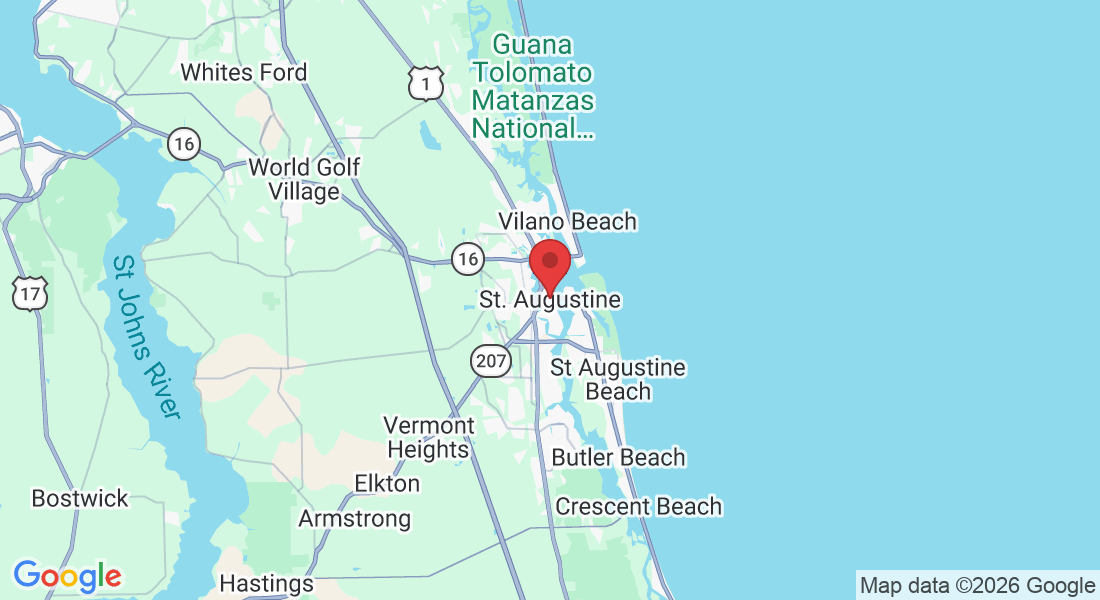
Address:
3515 Agricultural Center Drive
St. Augustine, FL 32092
Phone:
(904) 484-7580
Email:
Hours:
Monday - Friday: 8:00 AM - 5:00 PM
Saturday: By Appointment
Sunday: Closed
How Can We Help You?
Whether you're ready to schedule a free design consultation, have questions about our products, or need support with an existing installation—we're here for you.
Address:
3515 Agricultural Center Drive
St. Augustine, FL 32092
Phone:
(904) 484-7580
Email:
Hours:
Monday - Friday: 8:00 AM - 5:00 PM
Saturday: By Appointment
Sunday: Closed
Our Service Areas
We proudly serve homeowners throughout Northeast Florida's most beautiful communities.
Ready to transform your
outdoor living?
Quality craftsmanship. Year-round comfort. Stress-free process.
Stay Informed
Per the StoryBrand framework — a clear, simple plan (3-4 steps max) reduces decision anxiety.
The Paver Patterns and Materials That Increase (or Destroy) Your Home's Value
You are standing in a showroom the size of a small airplane hangar, and every surface is covered in squares. Travertine in tumbled ivory, porcelain in charcoal slate, concrete in something called "Tuscany Blend" that looks nothing like Tuscany and everything like the patio at the Olive Garden where your in-laws celebrated their anniversary last March. There are brick pavers in twelve shades of red. There are natural stone samples that weigh more than your toddler. There is a wall display labeled "2026 Trending Patterns" that features a geometric arrangement so aggressive it looks like the floor of a nightclub in Miami Beach. And somewhere in this visual avalanche, there is supposed to be the right answer for your outdoor room, the floor that will set the tone for the pergola above it, the Go-Fenetex retractable screens around it, and the furniture within it for the next twenty years.
Nobody told you that choosing pavers would feel like this. Nobody explained that the best paver patterns for patio design are not simply the ones that look attractive on a showroom wall, but the ones that scale correctly to the dimensions of your space, complement the architectural vocabulary of your home, resist the specific weathering patterns of your climate, and still look current a decade after the sealant has been reapplied for the third time. The showroom has three hundred options. You need one. And the distance between those two numbers is where most homeowners either make the decision that elevates their entire outdoor living space or the decision they quietly regret every time they walk outside.
[Explore Go-Fenetex Residential Solutions → https://gofenetex.com/residential]
The Catalog Problem: Why More Options Make Worse Decisions
Psychologist Barry Schwartz documented the phenomenon in his research on choice overload: when the number of available options exceeds the human capacity to evaluate them meaningfully, decision quality drops. Shoppers offered six varieties of jam were ten times more likely to purchase than shoppers offered twenty-four. The paver showroom is the twenty-four-jam scenario multiplied by a factor of twelve, and it produces exactly the response Schwartz predicted: paralysis, anxiety, and ultimately a decision driven by whichever sample happens to be closest to the exit or whichever salesperson happens to be the most persuasive on that particular Tuesday.
The antidote to choice overload in paver patio design ideas is not more information. It is a framework, a sequence of filters that reduces three hundred options to three. The framework starts not with the pavers but with the home itself, because the floor of your outdoor room must speak the same architectural language as the structure it extends.
[See Why Homeowners Choose Go-Fenetex → https://gofenetex.com/why-go-fenetex]
Material Science for Real Decisions
Every paver material has a personality, and that personality expresses itself not on day one when everything looks beautiful, but on year five when the climate has had its say. Understanding the best paver material for Florida weather, or for any subtropical or high-exposure environment, requires looking past the showroom sample and into the material's long-term behavior under UV exposure, thermal cycling, moisture absorption, and foot traffic.
Travertine
Travertine is a natural limestone formed in mineral springs, and it is among the most popular paver materials in Florida for a reason that has nothing to do with aesthetics: it stays cool. The stone's porous structure and light coloring give it one of the lowest surface temperatures of any paver material in direct sunlight, which matters enormously when the ambient temperature exceeds 90 degrees for five consecutive months. A travertine patio at 2 p.m. in July is 30 to 40 degrees cooler than a dark concrete paver at the same moment. Bare feet notice this difference instantly. Travertine is also naturally slip-resistant when wet, which matters for pool decks and patios that receive afternoon thunderstorms with regularity. The downsides are real: travertine is softer than porcelain or concrete, which means it can scratch and chip under heavy furniture or dropped objects. It is porous, which means spills can stain if the surface is not sealed. And the tumbled finish that gives travertine its characteristic warmth also means the surface is slightly uneven, which some homeowners find difficult to keep clean.
Porcelain
Porcelain pavers are the material that has transformed the outdoor flooring market in the past decade, and their advantages are almost aggressively practical. Porcelain is manufactured at extremely high temperatures, which produces a surface that is virtually impervious to moisture absorption (less than 0.5 percent), highly resistant to staining, dimensionally stable across temperature extremes, and available in a range of finishes that can convincingly replicate natural stone, wood, concrete, or virtually any surface texture. Porcelain pavers are thinner and lighter than concrete pavers, which can reduce base preparation requirements and installation labor. The downside is cost, which tends to be at the higher end of the paver spectrum, and the aesthetic risk that some porcelain finishes can look manufactured rather than natural under certain lighting conditions.
Concrete Pavers
Concrete pavers are the workhorses of the paver industry: durable, versatile, available in more shapes, sizes, colors, and patterns than any other material, and priced at a point that makes them accessible for larger installations. Modern concrete pavers bear little resemblance to the grey rectangles of twenty years ago; manufacturing advances have produced units with surface textures, color blending, and edge profiles that approach the appearance of natural stone at a fraction of the cost. The trade-off is that concrete pavers can absorb more moisture than porcelain, may require more frequent sealing in high-exposure environments, and some colors can fade under prolonged UV exposure, particularly reds and dark browns.
Brick
Brick pavers carry a timeless aesthetic that complements certain architectural styles, particularly colonial, craftsman, and traditional Southern homes, with an authenticity that no manufactured material can fully replicate. Brick ages beautifully, developing a patina that many homeowners find increasingly attractive over time. The limitation of brick in Florida is primarily functional: brick absorbs moisture, which in a high-humidity environment can encourage moss and algae growth, particularly in shaded areas. Brick is also limited in size and shape compared to concrete or porcelain, which restricts pattern options.
[Find a Go-Fenetex Dealer Near You → https://gofenetex.com/dealership]
Patterns That Work and Patterns That Date
The pattern you choose for your paver patio is as important as the material, because pattern determines how the eye reads the space, how the surface interacts with the architecture above it, and whether the design feels intentional or arbitrary at scale.
Herringbone
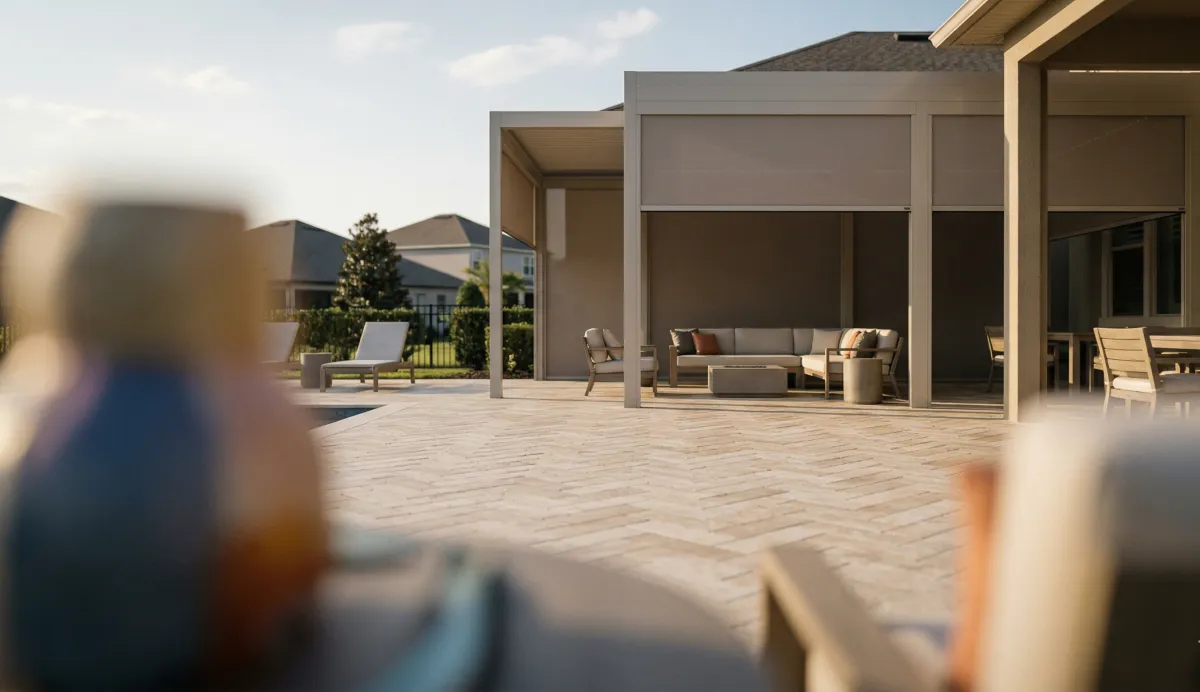
Herringbone is the pattern most recommended by landscape architects for large paver patios, and the reason is structural as much as aesthetic. The interlocking 45-degree or 90-degree arrangement of rectangular pavers creates a surface that resists shifting under load more effectively than any other pattern, which is why it is the standard for driveways and high-traffic commercial installations. Visually, herringbone creates a sense of movement and sophistication without competing with the architecture above it. It is the pattern most likely to complement a modern pergola and Go-Fenetex retractable screen installation, because its visual texture is active enough to be interesting but controlled enough not to clash with the linear geometry of overhead beams and vertical track channels.
Running Bond
Running bond, the pattern you recognize from every brick wall you have ever seen, is the simplest and most universally appropriate paver layout. Each row is offset by half the paver's length from the row below it, creating a staggered rhythm that is clean, unobtrusive, and scalable to any dimension. Running bond is the safe choice, and "safe" is not a criticism when the goal is a floor that supports rather than competes with the outdoor room above it. Modern paver patio design ideas often use running bond with large-format pavers (12x24 or larger) to create a contemporary, minimalist aesthetic.
Basketweave
Basketweave alternates pairs of pavers in perpendicular orientations, creating a woven texture that reads as traditional and decorative. It works beautifully on smaller patios and garden paths but can feel busy at the scale of a large outdoor room. Use it selectively, perhaps as a border or accent band within a larger running bond field, rather than as the primary pattern for a space that will also contain a pergola, screens, furniture, and a fire feature.
Random or Ashlar Patterns
Random patterns, which use multiple paver sizes arranged in a repeating or non-repeating layout, create a natural stone aesthetic that suits rustic, Mediterranean, and organic architectural styles. The risk with random patterns is that they can look genuinely random rather than intentionally designed if the size ratios and color blending are not carefully controlled.
[Explore Commercial Solutions by Go-Fenetex → https://gofenetex.com/commercial]
The Pergola and Screen Compatibility Factor
Here is the conversation that no showroom salesperson will initiate: the pavers you choose today set the visual foundation for every element that will exist above them. The pergola's column color, beam finish, and proportions must harmonize with the floor. The Go-Fenetex retractable screens, whether in insect mesh or vinyl, add their own visual layer, and the fabric color interacts with the paver tone beneath it. The furniture, the fire feature, the lighting, the plantings; everything exists in visual relationship to the floor. A paver choice that ignores this relationship produces a space where individual elements may be beautiful but the composition feels disjointed.
Warm-toned travertine pairs naturally with the warm metallic finishes common in aluminum pergolas, earth-toned furniture, and the neutral fabric tones of Go-Fenetex's screen options. Cool-toned grey porcelain suits modern, minimalist pergola designs with clean lines and monochromatic furniture schemes. Red brick demands careful attention to overhead material selection, because the visual warmth of brick can clash with certain metallic finishes. The best paver patterns for patio environments that will include a pergola and screens are the ones chosen with the complete visual composition in mind, not just the floor in isolation.
[See Go-Fenetex Home Page → https://gofenetex.com/home-page]
What Real Estate Data Says About Paver ROI
Do pavers increase home value? The data is consistent across multiple real estate studies: yes, and by more than most homeowners expect. The National Association of Realtors' 2023 Remodeling Impact Report found that outdoor living improvements, including hardscape patios, returned an estimated 75 to 100 percent of cost at resale, with professionally installed paver patios at the higher end of that range. In Florida and other Sunbelt markets where outdoor living is a primary lifestyle feature, the return can exceed 100 percent when the patio is part of a complete outdoor room that includes overhead structure and comfort systems.
The mechanism is not abstract. Real estate listing photographs of homes with defined outdoor rooms, pavers underfoot, pergola overhead, screens visible, generate measurably higher engagement than listings with bare concrete patios. Buyers see the outdoor room and mentally add it to the home's living space. They see the bare patio and mentally subtract it. The paver floor is the first visual signal that this outdoor space was designed, not defaulted.
[Explore Residential Retractable Screens → https://gofenetex.com/residential]
A Decision Framework, Not a Catalog
Stop looking at three hundred samples. Start with four questions. First: what is the architectural style of your home? Match the paver material and color to the existing visual vocabulary. Second: what climate conditions will the pavers endure? In Florida, prioritize low heat absorption, moisture resistance, and UV stability. Third: what is the scale of the space? Large patios need patterns that read well at distance; small patios need patterns that do not overwhelm. Fourth: what will exist above and around the pavers? The pergola, the screens, the furniture, the lighting. The floor sets the tone. Everything else harmonizes with it.
These four filters will reduce three hundred options to fewer than ten. From there, the decision becomes personal preference rather than paralysis.
The floor is chosen. The foundation is engineered. The material complements the home. Now the eye travels upward, past the paver surface, past the furniture, past the fire feature, to the empty sky above. The floor is beautiful. But it is still a floor. What transforms it into a room is the structure overhead, the pergola that provides shade, definition, and the mounting platform for every comfort system the outdoor room will eventually need. That structure is the subject of our next article, and it is the decision that changes everything about how the space performs.
Start exploring the complete outdoor living ecosystem at NextGen Screens
Discover Onetrack's motorized screen systems at Onetrack Screens
Learn about hurricane-rated protection with Maxforce Screens

Stay Informed
Per the StoryBrand framework — a clear, simple plan (3-4 steps max) reduces decision anxiety.
The Paver Patterns and Materials That Increase (or Destroy) Your Home's Value
You are standing in a showroom the size of a small airplane hangar, and every surface is covered in squares. Travertine in tumbled ivory, porcelain in charcoal slate, concrete in something called "Tuscany Blend" that looks nothing like Tuscany and everything like the patio at the Olive Garden where your in-laws celebrated their anniversary last March. There are brick pavers in twelve shades of red. There are natural stone samples that weigh more than your toddler. There is a wall display labeled "2026 Trending Patterns" that features a geometric arrangement so aggressive it looks like the floor of a nightclub in Miami Beach. And somewhere in this visual avalanche, there is supposed to be the right answer for your outdoor room, the floor that will set the tone for the pergola above it, the Go-Fenetex retractable screens around it, and the furniture within it for the next twenty years.
Nobody told you that choosing pavers would feel like this. Nobody explained that the best paver patterns for patio design are not simply the ones that look attractive on a showroom wall, but the ones that scale correctly to the dimensions of your space, complement the architectural vocabulary of your home, resist the specific weathering patterns of your climate, and still look current a decade after the sealant has been reapplied for the third time. The showroom has three hundred options. You need one. And the distance between those two numbers is where most homeowners either make the decision that elevates their entire outdoor living space or the decision they quietly regret every time they walk outside.
[Explore Go-Fenetex Residential Solutions → https://gofenetex.com/residential]
The Catalog Problem: Why More Options Make Worse Decisions
Psychologist Barry Schwartz documented the phenomenon in his research on choice overload: when the number of available options exceeds the human capacity to evaluate them meaningfully, decision quality drops. Shoppers offered six varieties of jam were ten times more likely to purchase than shoppers offered twenty-four. The paver showroom is the twenty-four-jam scenario multiplied by a factor of twelve, and it produces exactly the response Schwartz predicted: paralysis, anxiety, and ultimately a decision driven by whichever sample happens to be closest to the exit or whichever salesperson happens to be the most persuasive on that particular Tuesday.
The antidote to choice overload in paver patio design ideas is not more information. It is a framework, a sequence of filters that reduces three hundred options to three. The framework starts not with the pavers but with the home itself, because the floor of your outdoor room must speak the same architectural language as the structure it extends.
[See Why Homeowners Choose Go-Fenetex → https://gofenetex.com/why-go-fenetex]
Material Science for Real Decisions
Every paver material has a personality, and that personality expresses itself not on day one when everything looks beautiful, but on year five when the climate has had its say. Understanding the best paver material for Florida weather, or for any subtropical or high-exposure environment, requires looking past the showroom sample and into the material's long-term behavior under UV exposure, thermal cycling, moisture absorption, and foot traffic.
Travertine
Travertine is a natural limestone formed in mineral springs, and it is among the most popular paver materials in Florida for a reason that has nothing to do with aesthetics: it stays cool. The stone's porous structure and light coloring give it one of the lowest surface temperatures of any paver material in direct sunlight, which matters enormously when the ambient temperature exceeds 90 degrees for five consecutive months. A travertine patio at 2 p.m. in July is 30 to 40 degrees cooler than a dark concrete paver at the same moment. Bare feet notice this difference instantly. Travertine is also naturally slip-resistant when wet, which matters for pool decks and patios that receive afternoon thunderstorms with regularity. The downsides are real: travertine is softer than porcelain or concrete, which means it can scratch and chip under heavy furniture or dropped objects. It is porous, which means spills can stain if the surface is not sealed. And the tumbled finish that gives travertine its characteristic warmth also means the surface is slightly uneven, which some homeowners find difficult to keep clean.
Porcelain
Porcelain pavers are the material that has transformed the outdoor flooring market in the past decade, and their advantages are almost aggressively practical. Porcelain is manufactured at extremely high temperatures, which produces a surface that is virtually impervious to moisture absorption (less than 0.5 percent), highly resistant to staining, dimensionally stable across temperature extremes, and available in a range of finishes that can convincingly replicate natural stone, wood, concrete, or virtually any surface texture. Porcelain pavers are thinner and lighter than concrete pavers, which can reduce base preparation requirements and installation labor. The downside is cost, which tends to be at the higher end of the paver spectrum, and the aesthetic risk that some porcelain finishes can look manufactured rather than natural under certain lighting conditions.
Concrete Pavers
Concrete pavers are the workhorses of the paver industry: durable, versatile, available in more shapes, sizes, colors, and patterns than any other material, and priced at a point that makes them accessible for larger installations. Modern concrete pavers bear little resemblance to the grey rectangles of twenty years ago; manufacturing advances have produced units with surface textures, color blending, and edge profiles that approach the appearance of natural stone at a fraction of the cost. The trade-off is that concrete pavers can absorb more moisture than porcelain, may require more frequent sealing in high-exposure environments, and some colors can fade under prolonged UV exposure, particularly reds and dark browns.
Brick
Brick pavers carry a timeless aesthetic that complements certain architectural styles, particularly colonial, craftsman, and traditional Southern homes, with an authenticity that no manufactured material can fully replicate. Brick ages beautifully, developing a patina that many homeowners find increasingly attractive over time. The limitation of brick in Florida is primarily functional: brick absorbs moisture, which in a high-humidity environment can encourage moss and algae growth, particularly in shaded areas. Brick is also limited in size and shape compared to concrete or porcelain, which restricts pattern options.
[Find a Go-Fenetex Dealer Near You → https://gofenetex.com/dealership]
Patterns That Work and Patterns That Date
The pattern you choose for your paver patio is as important as the material, because pattern determines how the eye reads the space, how the surface interacts with the architecture above it, and whether the design feels intentional or arbitrary at scale.
Herringbone
Herringbone is the pattern most recommended by landscape architects for large paver patios, and the reason is structural as much as aesthetic. The interlocking 45-degree or 90-degree arrangement of rectangular pavers creates a surface that resists shifting under load more effectively than any other pattern, which is why it is the standard for driveways and high-traffic commercial installations. Visually, herringbone creates a sense of movement and sophistication without competing with the architecture above it. It is the pattern most likely to complement a modern pergola and Go-Fenetex retractable screen installation, because its visual texture is active enough to be interesting but controlled enough not to clash with the linear geometry of overhead beams and vertical track channels.
Running Bond
Running bond, the pattern you recognize from every brick wall you have ever seen, is the simplest and most universally appropriate paver layout. Each row is offset by half the paver's length from the row below it, creating a staggered rhythm that is clean, unobtrusive, and scalable to any dimension. Running bond is the safe choice, and "safe" is not a criticism when the goal is a floor that supports rather than competes with the outdoor room above it. Modern paver patio design ideas often use running bond with large-format pavers (12x24 or larger) to create a contemporary, minimalist aesthetic.
Basketweave
Basketweave alternates pairs of pavers in perpendicular orientations, creating a woven texture that reads as traditional and decorative. It works beautifully on smaller patios and garden paths but can feel busy at the scale of a large outdoor room. Use it selectively, perhaps as a border or accent band within a larger running bond field, rather than as the primary pattern for a space that will also contain a pergola, screens, furniture, and a fire feature.
Random or Ashlar Patterns
Random patterns, which use multiple paver sizes arranged in a repeating or non-repeating layout, create a natural stone aesthetic that suits rustic, Mediterranean, and organic architectural styles. The risk with random patterns is that they can look genuinely random rather than intentionally designed if the size ratios and color blending are not carefully controlled.
[Explore Commercial Solutions by Go-Fenetex → https://gofenetex.com/commercial]
The Pergola and Screen Compatibility Factor
Here is the conversation that no showroom salesperson will initiate: the pavers you choose today set the visual foundation for every element that will exist above them. The pergola's column color, beam finish, and proportions must harmonize with the floor. The Go-Fenetex retractable screens, whether in insect mesh or vinyl, add their own visual layer, and the fabric color interacts with the paver tone beneath it. The furniture, the fire feature, the lighting, the plantings; everything exists in visual relationship to the floor. A paver choice that ignores this relationship produces a space where individual elements may be beautiful but the composition feels disjointed.
Warm-toned travertine pairs naturally with the warm metallic finishes common in aluminum pergolas, earth-toned furniture, and the neutral fabric tones of Go-Fenetex's screen options. Cool-toned grey porcelain suits modern, minimalist pergola designs with clean lines and monochromatic furniture schemes. Red brick demands careful attention to overhead material selection, because the visual warmth of brick can clash with certain metallic finishes. The best paver patterns for patio environments that will include a pergola and screens are the ones chosen with the complete visual composition in mind, not just the floor in isolation.
[See Go-Fenetex Home Page → https://gofenetex.com/home-page]
What Real Estate Data Says About Paver ROI
Do pavers increase home value? The data is consistent across multiple real estate studies: yes, and by more than most homeowners expect. The National Association of Realtors' 2023 Remodeling Impact Report found that outdoor living improvements, including hardscape patios, returned an estimated 75 to 100 percent of cost at resale, with professionally installed paver patios at the higher end of that range. In Florida and other Sunbelt markets where outdoor living is a primary lifestyle feature, the return can exceed 100 percent when the patio is part of a complete outdoor room that includes overhead structure and comfort systems.
The mechanism is not abstract. Real estate listing photographs of homes with defined outdoor rooms, pavers underfoot, pergola overhead, screens visible, generate measurably higher engagement than listings with bare concrete patios. Buyers see the outdoor room and mentally add it to the home's living space. They see the bare patio and mentally subtract it. The paver floor is the first visual signal that this outdoor space was designed, not defaulted.
[Explore Residential Retractable Screens → https://gofenetex.com/residential]
A Decision Framework, Not a Catalog
Stop looking at three hundred samples. Start with four questions. First: what is the architectural style of your home? Match the paver material and color to the existing visual vocabulary. Second: what climate conditions will the pavers endure? In Florida, prioritize low heat absorption, moisture resistance, and UV stability. Third: what is the scale of the space? Large patios need patterns that read well at distance; small patios need patterns that do not overwhelm. Fourth: what will exist above and around the pavers? The pergola, the screens, the furniture, the lighting. The floor sets the tone. Everything else harmonizes with it.
These four filters will reduce three hundred options to fewer than ten. From there, the decision becomes personal preference rather than paralysis.
The floor is chosen. The foundation is engineered. The material complements the home. Now the eye travels upward, past the paver surface, past the furniture, past the fire feature, to the empty sky above. The floor is beautiful. But it is still a floor. What transforms it into a room is the structure overhead, the pergola that provides shade, definition, and the mounting platform for every comfort system the outdoor room will eventually need. That structure is the subject of our next article, and it is the decision that changes everything about how the space performs.
Start exploring the complete outdoor living ecosystem at NextGen Screens
Discover Onetrack's motorized screen systems at Onetrack Screens
Learn about hurricane-rated protection with Maxforce Screens


COMPANY
OUR PRODUCTS
SERVICE AREAS
SUPPORT
Copyright 2026. Titan Outdoor Solution.All Rights Reserved.