
Contact Titan Outdoor Solutions
Ready to extend your outdoor living space? Let's talk about what's possible for your home.
How Can We Help You?
Whether you're ready to schedule a free design consultation, have questions about our products, or need support with an existing installation—we're here for you.
Address:
3515 Agricultural Center Drive
St. Augustine, FL 32092
Phone:
(904) 484-7580
Email:
Hours:
Monday - Friday: 8:00 AM - 5:00 PM
Saturday: By Appointment
Sunday: Closed
How Can We Help You?
Whether you're ready to schedule a free design consultation, have questions about our products, or need support with an existing installation—we're here for you.
Address:
3515 Agricultural Center Drive
St. Augustine, FL 32092
Phone:
(904) 484-7580
Email:
Hours:
Monday - Friday: 8:00 AM - 5:00 PM
Saturday: By Appointment
Sunday: Closed
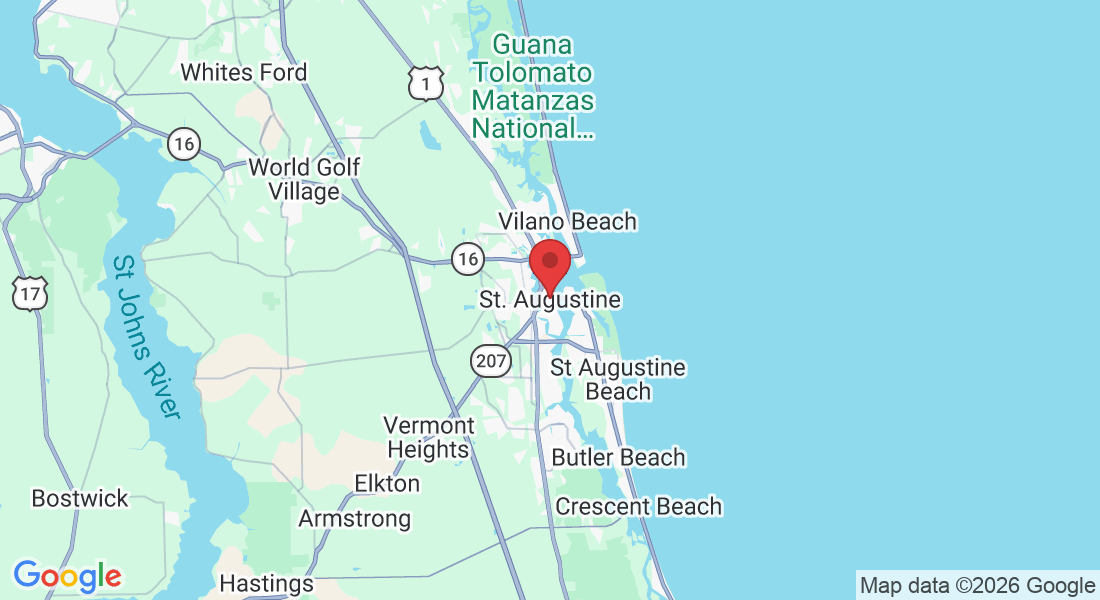
Our Service Areas
We proudly serve homeowners throughout Northeast Florida's most beautiful communities.
Ready to transform your
outdoor living?
Quality craftsmanship. Year-round comfort. Stress-free process.
Stay Informed
Per the StoryBrand framework — a clear, simple plan (3-4 steps max) reduces decision anxiety.
Hurricane Season Is Coming Is Your St. Augustine Home Ready?
Preparing your home for hurricane season in Northeast Florida starts with one honest assessment: which openings are protected, and which are not.
For homeowners in St. Augustine, Nocatee, Ponte Vedra Beach, and the surrounding St. Johns and Flagler County communities, that assessment should happen in April — not June. Hurricane season runs from June 1 through November 30. Custom-built protection systems, including aluminum hurricane shutters and motorized screens rated for hurricane protection in Florida, carry lead times of 60 to 90 days. That means the window to act before the season opens is right now.
This is not a warning designed to alarm you. It is a timeline designed to protect you.
The Clock That Runs Every Year
Every April, a familiar tension settles over coastal Florida. The weather is still forgiving — warm mornings, manageable afternoons, the last weeks before the humidity arrives in full force. But for homeowners who have lived through a real storm in Northeast Florida, April carries a weight that visitors never feel.
Hurricane Matthew made landfall in October 2016 as a Category 3. It tracked parallel to the First Coast, close enough to cause catastrophic damage without a direct hit. In Ponte Vedra Beach, storm surge damaged more than 200 homes. A section of A1A — the evacuation route running along the coast — was washed away entirely. Jacksonville flooded. The storm left more than a million Floridians without power and caused roughly $10 billion in damage across the region.
Hurricane Milton struck Florida's west coast in October 2024. Flagler County, well east of the direct landfall, still absorbed an estimated $18.8 million in damages from storm surge, dune erosion, and coastal flooding. Dunes that communities in Palm Coast had spent years rebuilding were gone overnight.
Neither storm made a direct hit on St. Augustine. Both caused real, lasting damage to communities across Northeast Florida. The next one will not ask for your permission first.
This is the context in which April matters. Not as a month of anxiety — but as a month of opportunity. The homeowners who invest in hurricane prep in St. Augustine FL and across St. Johns County now are the ones who face storm season with something most of their neighbors will not have: genuine confidence.
What Northeast Florida Homeowners Are Actually Facing
The threat in this part of Florida is not hypothetical. St. Johns County sits between the Atlantic Ocean and the Intracoastal Waterway, a geography that makes it uniquely vulnerable to storm surge from the east and river flooding from the west. Ponte Vedra Beach, Vilano Beach, Anastasia Island, and the A1A corridor fall inside evacuation zones A and B — the highest-risk classifications in St. Johns County Emergency Management's system.
Inland communities like Nocatee, World Golf Village, and Silverleaf are better buffered from surge. But they are not immune to hurricane season in Northeast Florida. Wind-borne debris travels regardless of elevation. Power outages can last days. And the anxiety of a named storm tracking up the Florida coast affects every homeowner in this region, from the oceanfront properties in Crescent Beach to the new construction neighborhoods off Nocatee Parkway.
What most homeowners lack is not awareness of the risk. It is a plan.
They have watched the weather app. They have tracked storms that turned north at the last minute. They have made it through another season unscathed and filed it away as evidence that they have time. And then one year, the storm does not turn.
The homeowners who get caught unprepared are rarely careless. They are usually people who assumed they had more time. In a market where custom-built storm protection systems carry 60 to 90-day lead times, time is the one resource you cannot manufacture on short notice.
Two Lines of Defense — Not One
Here is where most conversations about storm protection on the First Coast oversimplify things.
The standard advice is: get shutters. And aluminum hurricane shutters — accordion, roll-down, or panel — are absolutely the right answer for windows and doors. Hurricane shutters in St. Johns County remain the gold standard for protecting primary openings from wind pressure and impact debris. But a Florida home has other vulnerabilities that rigid shutters were never designed to address. Lanais. Large patio openings. Pergolas. Covered outdoor kitchens with glass sliders behind them. These spaces, which represent a meaningful share of a home's livable square footage in Northeast Florida, require a different kind of thinking.
That is where motorized screens enter the conversation — and where the real hurricane preparedness strategy for St. Augustine FL homeowners begins to take shape.
Titan Outdoor Solutions installs both. We are a dealer and factory installer for AHT aluminum hurricane shutters — one of the most trusted names in Florida storm protection — and for Fenetex motorized retractable screens, a system we have specialized in since our founding. We are not in the business of selling one product when a home needs two. Understanding the difference between them, and knowing which openings each is built for, is the foundation of a real storm plan.
Aluminum Hurricane Shutters: The Foundation of Storm Protection
Aluminum hurricane shutters are the foundation of any serious storm protection plan for homes across St. Augustine, Jacksonville, and the broader First Coast. They protect windows and doors from the two primary threats in a hurricane: sustained wind pressure and impact from airborne debris.
When a major storm approaches, the most dangerous moment is not the sustained wind itself. It is when a single opening is breached. A window shatters. A door fails. The pressure differential inside the home changes immediately, and the risk of structural damage escalates sharply. Properly rated aluminum shutters prevent that breach from happening.
In Northeast Florida, the governing standard is the Florida Building Code, which sets wind load ratings and impact resistance requirements for all hurricane protection products sold in coastal communities. AHT shutters carry Florida Product Approval numbers — verifiable credentials confirming they have been tested to the code standards required in St. Johns, Duval, and Flagler counties.
There is also a financial dimension that most homeowners underestimate. Florida Statute §627.0629 requires insurance carriers to offer premium discounts for verified wind mitigation features. Aluminum shutters qualify. A wind mitigation inspection can result in savings typically ranging from 10 to 30 percent on the wind and hurricane portion of your premium. In St. Johns County — where home values and insurance costs are among the highest in the state — that discount represents real money, year after year.
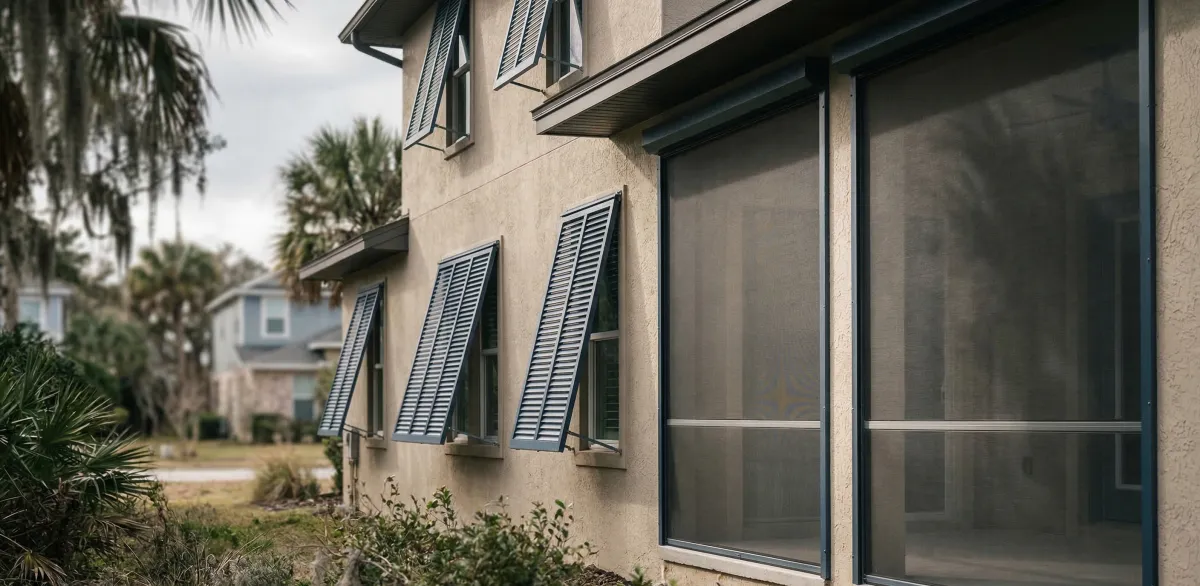
Titan installs roll-down shutters for motorized convenience on large openings and second-story windows, accordion shutters for homes in Ponte Vedra Beach and Nocatee that prefer a permanently mounted, easy-deploy solution, and Bahama and colonial shutters for homeowners in HOA communities where curb appeal and code compliance need to coexist.
Motorized Screens: The Everyday Protector That Also Fights Storms
Motorized retractable screens serve a different purpose — and it is worth being honest about exactly what they are and what they are not.
A motorized screen is not a replacement for an aluminum shutter on a window or a primary entry door. Motorized screens and hurricane shutters serve different roles in a Florida home's defense system. However, a motorized screen is the right solution for a lanai, a covered patio, a StruXure pergola opening, or any large open-air area where a rigid shutter is either impractical or architecturally out of place. And unlike a shutter, a motorized screen does something every day: it makes your outdoor space genuinely usable, not just protected.
The Fenetex motorized hurricane screens Titan installs are built on a self-adjusting tension mechanism that keeps the fabric taut and functional through wind, rain, and Florida's relentless UV exposure. The hurricane-rated Fenetex fabric is engineered from OmegaTex — the same aramid fiber technology used in body armor. It blocks 91 percent of UV rays, resists wind-borne debris, and deploys or retracts at the press of a single button, or through a smart home app integrated with Alexa, Google Home, or Somfy.
Before a storm, a motorized screen deploys to protect your lanai furniture, your outdoor kitchen appliances, and the large sliding glass doors behind the opening. After the storm, it retracts — and your outdoor space is intact. No rescreening bill. No structural repairs from mesh that behaved like a sail in high winds.
That last point is worth staying on. Traditional fixed screen enclosures — the aluminum-framed cages that surround many Northeast Florida pools and patios — are not hurricane rated. Their mesh acts as a sail in high winds, placing enormous structural stress on the frame. Most contractors advise cutting the screens before a major storm and paying for rescreening afterward. That cycle typically costs between $2,000 and $8,000 per event, depending on the size of the enclosure.
A motorized screen retracts before the storm. It protects itself. That is a meaningful operational and financial difference for every homeowner preparing for hurricane season in Northeast Florida.
The Combination Most Northeast Florida Homeowners Don't Know About
The most effective storm plan for a Northeast Florida home is not all shutters or all screens. It is a thoughtful combination of both, matched to the specific architecture and exposure of each opening. This is what genuine hurricane prep in St. Augustine FL looks like — not a single product, but a system.
A typical Titan installation in St. Johns County looks something like this: roll-down aluminum shutters on the windows and primary entry doors, Fenetex hurricane-rated motorized screens on the lanai and rear patio openings, and motorized screens paired with a StruXure pergola for homeowners who have invested in an outdoor living area they want to protect and enjoy year-round. Each product is doing the job it was designed to do. Nothing is asked to perform outside its capability.
This approach does three things simultaneously:
It provides code-compliant, Florida Building Code-approved protection for the primary openings that carry the highest structural risk. It gives outdoor living areas — including outdoor kitchens, outdoor fireplaces, and covered patios — a deployable screen system that protects furniture, framing, and adjacent glass without requiring disassembly before a storm. And it delivers a daily lifestyle benefit — bug protection, UV blocking, privacy control, wind management — that makes the investment functional every month of the year, not only during hurricane season.
Because Titan installs both systems, we design a single, cohesive protection plan. You are not coordinating between two contractors with different installation windows and different approaches to your home. You can see examples of our completed projects in our project gallery and video gallery.
The Lead Time Reality: Why April Is the Preparation Window
This is the part of the conversation that most contractors avoid, because it can sound like a sales pressure tactic. We say it plainly because it is simply true — and because understanding hurricane shutter installation lead times in St. Augustine is the difference between being protected by June 1 and being on a waiting list.
Aluminum shutters are custom-built to fit each opening on a specific home. Accordion and roll-down systems carry lead times of 60 to 90 days from deposit to completed installation. Motorized screen systems, which are also fabricated to order, carry lead times of approximately 90 days. Permits are required for permanent hurricane protection installations across Florida, adding additional scheduling time.
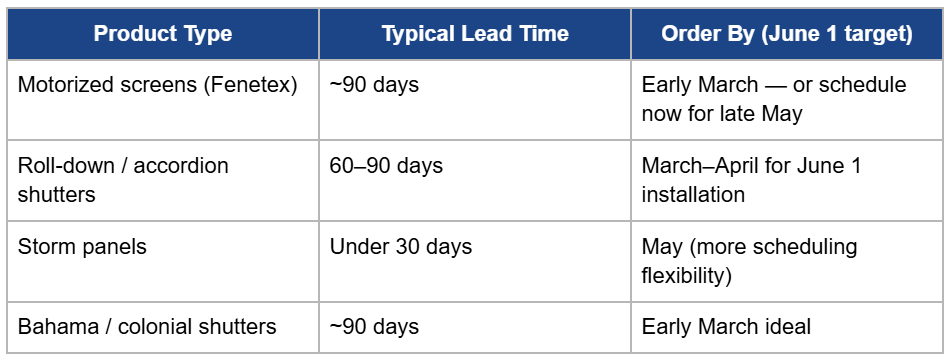
June 1 is 60 days from April 1. Homeowners who start the process in early April get their systems installed before hurricane season opens. Homeowners who call in May get them installed during the season — with some exposure in the gap. Homeowners who call in June receive a quote, a proposal, and a wait.
This is not pressure. It is a supply chain reality the installation industry navigates every year. And it applies equally whether you are in Jacksonville, Palm Coast, or the barrier islands along the First Coast.
A Note on HOAs in Nocatee, Ponte Vedra, and Master-Planned Communities
One of the most consistent questions we receive from homeowners in Nocatee, Ponte Vedra Beach, Coastal Oaks, and similar master-planned communities across St. Johns County is whether their HOA will allow hurricane shutters or motorized screens.
Florida House Bill 293, which took effect in 2024, changed this dynamic significantly. Under HB 293, homeowners associations — regardless of when they were established — are required to adopt hurricane protection specifications for all structures in their community. More importantly, HOAs can no longer deny a homeowner the right to install code-compliant hurricane protection. They may regulate the color and style to maintain community aesthetic standards. They may not prevent the installation itself.
If you have previously been told that your HOA restricts hurricane shutters or motorized screens for hurricane protection in Florida, that conversation is worth revisiting. The law has changed. We are happy to provide documentation to support your HOA approval process, and we have extensive experience navigating the requirements of the major communities in this market — from Nocatee's Crosswater and Coastal Oaks to Ponte Vedra Beach's oceanfront HOAs.
The primary objection that kept many Nocatee and Ponte Vedra homeowners from moving forward — "my HOA won't allow it" — no longer applies in the way it once did.
What to Do Right Now
The most useful thing you can do today is a simple walk-through of your property. Look at every opening with fresh eyes — and consider what a pre-season hurricane home assessment in St. Johns County would reveal.
Start with the windows and exterior doors on all four sides of the home. Then look at the lanai, the patio, any covered outdoor area with large openings or sliding glass doors behind it. If you have a StruXure pergola or an outdoor kitchen, look at how those spaces connect to the home — and what happens to them in a Category 2 or 3 event. Then look at any screen enclosure currently protecting your pool or patio — and ask whether it is actually rated for hurricane conditions, or whether it is a liability waiting for the next named storm.
As you walk, ask yourself three questions:
Which openings are unprotected, or protected only by a fixed screen enclosure that carries no hurricane rating?
Which openings would cause the most structural and water damage if they were breached during a major storm?
What have I already invested in my outdoor living space — the furniture, the kitchen, the outdoor fireplace, the pergola, the travertine patio — and what would it cost me if a storm I could have prepared for took it all?
Those three questions will tell you where to start. Then call us.
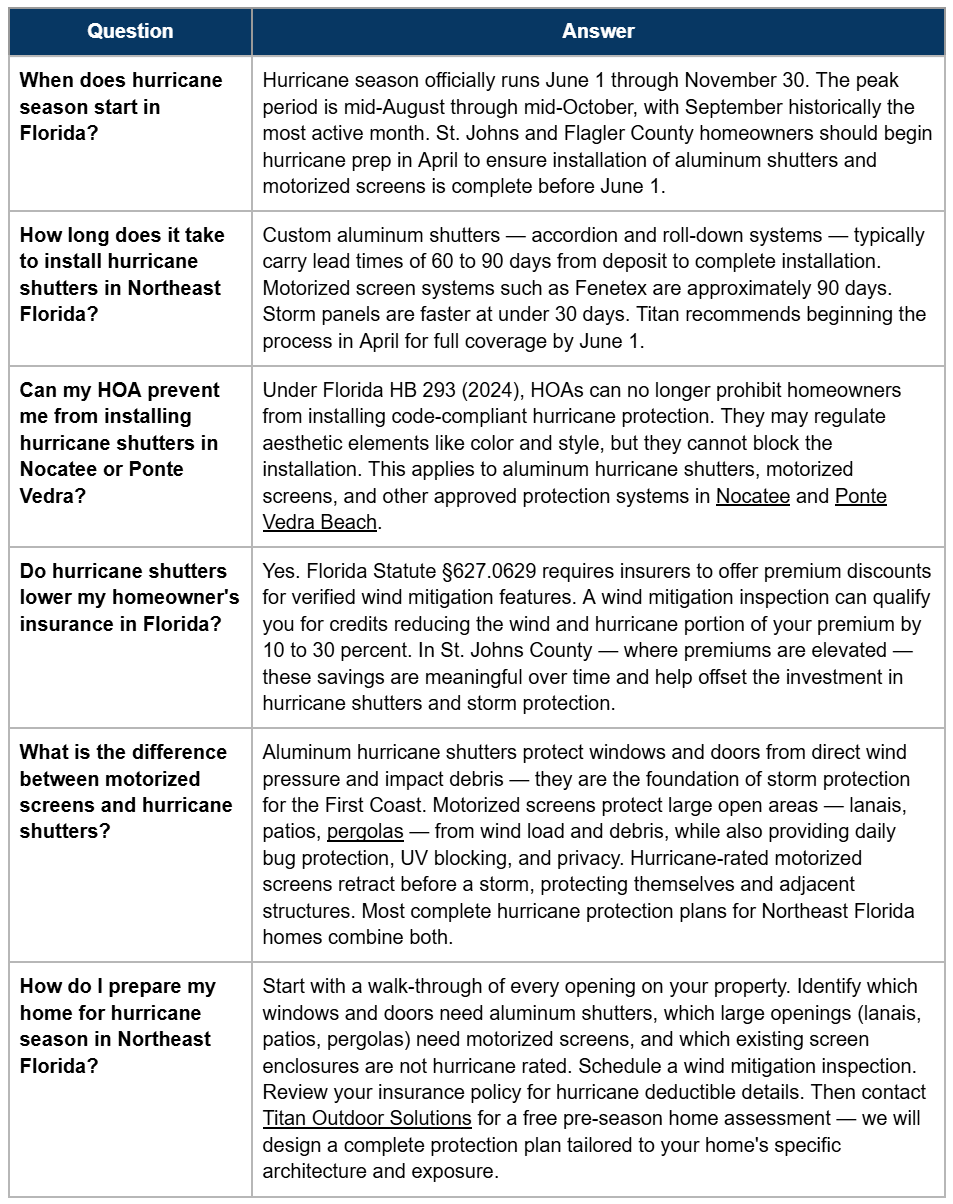
Titan Outdoor Solutions offers a free, no-obligation home assessment — typically 30 to 45 minutes — in which one of our installation specialists walks through your property with you, identifies the openings that carry the most risk, and presents a custom protection plan covering both your storm exposure and your outdoor living needs. We install both shutters and screens. We will tell you honestly which product is right for each opening, because our goal is to design a system you can rely on — not to sell you something you do not need.
What there is, alongside no obligation, is a limited window in the installation calendar. The homeowners who act in April are the ones who face June 1 with their homes protected.
Schedule Your Free Pre-Season Home Assessment
Serving St. Augustine · Nocatee · Ponte Vedra Beach · Palm Coast · Jacksonville · Northeast Florida
We walk through your property, identify every unprotected opening, and build a custom plan — at no cost, no obligation. Installation slots are filling now for May and June.
Call or text: (904) 484-7580 | TitanOutdoorSolution.com

Stay Informed
Per the StoryBrand framework — a clear, simple plan (3-4 steps max) reduces decision anxiety.
Hurricane Season Is Coming Is Your St. Augustine Home Ready?
Preparing your home for hurricane season in Northeast Florida starts with one honest assessment: which openings are protected, and which are not.
For homeowners in St. Augustine, Nocatee, Ponte Vedra Beach, and the surrounding St. Johns and Flagler County communities, that assessment should happen in April — not June. Hurricane season runs from June 1 through November 30. Custom-built protection systems, including aluminum hurricane shutters and motorized screens rated for hurricane protection in Florida, carry lead times of 60 to 90 days. That means the window to act before the season opens is right now.
This is not a warning designed to alarm you. It is a timeline designed to protect you.
The Clock That Runs Every Year
Every April, a familiar tension settles over coastal Florida. The weather is still forgiving — warm mornings, manageable afternoons, the last weeks before the humidity arrives in full force. But for homeowners who have lived through a real storm in Northeast Florida, April carries a weight that visitors never feel.
Hurricane Matthew made landfall in October 2016 as a Category 3. It tracked parallel to the First Coast, close enough to cause catastrophic damage without a direct hit. In Ponte Vedra Beach, storm surge damaged more than 200 homes. A section of A1A — the evacuation route running along the coast — was washed away entirely. Jacksonville flooded. The storm left more than a million Floridians without power and caused roughly $10 billion in damage across the region.
Hurricane Milton struck Florida's west coast in October 2024. Flagler County, well east of the direct landfall, still absorbed an estimated $18.8 million in damages from storm surge, dune erosion, and coastal flooding. Dunes that communities in Palm Coast had spent years rebuilding were gone overnight.
Neither storm made a direct hit on St. Augustine. Both caused real, lasting damage to communities across Northeast Florida. The next one will not ask for your permission first.
This is the context in which April matters. Not as a month of anxiety — but as a month of opportunity. The homeowners who invest in hurricane prep in St. Augustine FL and across St. Johns County now are the ones who face storm season with something most of their neighbors will not have: genuine confidence.
What Northeast Florida Homeowners Are Actually Facing
The threat in this part of Florida is not hypothetical. St. Johns County sits between the Atlantic Ocean and the Intracoastal Waterway, a geography that makes it uniquely vulnerable to storm surge from the east and river flooding from the west. Ponte Vedra Beach, Vilano Beach, Anastasia Island, and the A1A corridor fall inside evacuation zones A and B — the highest-risk classifications in St. Johns County Emergency Management's system.
Inland communities like Nocatee, World Golf Village, and Silverleaf are better buffered from surge. But they are not immune to hurricane season in Northeast Florida. Wind-borne debris travels regardless of elevation. Power outages can last days. And the anxiety of a named storm tracking up the Florida coast affects every homeowner in this region, from the oceanfront properties in Crescent Beach to the new construction neighborhoods off Nocatee Parkway.
What most homeowners lack is not awareness of the risk. It is a plan.
They have watched the weather app. They have tracked storms that turned north at the last minute. They have made it through another season unscathed and filed it away as evidence that they have time. And then one year, the storm does not turn.
The homeowners who get caught unprepared are rarely careless. They are usually people who assumed they had more time. In a market where custom-built storm protection systems carry 60 to 90-day lead times, time is the one resource you cannot manufacture on short notice.
Two Lines of Defense — Not One
Here is where most conversations about storm protection on the First Coast oversimplify things.
The standard advice is: get shutters. And aluminum hurricane shutters — accordion, roll-down, or panel — are absolutely the right answer for windows and doors. Hurricane shutters in St. Johns County remain the gold standard for protecting primary openings from wind pressure and impact debris. But a Florida home has other vulnerabilities that rigid shutters were never designed to address. Lanais. Large patio openings. Pergolas. Covered outdoor kitchens with glass sliders behind them. These spaces, which represent a meaningful share of a home's livable square footage in Northeast Florida, require a different kind of thinking.
That is where motorized screens enter the conversation — and where the real hurricane preparedness strategy for St. Augustine FL homeowners begins to take shape.
Titan Outdoor Solutions installs both. We are a dealer and factory installer for AHT aluminum hurricane shutters — one of the most trusted names in Florida storm protection — and for Fenetex motorized retractable screens, a system we have specialized in since our founding. We are not in the business of selling one product when a home needs two. Understanding the difference between them, and knowing which openings each is built for, is the foundation of a real storm plan.
Aluminum Hurricane Shutters: The Foundation of Storm Protection
Aluminum hurricane shutters are the foundation of any serious storm protection plan for homes across St. Augustine, Jacksonville, and the broader First Coast. They protect windows and doors from the two primary threats in a hurricane: sustained wind pressure and impact from airborne debris.
When a major storm approaches, the most dangerous moment is not the sustained wind itself. It is when a single opening is breached. A window shatters. A door fails. The pressure differential inside the home changes immediately, and the risk of structural damage escalates sharply. Properly rated aluminum shutters prevent that breach from happening.
In Northeast Florida, the governing standard is the Florida Building Code, which sets wind load ratings and impact resistance requirements for all hurricane protection products sold in coastal communities. AHT shutters carry Florida Product Approval numbers — verifiable credentials confirming they have been tested to the code standards required in St. Johns, Duval, and Flagler counties.
There is also a financial dimension that most homeowners underestimate. Florida Statute §627.0629 requires insurance carriers to offer premium discounts for verified wind mitigation features. Aluminum shutters qualify. A wind mitigation inspection can result in savings typically ranging from 10 to 30 percent on the wind and hurricane portion of your premium. In St. Johns County — where home values and insurance costs are among the highest in the state — that discount represents real money, year after year.
Titan installs roll-down shutters for motorized convenience on large openings and second-story windows, accordion shutters for homes in Ponte Vedra Beach and Nocatee that prefer a permanently mounted, easy-deploy solution, and Bahama and colonial shutters for homeowners in HOA communities where curb appeal and code compliance need to coexist.
Motorized Screens: The Everyday Protector That Also Fights Storms
Motorized retractable screens serve a different purpose — and it is worth being honest about exactly what they are and what they are not.
A motorized screen is not a replacement for an aluminum shutter on a window or a primary entry door. Motorized screens and hurricane shutters serve different roles in a Florida home's defense system. However, a motorized screen is the right solution for a lanai, a covered patio, a StruXure pergola opening, or any large open-air area where a rigid shutter is either impractical or architecturally out of place. And unlike a shutter, a motorized screen does something every day: it makes your outdoor space genuinely usable, not just protected.
The Fenetex motorized hurricane screens Titan installs are built on a self-adjusting tension mechanism that keeps the fabric taut and functional through wind, rain, and Florida's relentless UV exposure. The hurricane-rated Fenetex fabric is engineered from OmegaTex — the same aramid fiber technology used in body armor. It blocks 91 percent of UV rays, resists wind-borne debris, and deploys or retracts at the press of a single button, or through a smart home app integrated with Alexa, Google Home, or Somfy.
Before a storm, a motorized screen deploys to protect your lanai furniture, your outdoor kitchen appliances, and the large sliding glass doors behind the opening. After the storm, it retracts — and your outdoor space is intact. No rescreening bill. No structural repairs from mesh that behaved like a sail in high winds.
That last point is worth staying on. Traditional fixed screen enclosures — the aluminum-framed cages that surround many Northeast Florida pools and patios — are not hurricane rated. Their mesh acts as a sail in high winds, placing enormous structural stress on the frame. Most contractors advise cutting the screens before a major storm and paying for rescreening afterward. That cycle typically costs between $2,000 and $8,000 per event, depending on the size of the enclosure.
A motorized screen retracts before the storm. It protects itself. That is a meaningful operational and financial difference for every homeowner preparing for hurricane season in Northeast Florida.
The Combination Most Northeast Florida Homeowners Don't Know About
The most effective storm plan for a Northeast Florida home is not all shutters or all screens. It is a thoughtful combination of both, matched to the specific architecture and exposure of each opening. This is what genuine hurricane prep in St. Augustine FL looks like — not a single product, but a system.
A typical Titan installation in St. Johns County looks something like this: roll-down aluminum shutters on the windows and primary entry doors, Fenetex hurricane-rated motorized screens on the lanai and rear patio openings, and motorized screens paired with a StruXure pergola for homeowners who have invested in an outdoor living area they want to protect and enjoy year-round. Each product is doing the job it was designed to do. Nothing is asked to perform outside its capability.
This approach does three things simultaneously:
It provides code-compliant, Florida Building Code-approved protection for the primary openings that carry the highest structural risk. It gives outdoor living areas — including outdoor kitchens, outdoor fireplaces, and covered patios — a deployable screen system that protects furniture, framing, and adjacent glass without requiring disassembly before a storm. And it delivers a daily lifestyle benefit — bug protection, UV blocking, privacy control, wind management — that makes the investment functional every month of the year, not only during hurricane season.
Because Titan installs both systems, we design a single, cohesive protection plan. You are not coordinating between two contractors with different installation windows and different approaches to your home. You can see examples of our completed projects in our project gallery and video gallery.
The Lead Time Reality: Why April Is the Preparation Window
This is the part of the conversation that most contractors avoid, because it can sound like a sales pressure tactic. We say it plainly because it is simply true — and because understanding hurricane shutter installation lead times in St. Augustine is the difference between being protected by June 1 and being on a waiting list.
Aluminum shutters are custom-built to fit each opening on a specific home. Accordion and roll-down systems carry lead times of 60 to 90 days from deposit to completed installation. Motorized screen systems, which are also fabricated to order, carry lead times of approximately 90 days. Permits are required for permanent hurricane protection installations across Florida, adding additional scheduling time.
June 1 is 60 days from April 1. Homeowners who start the process in early April get their systems installed before hurricane season opens. Homeowners who call in May get them installed during the season — with some exposure in the gap. Homeowners who call in June receive a quote, a proposal, and a wait.
This is not pressure. It is a supply chain reality the installation industry navigates every year. And it applies equally whether you are in Jacksonville, Palm Coast, or the barrier islands along the First Coast.
A Note on HOAs in Nocatee, Ponte Vedra, and Master-Planned Communities
One of the most consistent questions we receive from homeowners in Nocatee, Ponte Vedra Beach, Coastal Oaks, and similar master-planned communities across St. Johns County is whether their HOA will allow hurricane shutters or motorized screens.
Florida House Bill 293, which took effect in 2024, changed this dynamic significantly. Under HB 293, homeowners associations — regardless of when they were established — are required to adopt hurricane protection specifications for all structures in their community. More importantly, HOAs can no longer deny a homeowner the right to install code-compliant hurricane protection. They may regulate the color and style to maintain community aesthetic standards. They may not prevent the installation itself.
If you have previously been told that your HOA restricts hurricane shutters or motorized screens for hurricane protection in Florida, that conversation is worth revisiting. The law has changed. We are happy to provide documentation to support your HOA approval process, and we have extensive experience navigating the requirements of the major communities in this market — from Nocatee's Crosswater and Coastal Oaks to Ponte Vedra Beach's oceanfront HOAs.
The primary objection that kept many Nocatee and Ponte Vedra homeowners from moving forward — "my HOA won't allow it" — no longer applies in the way it once did.
What to Do Right Now
The most useful thing you can do today is a simple walk-through of your property. Look at every opening with fresh eyes — and consider what a pre-season hurricane home assessment in St. Johns County would reveal.
Start with the windows and exterior doors on all four sides of the home. Then look at the lanai, the patio, any covered outdoor area with large openings or sliding glass doors behind it. If you have a StruXure pergola or an outdoor kitchen, look at how those spaces connect to the home — and what happens to them in a Category 2 or 3 event. Then look at any screen enclosure currently protecting your pool or patio — and ask whether it is actually rated for hurricane conditions, or whether it is a liability waiting for the next named storm.
As you walk, ask yourself three questions:
Which openings are unprotected, or protected only by a fixed screen enclosure that carries no hurricane rating?
Which openings would cause the most structural and water damage if they were breached during a major storm?
What have I already invested in my outdoor living space — the furniture, the kitchen, the outdoor fireplace, the pergola, the travertine patio — and what would it cost me if a storm I could have prepared for took it all?
Those three questions will tell you where to start. Then call us.
Titan Outdoor Solutions offers a free, no-obligation home assessment — typically 30 to 45 minutes — in which one of our installation specialists walks through your property with you, identifies the openings that carry the most risk, and presents a custom protection plan covering both your storm exposure and your outdoor living needs. We install both shutters and screens. We will tell you honestly which product is right for each opening, because our goal is to design a system you can rely on — not to sell you something you do not need.
What there is, alongside no obligation, is a limited window in the installation calendar. The homeowners who act in April are the ones who face June 1 with their homes protected.
Schedule Your Free Pre-Season Home Assessment
Serving St. Augustine · Nocatee · Ponte Vedra Beach · Palm Coast · Jacksonville · Northeast Florida
We walk through your property, identify every unprotected opening, and build a custom plan — at no cost, no obligation. Installation slots are filling now for May and June.
Call or text: (904) 484-7580 | TitanOutdoorSolution.com


COMPANY
OUR PRODUCTS
SERVICE AREAS
SUPPORT
Copyright 2026. Titan Outdoor Solutions.All Rights Reserved.