
Contact Titan Outdoor Solutions
Ready to extend your outdoor living space? Let's talk about what's possible for your home.
How Can We Help You?
Whether you're ready to schedule a free design consultation, have questions about our products, or need support with an existing installation—we're here for you.
Address:
3515 Agricultural Center Drive
St. Augustine, FL 32092
Phone:
(904) 484-7580
Email:
Hours:
Monday - Friday: 8:00 AM - 5:00 PM
Saturday: By Appointment
Sunday: Closed
How Can We Help You?
Whether you're ready to schedule a free design consultation, have questions about our products, or need support with an existing installation—we're here for you.
Address:
3515 Agricultural Center Drive
St. Augustine, FL 32092
Phone:
(904) 484-7580
Email:
Hours:
Monday - Friday: 8:00 AM - 5:00 PM
Saturday: By Appointment
Sunday: Closed
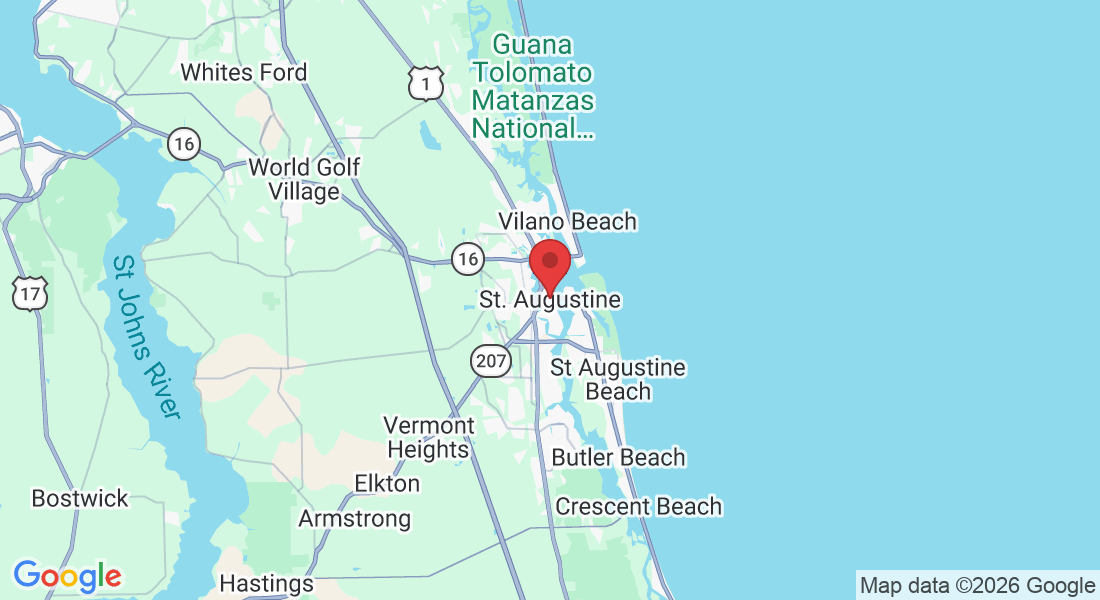
Our Service Areas
We proudly serve homeowners throughout Northeast Florida's most beautiful communities.
Ready to transform your
outdoor living?
Quality craftsmanship. Year-round comfort. Stress-free process.
Stay Informed
Per the StoryBrand framework — a clear, simple plan (3-4 steps max) reduces decision anxiety.
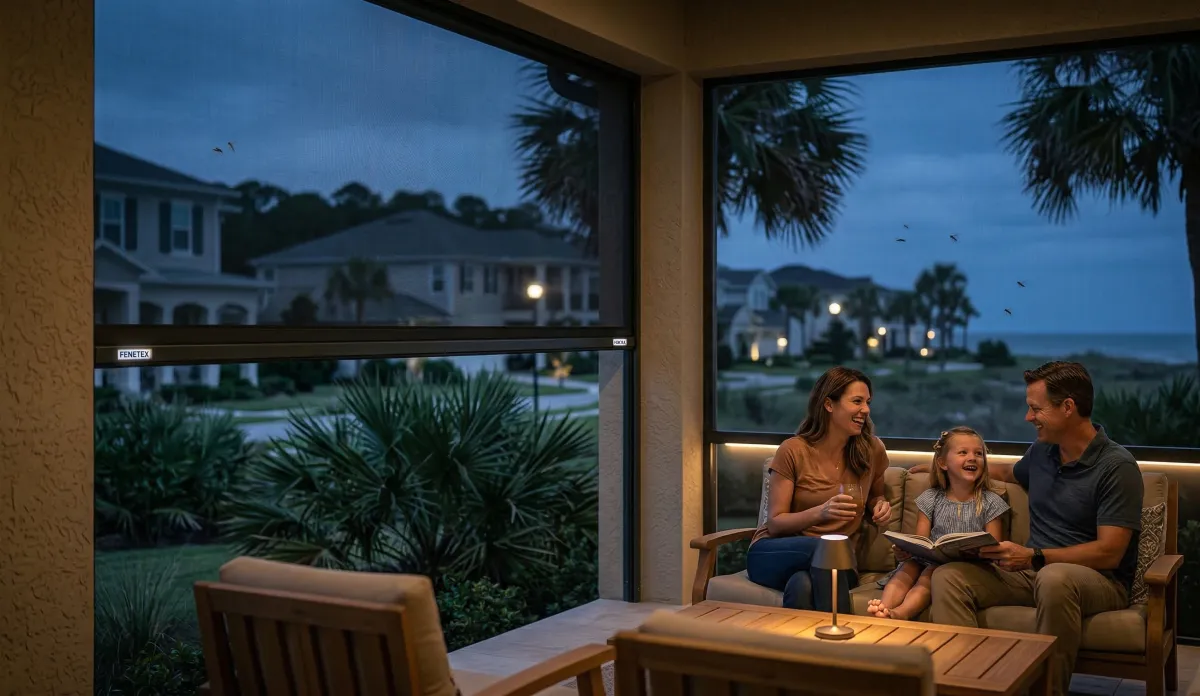
Finally Bug-Free: How Motorized Screens Are Reclaiming Nocatee and Ponte Vedra Lanais
You moved to Northeast Florida for the outdoor life. The climate. The community. The backyard you designed with evenings in mind — the lanai, the patio, the outdoor kitchen you use exactly three months of the year because the other nine belong to the mosquitoes.
That is not an exaggeration. It is the lived experience of thousands of homeowners across Nocatee, Ponte Vedra Beach, and St. Augustine who invested in outdoor spaces that look beautiful from inside the house — because inside the house is where they spend every evening from April through November.
The mosquitoes arrive at dusk. The no-see-ums arrive slightly before that. Together, they transform a perfectly designed outdoor space into an unusable one in the span of about twenty minutes. Citronella candles do not work. Fans help at the margins. Chemical sprays create a temporary perimeter that breaks down in humidity and smells like a hardware store. And the cycle repeats every single evening, every single week, for seven months of the year.
Motorized screens end that cycle. One button. Thirty seconds. Bug-free.
This post is about how Fenetex motorized insect screens are reclaiming outdoor living for homeowners in Nocatee, Ponte Vedra Beach, and across Northeast Florida — and why the technology that protects your lanai from bugs in May is the same technology that protects it from hurricanes in September.
The Insect Reality in Northeast Florida And Why It Is Worse Than You Expected
If you relocated to St. Johns County from the mid-Atlantic, the Midwest, or anywhere that is not subtropical coastal Florida, the insect situation was probably the one thing the real estate agent did not mention.
Northeast Florida sits at the intersection of saltwater marshes, freshwater wetlands, and warm subtropical air — the precise combination that produces one of the densest mosquito and no-see-um populations in the southeastern United States. The salt marshes that border Nocatee to the east and south, the Guana Tolomato Matanzas National Estuarine Research Reserve that flanks Ponte Vedra Beach, and the wetland corridors threading through St. Augustine and Palm Coast are prolific breeding grounds for both species.
The timing is specific and predictable. Mosquito activity spikes at dusk — precisely when the Florida afternoon heat breaks and outdoor living becomes comfortable. No-see-ums, the biting gnats that are small enough to pass through standard screen enclosure mesh, peak in the same window. The result is a cruel daily irony: the hour when your outdoor space is most pleasant is the exact hour when it becomes most hostile.
St. Johns County Mosquito Control conducts aerial and ground spraying throughout the season, and Nocatee's community management invests in supplemental treatment. These programs reduce the population but do not eliminate it. Any homeowner in Crosswater, Coastal Oaks, Palm Valley, Tidewater, Twenty Mile, or the newer Nocatee phases will confirm that the spraying helps — and that the mosquitoes are still there at 7 PM.
The homeowners who feel this most acutely are the ones who invested the most. You built the outdoor kitchen. You installed the StruXure pergola. You chose the travertine patio. You bought the furniture. And every evening, you watch it all sit empty from inside the sliding glass door because the bugs own the space after 6 PM.
What Citronella, Fans, and Sprays Cannot Do And Why
Before explaining how motorized screens solve this problem, it is worth being direct about why the conventional approaches do not.
Citronella candles and torches produce a localized scent barrier that repels some mosquito species at very close range. In an open-air environment with any cross breeze — which describes every lanai in Northeast Florida — the effective zone collapses to a few feet around the flame. A single candle does not protect a 200-square-foot patio. Four candles do not protect it either. They create ambiance. They do not create a barrier.
Outdoor fans are more effective. Moving air disrupts the flight pattern of mosquitoes and no-see-ums, which are weak fliers. A well-positioned ceiling fan on a covered lanai meaningfully reduces insect landing rates directly beneath the fan. But the effect drops off sharply with distance, and it does nothing for the perimeter of the space — the entry points where insects arrive from the surrounding landscape. Fans are a useful supplement. They are not a solution.
Chemical sprays and fogging treatments create a temporary toxic perimeter around the treated area. They work for hours, sometimes a day. Then the humidity degrades the chemical barrier, the next wave of insects arrives from the adjacent wetlands, and you are back to baseline. The cost of regular professional mosquito treatments across a season adds up — $400 to $1,200 per year in Northeast Florida — and the result is temporary relief, not permanent protection. There are also legitimate questions about the long-term effects of repeated chemical application on yards where children and pets play.
Standard screen enclosures — the aluminum-framed cages that surround many pools and lanais in Jacksonville and across St. Johns County — block mosquitoes effectively. They do not block no-see-ums. Standard screen mesh has openings large enough for these tiny gnats to pass through freely. Many homeowners who installed a full screen cage specifically for insect protection discover, often during their first Florida spring, that the smallest and most aggressive biting insect in the region goes right through it.
And as we covered in Week 3, those same screen enclosures are not hurricane rated. They become a liability during storms and carry rescreening costs of $2,000 to $8,000 per event.
The conventional approaches share a common limitation: they are all attempting to manage bugs in an open or semi-open environment. The only approach that eliminates the problem is creating a sealed barrier that insects cannot penetrate — one that deploys when you need it and disappears when you do not.
How Fenetex Motorized Insect Screens Actually Work
The Fenetex motorized insect screen system Titan installs across Nocatee, Ponte Vedra Beach, and Northeast Florida is not a conventional screen. It is an engineered enclosure system that deploys on demand to create a sealed, insect-proof barrier around your outdoor space.
Here is how it works, component by component.
The fabric. Fenetex insect mesh is woven with an openness factor specifically calibrated to block both mosquitoes and no-see-ums — the two primary biting insects in Northeast Florida. Standard screen mesh has openings of approximately 18x16 per inch. Fenetex insect mesh uses a tighter weave that prevents even the smallest gnats from passing through while maintaining meaningful airflow and outward visibility. You can see through the screen. You can feel the breeze. The bugs cannot get in.
The housing. When retracted, the screen rolls into a slim aluminum housing mounted at the top of the opening — above the roofline of your lanai, under the fascia of your covered patio, or integrated into the beam of your StruXure pergola. The housing is color-matched to your home's exterior. When the screen is up, it is effectively invisible. Your view is unobstructed. Your architectural lines are clean.
The side channels. As the screen deploys, it tracks through channels on each side of the opening that maintain tension and create a seal. This is not a screen that flaps in the breeze or leaves gaps at the edges where insects find their way in. The side channels ensure a tight, consistent seal from the housing to the base — the same engineering that enables hurricane-rated Fenetex screens to withstand wind loads, applied here for a tighter, more refined insect barrier.
The motor. Deployment is fully motorized. Press the button on a wall-mounted switch, a handheld remote, or your smartphone app — the screen descends smoothly, tracks into the side channels, and creates a sealed enclosure in approximately 30 to 60 seconds. Press the button again and it retracts completely, disappearing into the housing. No manual effort. No cranking. No wrestling with fixed screen panels.
Smart integration. Fenetex screens integrate with Somfy motor technology and are compatible with Alexa, Google Home, and the Bond Pro app. You can deploy your insect screens by voice command, from your phone while still inside, or on a timer that automatically deploys the screens at dusk — the exact moment the mosquitoes arrive — without you lifting a finger.
The Stolen Evenings And What Getting Them Back Actually Looks Like
The real cost of the insect problem in Northeast Florida is not measured in citronella candles or spray treatments. It is measured in lost time.
Every evening you go inside at 6:30 because the mosquitoes arrived is an evening you did not spend on the lanai you designed, on the patio you paid for, in the outdoor space you moved to Florida to enjoy. Multiply that by the roughly 210 evenings between April and November — the core insect season in St. Johns County — and you begin to see the scope of what the bugs actually take from you.
For the Nocatee homeowner who invested in a complete outdoor living setup — the pergola, the outdoor kitchen, the travertine patio, the fireplace, the furniture — the insect problem is not just an inconvenience. It is a failure of the investment thesis. You spent that money to live outdoors. The bugs prevent it. And every month that passes without a solution, the gap between what you imagined and what you experience grows wider.
Motorized screens close that gap. Completely.
Here is what the evening looks like with Fenetex screens deployed: You walk outside at 5:30. The afternoon is cooling. You press a button — one button — and the screens descend around your lanai. By the time you reach the outdoor kitchen, the space is sealed. The air moves freely through the mesh. The view through the screen is clear — you can see the yard, the trees, the sky turning orange. But the mosquitoes that arrived at the tree line at 5:45 stop at the screen. The no-see-ums that swarmed your neighbor's unscreened patio at 6:00 are not in your space.
At 9 PM, you are still outside. Your neighbors went in two and a half hours ago.
That is not a product description. It is the experience Titan has delivered to hundreds of homeowners across Nocatee, Ponte Vedra, and St. Augustine. You can see the transformations in our project gallery and video gallery.
You did not move to Florida to watch the sunset through a sliding glass door. You moved here to be outside for it. Motorized screens make that possible — every evening, not just the ones when the wind happens to cooperate.
Why This Is Not Just a Bug Screen The Year-Round Return
The insect protection alone justifies the investment for most Nocatee and Ponte Vedra homeowners. But the Fenetex motorized screen system Titan installs is not a single-purpose product. The same screen that blocks mosquitoes at dusk delivers a full spectrum of daily benefits that compound the value across every season.
UV protection. Fenetex screens block up to 91 percent of UV rays depending on the fabric option selected. In a region where the Florida sun fades outdoor furniture, bleaches cushions, and drives patio temperatures past the point of comfort by mid-morning, that UV blocking translates directly into dollars saved on replacement furniture and reduced cooling load on the adjacent indoor spaces.
Solar shading. The Fenetex solar mesh option reduces heat transfer through the screened opening, dropping the perceived temperature on your lanai by a meaningful margin. Homeowners in Ponte Vedra Beach and Palm Coast consistently report that their screened outdoor spaces become usable hours earlier in the day than they were before — the midday period that was previously unbearable becomes accessible.
Wind and rain management. When an afternoon thunderstorm rolls through — a near-daily occurrence in a Northeast Florida summer — deployed screens deflect wind-driven rain away from your furniture, electronics, and the glass doors behind the opening. No scrambling to drag cushions inside. No drying off the outdoor kitchen after every storm.
Privacy. From outside looking in through a deployed screen, visibility is reduced significantly. From inside looking out, visibility is maintained. This one-way privacy effect is particularly valued in Nocatee communities where homes are close together and golf course foot traffic passes behind rear lanais.
And hurricane protection. As we covered in Week 3, the Fenetex hurricane-rated screen option — OmegaTex aramid fiber fabric — provides certified storm protection for lanais and large openings. The same motorized system that blocks bugs in May deploys as a hurricane barrier in September. One product. One installation. Year-round value.
Nocatee, Ponte Vedra, and the Neighborhoods We Know Best
Titan Outdoor Solutions has installed motorized screen systems across the communities where our customers live — and where the insect pressure is highest. This is not generic Florida advice. This is specific to the neighborhoods we serve and the conditions we understand firsthand.
Nocatee — Crosswater, Coastal Oaks, Tidewater, Twenty Mile, Addison Park, Willowcove. These communities sit adjacent to or near the saltwater marshes east of the community. The mosquito and no-see-um pressure is among the highest in St. Johns County, particularly in neighborhoods closest to the preserve boundaries. Homeowners in these areas experience the insect problem most acutely — and see the most dramatic transformation when screens are deployed.
Ponte Vedra Beach — A1A corridor, Palm Valley, Sawgrass. Coastal proximity adds sand gnats and marsh mosquitoes to the standard insect population. Evening outdoor living without screens is essentially a non-option during the warm months.
St. Augustine — Anastasia Island, Vilano Beach, St. Augustine Beach. The proximity to the Intracoastal and the Matanzas River creates a dual-source insect environment. Homeowners on the barrier islands report the most persistent no-see-um populations in the region.
World Golf Village and Silverleaf. Inland location reduces saltwater marsh mosquitoes but does not eliminate the freshwater breeding populations from the retention ponds, lakes, and wetland corridors threaded through these master-planned communities.
Jacksonville — Riverside, San Marco, Mandarin, Julington Creek. The St. Johns River corridor is a breeding highway for mosquitoes across Duval County. Homeowners with river-adjacent or creek-adjacent properties experience amplified insect pressure from April through October.
We know these neighborhoods because we work in them. The Nocatee service area page and Ponte Vedra Beach service area page show the communities we serve and the specific outdoor living solutions we bring to each.
The Honest Cost Conversation
Motorized screens are a premium product. They cost more than a fixed screen enclosure, more than a set of citronella candles, and more than a season of spray treatments. That is worth stating directly.
What they also cost less than: a full screen enclosure rescreening after a hurricane ($2,000–$8,000), five years of outdoor furniture replacement due to UV fading ($2,000–$5,000), a decade of professional mosquito spray treatments ($4,000–$12,000), and the cumulative value of 210 stolen evenings per year — evenings you designed your outdoor space for and never get to enjoy.
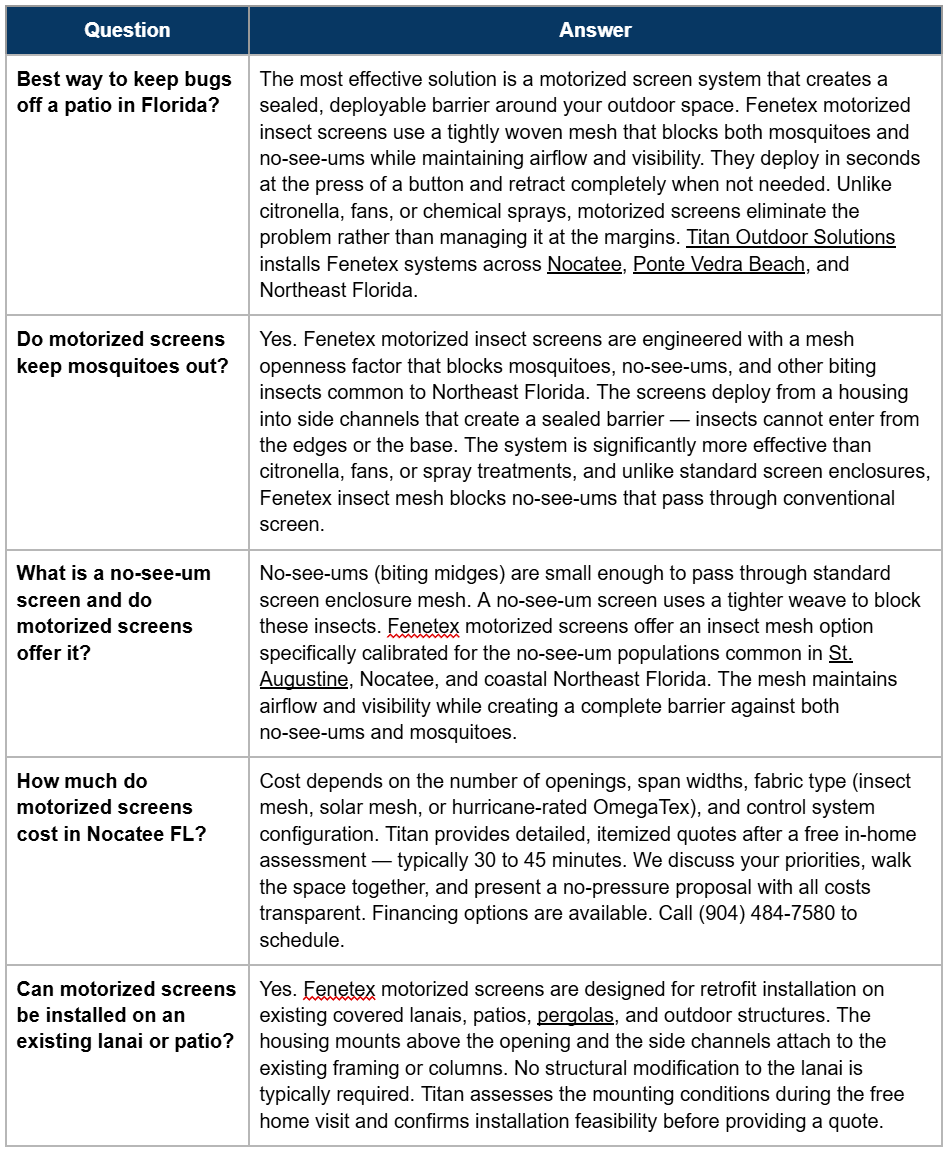
The specific cost of a Fenetex motorized screen installation depends on the number of openings, the span widths, the fabric type selected (insect mesh, solar mesh, or hurricane-rated OmegaTex), and the control system configuration. A single-opening installation starts at a different price point than a full-lanai, multi-panel system.
Titan provides detailed, itemized quotes after our free in-home assessment. We walk through the space with you, discuss which fabric and control options match your priorities, and present a proposal with no hidden costs and no pressure. We also offer financing options for homeowners who want to move forward without a single upfront payment.
The best way to understand the cost for your specific home is to schedule the assessment. It takes 30 to 45 minutes and costs you nothing.
Frequently Asked Questions
Schedule Your Free In-Home Demo
Serving St. Augustine · Nocatee · Ponte Vedra Beach · Palm Coast · Jacksonville · Northeast Florida
See the Fenetex insect screen in action — on your lanai, in your space. We bring the product to you, demonstrate the deployment, and show you exactly how it transforms the outdoor space you already have. Free. No obligation.
Call or text: (904) 484-7580 | TitanOutdoorSolution.com

Stay Informed
Per the StoryBrand framework — a clear, simple plan (3-4 steps max) reduces decision anxiety.
Finally Bug-Free: How Motorized Screens Are Reclaiming Nocatee and Ponte Vedra Lanais
You moved to Northeast Florida for the outdoor life. The climate. The community. The backyard you designed with evenings in mind — the lanai, the patio, the outdoor kitchen you use exactly three months of the year because the other nine belong to the mosquitoes.
That is not an exaggeration. It is the lived experience of thousands of homeowners across Nocatee, Ponte Vedra Beach, and St. Augustine who invested in outdoor spaces that look beautiful from inside the house — because inside the house is where they spend every evening from April through November.
The mosquitoes arrive at dusk. The no-see-ums arrive slightly before that. Together, they transform a perfectly designed outdoor space into an unusable one in the span of about twenty minutes. Citronella candles do not work. Fans help at the margins. Chemical sprays create a temporary perimeter that breaks down in humidity and smells like a hardware store. And the cycle repeats every single evening, every single week, for seven months of the year.
Motorized screens end that cycle. One button. Thirty seconds. Bug-free.
This post is about how Fenetex motorized insect screens are reclaiming outdoor living for homeowners in Nocatee, Ponte Vedra Beach, and across Northeast Florida — and why the technology that protects your lanai from bugs in May is the same technology that protects it from hurricanes in September.
The Insect Reality in Northeast Florida And Why It Is Worse Than You Expected
If you relocated to St. Johns County from the mid-Atlantic, the Midwest, or anywhere that is not subtropical coastal Florida, the insect situation was probably the one thing the real estate agent did not mention.
Northeast Florida sits at the intersection of saltwater marshes, freshwater wetlands, and warm subtropical air — the precise combination that produces one of the densest mosquito and no-see-um populations in the southeastern United States. The salt marshes that border Nocatee to the east and south, the Guana Tolomato Matanzas National Estuarine Research Reserve that flanks Ponte Vedra Beach, and the wetland corridors threading through St. Augustine and Palm Coast are prolific breeding grounds for both species.
The timing is specific and predictable. Mosquito activity spikes at dusk — precisely when the Florida afternoon heat breaks and outdoor living becomes comfortable. No-see-ums, the biting gnats that are small enough to pass through standard screen enclosure mesh, peak in the same window. The result is a cruel daily irony: the hour when your outdoor space is most pleasant is the exact hour when it becomes most hostile.
St. Johns County Mosquito Control conducts aerial and ground spraying throughout the season, and Nocatee's community management invests in supplemental treatment. These programs reduce the population but do not eliminate it. Any homeowner in Crosswater, Coastal Oaks, Palm Valley, Tidewater, Twenty Mile, or the newer Nocatee phases will confirm that the spraying helps — and that the mosquitoes are still there at 7 PM.
The homeowners who feel this most acutely are the ones who invested the most. You built the outdoor kitchen. You installed the StruXure pergola. You chose the travertine patio. You bought the furniture. And every evening, you watch it all sit empty from inside the sliding glass door because the bugs own the space after 6 PM.
What Citronella, Fans, and Sprays Cannot Do And Why
Before explaining how motorized screens solve this problem, it is worth being direct about why the conventional approaches do not.
Citronella candles and torches produce a localized scent barrier that repels some mosquito species at very close range. In an open-air environment with any cross breeze — which describes every lanai in Northeast Florida — the effective zone collapses to a few feet around the flame. A single candle does not protect a 200-square-foot patio. Four candles do not protect it either. They create ambiance. They do not create a barrier.
Outdoor fans are more effective. Moving air disrupts the flight pattern of mosquitoes and no-see-ums, which are weak fliers. A well-positioned ceiling fan on a covered lanai meaningfully reduces insect landing rates directly beneath the fan. But the effect drops off sharply with distance, and it does nothing for the perimeter of the space — the entry points where insects arrive from the surrounding landscape. Fans are a useful supplement. They are not a solution.
Chemical sprays and fogging treatments create a temporary toxic perimeter around the treated area. They work for hours, sometimes a day. Then the humidity degrades the chemical barrier, the next wave of insects arrives from the adjacent wetlands, and you are back to baseline. The cost of regular professional mosquito treatments across a season adds up — $400 to $1,200 per year in Northeast Florida — and the result is temporary relief, not permanent protection. There are also legitimate questions about the long-term effects of repeated chemical application on yards where children and pets play.
Standard screen enclosures — the aluminum-framed cages that surround many pools and lanais in Jacksonville and across St. Johns County — block mosquitoes effectively. They do not block no-see-ums. Standard screen mesh has openings large enough for these tiny gnats to pass through freely. Many homeowners who installed a full screen cage specifically for insect protection discover, often during their first Florida spring, that the smallest and most aggressive biting insect in the region goes right through it.
And as we covered in Week 3, those same screen enclosures are not hurricane rated. They become a liability during storms and carry rescreening costs of $2,000 to $8,000 per event.
The conventional approaches share a common limitation: they are all attempting to manage bugs in an open or semi-open environment. The only approach that eliminates the problem is creating a sealed barrier that insects cannot penetrate — one that deploys when you need it and disappears when you do not.
How Fenetex Motorized Insect Screens Actually Work
The Fenetex motorized insect screen system Titan installs across Nocatee, Ponte Vedra Beach, and Northeast Florida is not a conventional screen. It is an engineered enclosure system that deploys on demand to create a sealed, insect-proof barrier around your outdoor space.
Here is how it works, component by component.
The fabric. Fenetex insect mesh is woven with an openness factor specifically calibrated to block both mosquitoes and no-see-ums — the two primary biting insects in Northeast Florida. Standard screen mesh has openings of approximately 18x16 per inch. Fenetex insect mesh uses a tighter weave that prevents even the smallest gnats from passing through while maintaining meaningful airflow and outward visibility. You can see through the screen. You can feel the breeze. The bugs cannot get in.
The housing. When retracted, the screen rolls into a slim aluminum housing mounted at the top of the opening — above the roofline of your lanai, under the fascia of your covered patio, or integrated into the beam of your StruXure pergola. The housing is color-matched to your home's exterior. When the screen is up, it is effectively invisible. Your view is unobstructed. Your architectural lines are clean.
The side channels. As the screen deploys, it tracks through channels on each side of the opening that maintain tension and create a seal. This is not a screen that flaps in the breeze or leaves gaps at the edges where insects find their way in. The side channels ensure a tight, consistent seal from the housing to the base — the same engineering that enables hurricane-rated Fenetex screens to withstand wind loads, applied here for a tighter, more refined insect barrier.
The motor. Deployment is fully motorized. Press the button on a wall-mounted switch, a handheld remote, or your smartphone app — the screen descends smoothly, tracks into the side channels, and creates a sealed enclosure in approximately 30 to 60 seconds. Press the button again and it retracts completely, disappearing into the housing. No manual effort. No cranking. No wrestling with fixed screen panels.
Smart integration. Fenetex screens integrate with Somfy motor technology and are compatible with Alexa, Google Home, and the Bond Pro app. You can deploy your insect screens by voice command, from your phone while still inside, or on a timer that automatically deploys the screens at dusk — the exact moment the mosquitoes arrive — without you lifting a finger.
The Stolen Evenings And What Getting Them Back Actually Looks Like
The real cost of the insect problem in Northeast Florida is not measured in citronella candles or spray treatments. It is measured in lost time.
Every evening you go inside at 6:30 because the mosquitoes arrived is an evening you did not spend on the lanai you designed, on the patio you paid for, in the outdoor space you moved to Florida to enjoy. Multiply that by the roughly 210 evenings between April and November — the core insect season in St. Johns County — and you begin to see the scope of what the bugs actually take from you.
For the Nocatee homeowner who invested in a complete outdoor living setup — the pergola, the outdoor kitchen, the travertine patio, the fireplace, the furniture — the insect problem is not just an inconvenience. It is a failure of the investment thesis. You spent that money to live outdoors. The bugs prevent it. And every month that passes without a solution, the gap between what you imagined and what you experience grows wider.
Motorized screens close that gap. Completely.
Here is what the evening looks like with Fenetex screens deployed: You walk outside at 5:30. The afternoon is cooling. You press a button — one button — and the screens descend around your lanai. By the time you reach the outdoor kitchen, the space is sealed. The air moves freely through the mesh. The view through the screen is clear — you can see the yard, the trees, the sky turning orange. But the mosquitoes that arrived at the tree line at 5:45 stop at the screen. The no-see-ums that swarmed your neighbor's unscreened patio at 6:00 are not in your space.
At 9 PM, you are still outside. Your neighbors went in two and a half hours ago.
That is not a product description. It is the experience Titan has delivered to hundreds of homeowners across Nocatee, Ponte Vedra, and St. Augustine. You can see the transformations in our project gallery and video gallery.
You did not move to Florida to watch the sunset through a sliding glass door. You moved here to be outside for it. Motorized screens make that possible — every evening, not just the ones when the wind happens to cooperate.
Why This Is Not Just a Bug Screen The Year-Round Return
The insect protection alone justifies the investment for most Nocatee and Ponte Vedra homeowners. But the Fenetex motorized screen system Titan installs is not a single-purpose product. The same screen that blocks mosquitoes at dusk delivers a full spectrum of daily benefits that compound the value across every season.
UV protection. Fenetex screens block up to 91 percent of UV rays depending on the fabric option selected. In a region where the Florida sun fades outdoor furniture, bleaches cushions, and drives patio temperatures past the point of comfort by mid-morning, that UV blocking translates directly into dollars saved on replacement furniture and reduced cooling load on the adjacent indoor spaces.
Solar shading. The Fenetex solar mesh option reduces heat transfer through the screened opening, dropping the perceived temperature on your lanai by a meaningful margin. Homeowners in Ponte Vedra Beach and Palm Coast consistently report that their screened outdoor spaces become usable hours earlier in the day than they were before — the midday period that was previously unbearable becomes accessible.
Wind and rain management. When an afternoon thunderstorm rolls through — a near-daily occurrence in a Northeast Florida summer — deployed screens deflect wind-driven rain away from your furniture, electronics, and the glass doors behind the opening. No scrambling to drag cushions inside. No drying off the outdoor kitchen after every storm.
Privacy. From outside looking in through a deployed screen, visibility is reduced significantly. From inside looking out, visibility is maintained. This one-way privacy effect is particularly valued in Nocatee communities where homes are close together and golf course foot traffic passes behind rear lanais.
And hurricane protection. As we covered in Week 3, the Fenetex hurricane-rated screen option — OmegaTex aramid fiber fabric — provides certified storm protection for lanais and large openings. The same motorized system that blocks bugs in May deploys as a hurricane barrier in September. One product. One installation. Year-round value.
Nocatee, Ponte Vedra, and the Neighborhoods We Know Best
Titan Outdoor Solutions has installed motorized screen systems across the communities where our customers live — and where the insect pressure is highest. This is not generic Florida advice. This is specific to the neighborhoods we serve and the conditions we understand firsthand.
Nocatee — Crosswater, Coastal Oaks, Tidewater, Twenty Mile, Addison Park, Willowcove. These communities sit adjacent to or near the saltwater marshes east of the community. The mosquito and no-see-um pressure is among the highest in St. Johns County, particularly in neighborhoods closest to the preserve boundaries. Homeowners in these areas experience the insect problem most acutely — and see the most dramatic transformation when screens are deployed.
Ponte Vedra Beach — A1A corridor, Palm Valley, Sawgrass. Coastal proximity adds sand gnats and marsh mosquitoes to the standard insect population. Evening outdoor living without screens is essentially a non-option during the warm months.
St. Augustine — Anastasia Island, Vilano Beach, St. Augustine Beach. The proximity to the Intracoastal and the Matanzas River creates a dual-source insect environment. Homeowners on the barrier islands report the most persistent no-see-um populations in the region.
World Golf Village and Silverleaf. Inland location reduces saltwater marsh mosquitoes but does not eliminate the freshwater breeding populations from the retention ponds, lakes, and wetland corridors threaded through these master-planned communities.
Jacksonville — Riverside, San Marco, Mandarin, Julington Creek. The St. Johns River corridor is a breeding highway for mosquitoes across Duval County. Homeowners with river-adjacent or creek-adjacent properties experience amplified insect pressure from April through October.
We know these neighborhoods because we work in them. The Nocatee service area page and Ponte Vedra Beach service area page show the communities we serve and the specific outdoor living solutions we bring to each.
The Honest Cost Conversation
Motorized screens are a premium product. They cost more than a fixed screen enclosure, more than a set of citronella candles, and more than a season of spray treatments. That is worth stating directly.
What they also cost less than: a full screen enclosure rescreening after a hurricane ($2,000–$8,000), five years of outdoor furniture replacement due to UV fading ($2,000–$5,000), a decade of professional mosquito spray treatments ($4,000–$12,000), and the cumulative value of 210 stolen evenings per year — evenings you designed your outdoor space for and never get to enjoy.
The specific cost of a Fenetex motorized screen installation depends on the number of openings, the span widths, the fabric type selected (insect mesh, solar mesh, or hurricane-rated OmegaTex), and the control system configuration. A single-opening installation starts at a different price point than a full-lanai, multi-panel system.
Titan provides detailed, itemized quotes after our free in-home assessment. We walk through the space with you, discuss which fabric and control options match your priorities, and present a proposal with no hidden costs and no pressure. We also offer financing options for homeowners who want to move forward without a single upfront payment.
The best way to understand the cost for your specific home is to schedule the assessment. It takes 30 to 45 minutes and costs you nothing.
Frequently Asked Questions
Schedule Your Free In-Home Demo
Serving St. Augustine · Nocatee · Ponte Vedra Beach · Palm Coast · Jacksonville · Northeast Florida
See the Fenetex insect screen in action — on your lanai, in your space. We bring the product to you, demonstrate the deployment, and show you exactly how it transforms the outdoor space you already have. Free. No obligation.
Call or text: (904) 484-7580 | TitanOutdoorSolution.com


COMPANY
OUR PRODUCTS
SERVICE AREAS
SUPPORT
Copyright 2026. Titan Outdoor Solution.All Rights Reserved.