
Contact Titan Outdoor Solutions
Ready to extend your outdoor living space? Let's talk about what's possible for your home.
How Can We Help You?
Whether you're ready to schedule a free design consultation, have questions about our products, or need support with an existing installation—we're here for you.
Address:
3515 Agricultural Center Drive
St. Augustine, FL 32092
Phone:
(904) 484-7580
Email:
Hours:
Monday - Friday: 8:00 AM - 5:00 PM
Saturday: By Appointment
Sunday: Closed
How Can We Help You?
Whether you're ready to schedule a free design consultation, have questions about our products, or need support with an existing installation—we're here for you.
Address:
3515 Agricultural Center Drive
St. Augustine, FL 32092
Phone:
(904) 484-7580
Email:
Hours:
Monday - Friday: 8:00 AM - 5:00 PM
Saturday: By Appointment
Sunday: Closed
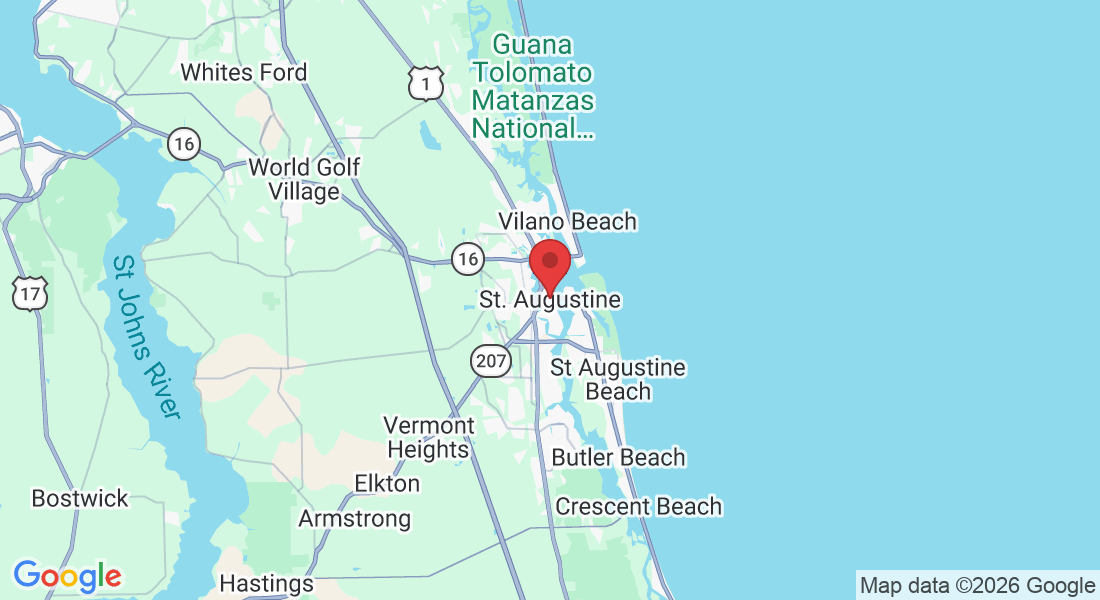
Our Service Areas
We proudly serve homeowners throughout Northeast Florida's most beautiful communities.
Ready to transform your
outdoor living?
Quality craftsmanship. Year-round comfort. Stress-free process.
Stay Informed
Per the StoryBrand framework — a clear, simple plan (3-4 steps max) reduces decision anxiety.
What Florida Soil Does to Outdoor Spaces (And How Smart Homeowners Build Anyway)
The crack appeared on a Tuesday. Not a dramatic, ground-splitting fracture that demanded immediate attention, but a hairline thread running diagonally across the concrete patio, thin enough to trace with a fingernail and subtle enough to ignore for a month. Jennifer ignored it for longer than a month. She ignored it through the rest of spring and into the summer, through the afternoon storms that dumped two inches of rain in twenty minutes and then vanished as though they had never arrived. She ignored it until the evening she walked outside barefoot for the first time in September and felt the lip. The crack had become a ridge. The slab had shifted. One section sat a quarter inch higher than the other, just enough to catch a toe, just enough to pool water after every storm, just enough to make the patio feel, in some indefinable way, broken.
Her contractor told her the crack was "normal settling." He was not wrong, technically. In Florida, concrete settling is normal the way humidity is normal: inevitable, pervasive, and quietly destructive if you do not account for it in every decision you make about the structure of your outdoor space. What the contractor did not tell Jennifer, and what most homeowners discover only after the damage becomes visible, is that Florida's soil conditions make outdoor construction fundamentally different from outdoor construction in nearly any other region of the continental United States. The rules that work in Georgia clay or Michigan loam do not work here. The soil is different. The water is different. The consequences of ignoring both are expensive and, in most cases, irreversible.
Understanding paver patio Florida soil conditions is not an academic exercise. It is the prerequisite for building an outdoor space that lasts. And it is the information gap that separates homeowners who build once from homeowners who build, watch it fail, and build again.
[Explore Go-Fenetex Residential Solutions → https://gofenetex.com/residential]
Florida Soil Science for Non-Engineers
The first thing to understand about Florida soil is that most of it is not soil in the way a midwestern farmer would recognize the word. Large portions of the state sit on a geologic foundation of marine limestone covered by varying depths of sand, shell, and organic material deposited over millennia of sea-level fluctuation. The "soil" beneath your patio in much of central and south Florida is predominantly sand: fine-grained, poorly cohesive, and capable of moving in ways that defy the expectations of homeowners who grew up in states where you could dig a hole and expect the sides to hold their shape.
Sandy substrate behaves differently than clay or loam under load. Where clay compresses and holds shape, sand shifts. Where loam distributes weight across a broad surface, sand allows concentrated loads to sink. Where clay holds water at the surface (creating different problems), sand allows water to percolate through with almost no resistance, which sounds advantageous until you understand the implication: the water that drains through your sandy soil doesn't simply disappear. It joins the water table. And Florida's water table, in many regions, sits remarkably close to the surface.
In coastal and low-lying areas of Florida, the water table may be as shallow as two to four feet below grade during the wet season. This means that the ground beneath your patio is not a stable, static foundation; it is a dynamic system influenced by rainfall, tidal patterns, seasonal variation, and the cumulative effect of every impervious surface in your neighborhood redirecting stormwater into the same saturated substrate. When the water table rises, it saturates the soil from below, reducing its load-bearing capacity. When it falls, the soil contracts, creating voids. This cycle of saturation and contraction is the primary mechanism by which Florida patios settle, shift, and crack.
Add to this the reality of Florida's sinkhole geography. Not every property sits above a sinkhole, but much of central Florida lies within the state's sinkhole belt, where the limestone bedrock is actively dissolving beneath the surface. Even properties outside the sinkhole belt can experience localized subsurface erosion, where water dissolves or displaces subsurface material and creates voids that eventually express themselves as settling at the surface. The paver patio Florida soil conditions that matter most are not the ones you can see. They are the ones you cannot, operating invisibly beneath the foundation, waiting for the first heavy rain or the first structural load to reveal their presence.
[See Why Homeowners Choose Go-Fenetex → https://gofenetex.com/why-go-fenetex]
The Base That Changes Everything
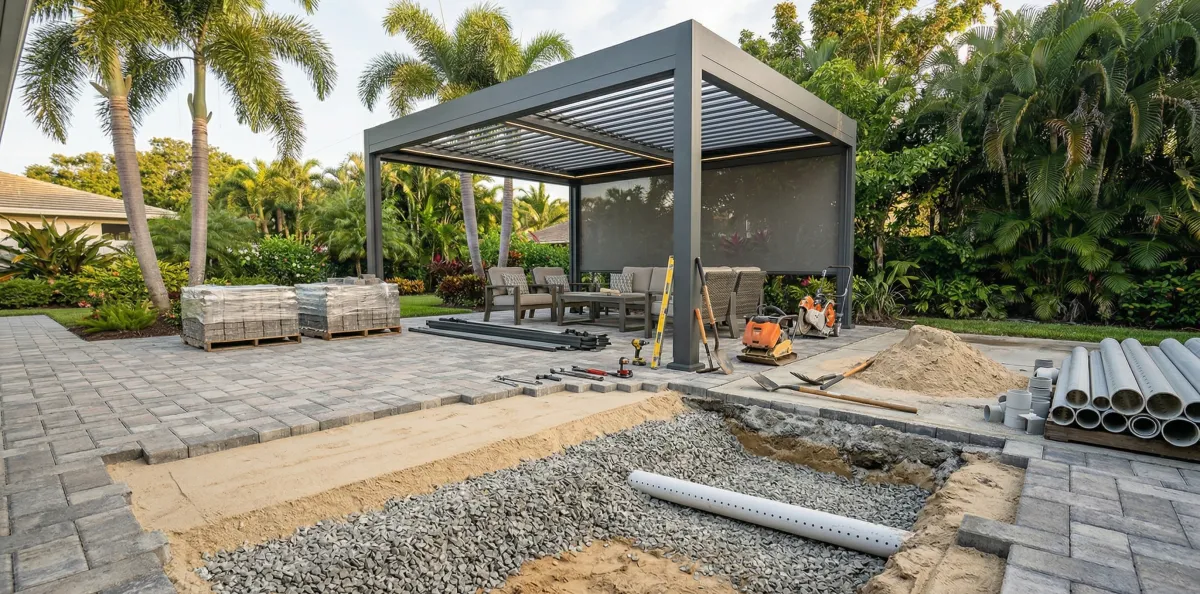
The difference between a patio that fails in Florida and one that performs for decades is not the material on the surface. It is the engineering beneath the surface. A properly installed Florida patio foundation requires a multi-layer base system designed to compensate for the specific challenges of sandy, water-influenced soil, and every layer serves a purpose that the one above it depends on.
The process begins with excavation to the correct depth, typically eight to twelve inches below the finished grade for a residential paver patio, depending on the application and the anticipated loads. This excavation removes the topsoil and organic material, which are unstable, compressible, and unsuitable as a load-bearing surface. What remains is the native sandy substrate, which must be compacted to a specified density before anything is placed on top of it.
The next layer is a geotextile fabric, a permeable synthetic membrane that is laid directly on the compacted native soil. The geotextile serves a function that is invisible but critical: it prevents the fine sand particles from migrating upward into the aggregate base layer over time. Without this barrier, the sand slowly infiltrates the crushed stone above it, fills the voids between aggregate particles, and destroys the drainage and load-distribution properties that the aggregate base was installed to provide. Geotextile failure is the silent killer of Florida paver patios, and it is the layer most often skipped by contractors cutting corners. Paver base preparation Florida specifications from manufacturers and industry associations universally require it. Homeowners who verify that their contractor includes geotextile fabric in the installation scope are protecting the structural integrity of every layer above it.
Above the geotextile sits the aggregate base: typically six to eight inches of compacted crushed limestone or recycled concrete, installed in lifts (layers) and mechanically compacted to a minimum density that varies by application. The aggregate base is the structural core of the patio. It distributes point loads across a broad area, prevents localized settling, provides subsurface drainage, and creates the stable, dimensionally consistent platform that the paver surface and everything built above it depend on. Compaction testing, using a plate compactor for residential applications, should achieve a minimum of 95 percent modified Proctor density, though many quality-focused installers target 98 percent.
Above the aggregate sits a thin bedding layer of coarse, angular sand (typically ASTM C33 specification), screeded to a uniform thickness of approximately one inch. The pavers are set into this bedding layer, and polymeric sand is swept into the joints to lock the individual units together and resist weed growth, insect infiltration, and joint erosion. Finally, edge restraints, typically aluminum or composite L-shaped profiles anchored with spikes, are installed around the perimeter to prevent the outermost pavers from migrating outward over time.
This is what paver base preparation Florida actually involves. It is not glamorous. It is invisible the moment the pavers are laid. And it is the only thing standing between a twenty-year patio and a five-year regret.
[Find a Go-Fenetex Dealer Near You → https://gofenetex.com/dealership]
Drainage Design for Florida Reality
Florida receives an average of 54 inches of rainfall per year, with the majority concentrated in the wet season between June and September. During peak summer, the state experiences convective thunderstorms that can deliver one to three inches of rain within a single hour, followed by immediate sunshine and rapid evaporation. This pattern of intense, brief, and frequent inundation is unlike the prolonged, gentle rainfall that drainage systems in northern climates are designed to handle. A patio drainage solution designed for New England will fail catastrophically in Tampa.
Effective patio drainage solutions for Florida homes require two separate systems working in concert. The first is surface drainage: the controlled movement of water across the paver surface toward designated collection points. This is achieved through slope, a minimum of one percent grade (one inch of fall per eight feet of horizontal distance), directed away from the home's foundation and toward landscape beds, swales, or subsurface collection systems. Flat patios that look beautiful in a photograph become ponds in a Florida thunderstorm. Slope is not optional.
The second system is subsurface drainage: the managed percolation of water through the paver joints, through the bedding sand, through the aggregate base, through the geotextile, and into the native soil. This vertical drainage path is one of the primary advantages of a paver system over poured concrete, which is entirely impervious and relies solely on surface slope to move water. In a paver system, the aggregate base functions as a reservoir, temporarily storing stormwater that drains through the joints and releasing it gradually into the native soil below. In some applications, particularly where the water table is high or the soil percolation rate is low, a perforated pipe or French drain system is integrated within the aggregate base to capture excess water and route it to a positive outlet.
Channel drains, trench drains, or slot drains are installed at the low point of the patio's slope to collect surface water that reaches the edge of the paved area. These drains connect to a subsurface pipe system that carries the water to a designated discharge point: a dry well, a municipal storm drain connection, or a landscape area designed to accept the volume.
The drainage design of a paver patio in Florida is inseparable from its structural design. The water that the system manages is the same water that, unmanaged, will erode the base, saturate the substrate, undermine the footings, and ultimately compromise the pergola, the screens, and every system the outdoor room depends on.
[Explore Commercial Solutions by Go-Fenetex → https://gofenetex.com/commercial]
How the Foundation Affects Everything Above
A pergola is an overhead structure. Its visual impact is above eye level, its functional benefits are experienced from beneath it, and its presence transforms the spatial character of the outdoor room. It is tempting to think of the pergola as independent of the foundation, operating in a different plane, governed by different engineering. It is not. The pergola is anchored to the foundation, and the foundation's stability determines the pergola's geometry over time.
Go-Fenetex motorized retractable screens mount to the pergola structure, with the screen cassette housing attached to the header beam and the Keder track retention channels mounted to the columns. The One-Track spring tensioning system maintains constant fabric tension as the screen deploys and retracts, ensuring a smooth, wrinkle-free surface that resists wind deflection and maintains a clean aesthetic line. This system's performance depends on precise dimensional relationships between the track channels: they must be parallel, plumb, and spaced to the specification that the OmegaTex fabric was manufactured to fit. If the pergola columns move, even by fractions of an inch, the track alignment changes, and screen performance degrades.
A paver foundation engineered for Florida's paver patio Florida soil conditions, with proper excavation, geotextile, compacted aggregate base, and drainage, maintains the dimensional stability that the pergola and screen systems require. The columns stay where the engineer placed them. The tracks remain parallel. The One-Track system maintains its tension. The Keder bead stays seated in the groove. And the homeowner presses a button and the screens deploy as silently and smoothly on year ten as they did on day one.
This is what foundation engineering protects. Not just the pavers. Not just the surface. The entire system, from the ground up.
[See Go-Fenetex Home Page → https://gofenetex.com/home-page]
Building Confidently on Challenging Ground
Florida soil is not a reason to avoid building an outdoor living space. It is a reason to build it correctly. The homeowners who struggle with settling, cracking, pooling, and structural compromise are not homeowners who built in the wrong place. They are homeowners who built with the wrong base. The soil beneath every home in Florida was there before the house was built, and the house's foundation was engineered to account for it. Your outdoor space deserves the same engineering attention.
The path forward is a phased approach that respects the three-layer model introduced in the first article of this series. The foundation comes first, and it must be designed for the specific soil conditions, water table depth, and drainage requirements of your property. The structure comes second, anchored to a foundation that will maintain its geometry through decades of Florida weather. The completion layer, the Go-Fenetex retractable motorized screens that seal the space against rain, wind, insects, and privacy intrusion, comes third, mounted to a structure that stands true because the ground beneath it was prepared for the long term.
Every outdoor room that works beautifully, every screened pergola that performs flawlessly, every patio that hosts Thanksgiving dinner without a puddle or a crack began with a foundation that nobody sees. The invisible engineering beneath the surface is the most important investment in the entire project. It is the investment that protects every other investment above it.
You now understand the ground. You understand the water. You understand the science that separates patios that last from patios that fail. The foundation is secure. The next decision is more visible, more personal, and, for many homeowners, more overwhelming: which paver patterns and materials will define the aesthetic character of your outdoor room, add measurable value to your property, and set the visual tone for the pergola and screens that complete the space above? That decision is the subject of our next article, and it is the one homeowners enjoy most, once they know the ground beneath the beauty is built to hold.
Start exploring the complete outdoor living ecosystem at NextGen Screens
Discover Onetrack's motorized screen systems at Onetrack Screens
Learn about hurricane-rated protection with Maxforce Screens

Stay Informed
Per the StoryBrand framework — a clear, simple plan (3-4 steps max) reduces decision anxiety.
What Florida Soil Does to Outdoor Spaces (And How Smart Homeowners Build Anyway)
The crack appeared on a Tuesday. Not a dramatic, ground-splitting fracture that demanded immediate attention, but a hairline thread running diagonally across the concrete patio, thin enough to trace with a fingernail and subtle enough to ignore for a month. Jennifer ignored it for longer than a month. She ignored it through the rest of spring and into the summer, through the afternoon storms that dumped two inches of rain in twenty minutes and then vanished as though they had never arrived. She ignored it until the evening she walked outside barefoot for the first time in September and felt the lip. The crack had become a ridge. The slab had shifted. One section sat a quarter inch higher than the other, just enough to catch a toe, just enough to pool water after every storm, just enough to make the patio feel, in some indefinable way, broken.
Her contractor told her the crack was "normal settling." He was not wrong, technically. In Florida, concrete settling is normal the way humidity is normal: inevitable, pervasive, and quietly destructive if you do not account for it in every decision you make about the structure of your outdoor space. What the contractor did not tell Jennifer, and what most homeowners discover only after the damage becomes visible, is that Florida's soil conditions make outdoor construction fundamentally different from outdoor construction in nearly any other region of the continental United States. The rules that work in Georgia clay or Michigan loam do not work here. The soil is different. The water is different. The consequences of ignoring both are expensive and, in most cases, irreversible.
Understanding paver patio Florida soil conditions is not an academic exercise. It is the prerequisite for building an outdoor space that lasts. And it is the information gap that separates homeowners who build once from homeowners who build, watch it fail, and build again.
[Explore Go-Fenetex Residential Solutions → https://gofenetex.com/residential]
Florida Soil Science for Non-Engineers
The first thing to understand about Florida soil is that most of it is not soil in the way a midwestern farmer would recognize the word. Large portions of the state sit on a geologic foundation of marine limestone covered by varying depths of sand, shell, and organic material deposited over millennia of sea-level fluctuation. The "soil" beneath your patio in much of central and south Florida is predominantly sand: fine-grained, poorly cohesive, and capable of moving in ways that defy the expectations of homeowners who grew up in states where you could dig a hole and expect the sides to hold their shape.
Sandy substrate behaves differently than clay or loam under load. Where clay compresses and holds shape, sand shifts. Where loam distributes weight across a broad surface, sand allows concentrated loads to sink. Where clay holds water at the surface (creating different problems), sand allows water to percolate through with almost no resistance, which sounds advantageous until you understand the implication: the water that drains through your sandy soil doesn't simply disappear. It joins the water table. And Florida's water table, in many regions, sits remarkably close to the surface.
In coastal and low-lying areas of Florida, the water table may be as shallow as two to four feet below grade during the wet season. This means that the ground beneath your patio is not a stable, static foundation; it is a dynamic system influenced by rainfall, tidal patterns, seasonal variation, and the cumulative effect of every impervious surface in your neighborhood redirecting stormwater into the same saturated substrate. When the water table rises, it saturates the soil from below, reducing its load-bearing capacity. When it falls, the soil contracts, creating voids. This cycle of saturation and contraction is the primary mechanism by which Florida patios settle, shift, and crack.
Add to this the reality of Florida's sinkhole geography. Not every property sits above a sinkhole, but much of central Florida lies within the state's sinkhole belt, where the limestone bedrock is actively dissolving beneath the surface. Even properties outside the sinkhole belt can experience localized subsurface erosion, where water dissolves or displaces subsurface material and creates voids that eventually express themselves as settling at the surface. The paver patio Florida soil conditions that matter most are not the ones you can see. They are the ones you cannot, operating invisibly beneath the foundation, waiting for the first heavy rain or the first structural load to reveal their presence.
[See Why Homeowners Choose Go-Fenetex → https://gofenetex.com/why-go-fenetex]
The Base That Changes Everything
The difference between a patio that fails in Florida and one that performs for decades is not the material on the surface. It is the engineering beneath the surface. A properly installed Florida patio foundation requires a multi-layer base system designed to compensate for the specific challenges of sandy, water-influenced soil, and every layer serves a purpose that the one above it depends on.
The process begins with excavation to the correct depth, typically eight to twelve inches below the finished grade for a residential paver patio, depending on the application and the anticipated loads. This excavation removes the topsoil and organic material, which are unstable, compressible, and unsuitable as a load-bearing surface. What remains is the native sandy substrate, which must be compacted to a specified density before anything is placed on top of it.
The next layer is a geotextile fabric, a permeable synthetic membrane that is laid directly on the compacted native soil. The geotextile serves a function that is invisible but critical: it prevents the fine sand particles from migrating upward into the aggregate base layer over time. Without this barrier, the sand slowly infiltrates the crushed stone above it, fills the voids between aggregate particles, and destroys the drainage and load-distribution properties that the aggregate base was installed to provide. Geotextile failure is the silent killer of Florida paver patios, and it is the layer most often skipped by contractors cutting corners. Paver base preparation Florida specifications from manufacturers and industry associations universally require it. Homeowners who verify that their contractor includes geotextile fabric in the installation scope are protecting the structural integrity of every layer above it.
Above the geotextile sits the aggregate base: typically six to eight inches of compacted crushed limestone or recycled concrete, installed in lifts (layers) and mechanically compacted to a minimum density that varies by application. The aggregate base is the structural core of the patio. It distributes point loads across a broad area, prevents localized settling, provides subsurface drainage, and creates the stable, dimensionally consistent platform that the paver surface and everything built above it depend on. Compaction testing, using a plate compactor for residential applications, should achieve a minimum of 95 percent modified Proctor density, though many quality-focused installers target 98 percent.
Above the aggregate sits a thin bedding layer of coarse, angular sand (typically ASTM C33 specification), screeded to a uniform thickness of approximately one inch. The pavers are set into this bedding layer, and polymeric sand is swept into the joints to lock the individual units together and resist weed growth, insect infiltration, and joint erosion. Finally, edge restraints, typically aluminum or composite L-shaped profiles anchored with spikes, are installed around the perimeter to prevent the outermost pavers from migrating outward over time.
This is what paver base preparation Florida actually involves. It is not glamorous. It is invisible the moment the pavers are laid. And it is the only thing standing between a twenty-year patio and a five-year regret.
[Find a Go-Fenetex Dealer Near You → https://gofenetex.com/dealership]
Drainage Design for Florida Reality
Florida receives an average of 54 inches of rainfall per year, with the majority concentrated in the wet season between June and September. During peak summer, the state experiences convective thunderstorms that can deliver one to three inches of rain within a single hour, followed by immediate sunshine and rapid evaporation. This pattern of intense, brief, and frequent inundation is unlike the prolonged, gentle rainfall that drainage systems in northern climates are designed to handle. A patio drainage solution designed for New England will fail catastrophically in Tampa.
Effective patio drainage solutions for Florida homes require two separate systems working in concert. The first is surface drainage: the controlled movement of water across the paver surface toward designated collection points. This is achieved through slope, a minimum of one percent grade (one inch of fall per eight feet of horizontal distance), directed away from the home's foundation and toward landscape beds, swales, or subsurface collection systems. Flat patios that look beautiful in a photograph become ponds in a Florida thunderstorm. Slope is not optional.
The second system is subsurface drainage: the managed percolation of water through the paver joints, through the bedding sand, through the aggregate base, through the geotextile, and into the native soil. This vertical drainage path is one of the primary advantages of a paver system over poured concrete, which is entirely impervious and relies solely on surface slope to move water. In a paver system, the aggregate base functions as a reservoir, temporarily storing stormwater that drains through the joints and releasing it gradually into the native soil below. In some applications, particularly where the water table is high or the soil percolation rate is low, a perforated pipe or French drain system is integrated within the aggregate base to capture excess water and route it to a positive outlet.
Channel drains, trench drains, or slot drains are installed at the low point of the patio's slope to collect surface water that reaches the edge of the paved area. These drains connect to a subsurface pipe system that carries the water to a designated discharge point: a dry well, a municipal storm drain connection, or a landscape area designed to accept the volume.
The drainage design of a paver patio in Florida is inseparable from its structural design. The water that the system manages is the same water that, unmanaged, will erode the base, saturate the substrate, undermine the footings, and ultimately compromise the pergola, the screens, and every system the outdoor room depends on.
[Explore Commercial Solutions by Go-Fenetex → https://gofenetex.com/commercial]
How the Foundation Affects Everything Above
A pergola is an overhead structure. Its visual impact is above eye level, its functional benefits are experienced from beneath it, and its presence transforms the spatial character of the outdoor room. It is tempting to think of the pergola as independent of the foundation, operating in a different plane, governed by different engineering. It is not. The pergola is anchored to the foundation, and the foundation's stability determines the pergola's geometry over time.
Go-Fenetex motorized retractable screens mount to the pergola structure, with the screen cassette housing attached to the header beam and the Keder track retention channels mounted to the columns. The One-Track spring tensioning system maintains constant fabric tension as the screen deploys and retracts, ensuring a smooth, wrinkle-free surface that resists wind deflection and maintains a clean aesthetic line. This system's performance depends on precise dimensional relationships between the track channels: they must be parallel, plumb, and spaced to the specification that the OmegaTex fabric was manufactured to fit. If the pergola columns move, even by fractions of an inch, the track alignment changes, and screen performance degrades.
A paver foundation engineered for Florida's paver patio Florida soil conditions, with proper excavation, geotextile, compacted aggregate base, and drainage, maintains the dimensional stability that the pergola and screen systems require. The columns stay where the engineer placed them. The tracks remain parallel. The One-Track system maintains its tension. The Keder bead stays seated in the groove. And the homeowner presses a button and the screens deploy as silently and smoothly on year ten as they did on day one.
This is what foundation engineering protects. Not just the pavers. Not just the surface. The entire system, from the ground up.
[See Go-Fenetex Home Page → https://gofenetex.com/home-page]
Building Confidently on Challenging Ground
Florida soil is not a reason to avoid building an outdoor living space. It is a reason to build it correctly. The homeowners who struggle with settling, cracking, pooling, and structural compromise are not homeowners who built in the wrong place. They are homeowners who built with the wrong base. The soil beneath every home in Florida was there before the house was built, and the house's foundation was engineered to account for it. Your outdoor space deserves the same engineering attention.
The path forward is a phased approach that respects the three-layer model introduced in the first article of this series. The foundation comes first, and it must be designed for the specific soil conditions, water table depth, and drainage requirements of your property. The structure comes second, anchored to a foundation that will maintain its geometry through decades of Florida weather. The completion layer, the Go-Fenetex retractable motorized screens that seal the space against rain, wind, insects, and privacy intrusion, comes third, mounted to a structure that stands true because the ground beneath it was prepared for the long term.
Every outdoor room that works beautifully, every screened pergola that performs flawlessly, every patio that hosts Thanksgiving dinner without a puddle or a crack began with a foundation that nobody sees. The invisible engineering beneath the surface is the most important investment in the entire project. It is the investment that protects every other investment above it.
You now understand the ground. You understand the water. You understand the science that separates patios that last from patios that fail. The foundation is secure. The next decision is more visible, more personal, and, for many homeowners, more overwhelming: which paver patterns and materials will define the aesthetic character of your outdoor room, add measurable value to your property, and set the visual tone for the pergola and screens that complete the space above? That decision is the subject of our next article, and it is the one homeowners enjoy most, once they know the ground beneath the beauty is built to hold.
Start exploring the complete outdoor living ecosystem at NextGen Screens
Discover Onetrack's motorized screen systems at Onetrack Screens
Learn about hurricane-rated protection with Maxforce Screens


COMPANY
OUR PRODUCTS
SERVICE AREAS
SUPPORT
Copyright 2026. Titan Outdoor Solution.All Rights Reserved.