
Contact Titan Outdoor Solutions
Ready to extend your outdoor living space? Let's talk about what's possible for your home.
How Can We Help You?
Whether you're ready to schedule a free design consultation, have questions about our products, or need support with an existing installation—we're here for you.
Address:
3515 Agricultural Center Drive
St. Augustine, FL 32092
Phone:
(904) 484-7580
Email:
Hours:
Monday - Friday: 8:00 AM - 5:00 PM
Saturday: By Appointment
Sunday: Closed
How Can We Help You?
Whether you're ready to schedule a free design consultation, have questions about our products, or need support with an existing installation—we're here for you.
Address:
3515 Agricultural Center Drive
St. Augustine, FL 32092
Phone:
(904) 484-7580
Email:
Hours:
Monday - Friday: 8:00 AM - 5:00 PM
Saturday: By Appointment
Sunday: Closed
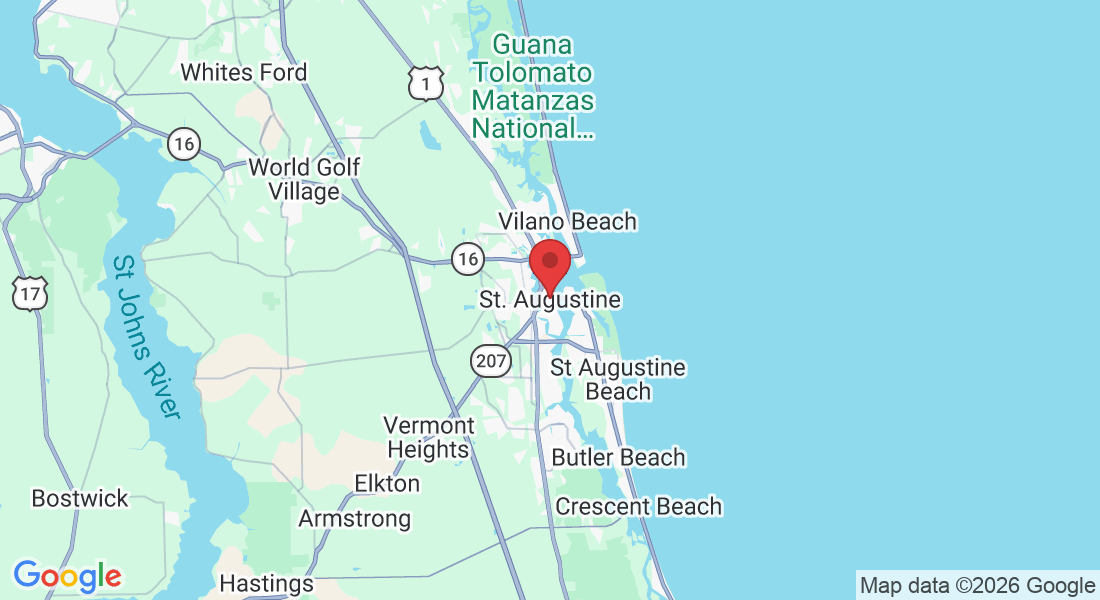
Our Service Areas
We proudly serve homeowners throughout Northeast Florida's most beautiful communities.
Ready to transform your
outdoor living?
Quality craftsmanship. Year-round comfort. Stress-free process.
Stay Informed
Per the StoryBrand framework — a clear, simple plan (3-4 steps max) reduces decision anxiety.
Beat the Florida Sun: UV Protection, Solar Shading & Heat Reduction with Motorized Screens
The mosquitoes get the blame. And they deserve it — as we covered in Week 5, they are the reason most Northeast Florida homeowners retreat inside at dusk.
But the sun is the reason they never made it outside in the first place.
From May through September, the afternoon sun in St. Augustine, Nocatee, Ponte Vedra Beach, and across St. Johns County turns an unscreened patio into a surface you cannot touch, a space you cannot sit in, and an environment that drives anyone without a death wish indoors by noon. Patio surface temperatures on exposed travertine, concrete, and composite decking regularly exceed 140°F in direct sun. Metal furniture frames become untouchable. Cushion fabric absorbs heat until the seating itself becomes a deterrent.
And while the heat is the immediate discomfort, the UV radiation is the silent cost.
Every hour your outdoor furniture, cushions, rugs, and fixtures spend in direct Florida sun is an hour of degradation. Fabrics fade. Colors bleach. Plastics become brittle. Wicker dries and cracks. The $8,000 furniture set you bought two years ago looks like it has been outside for a decade — because, in UV-equivalent exposure terms, it has.
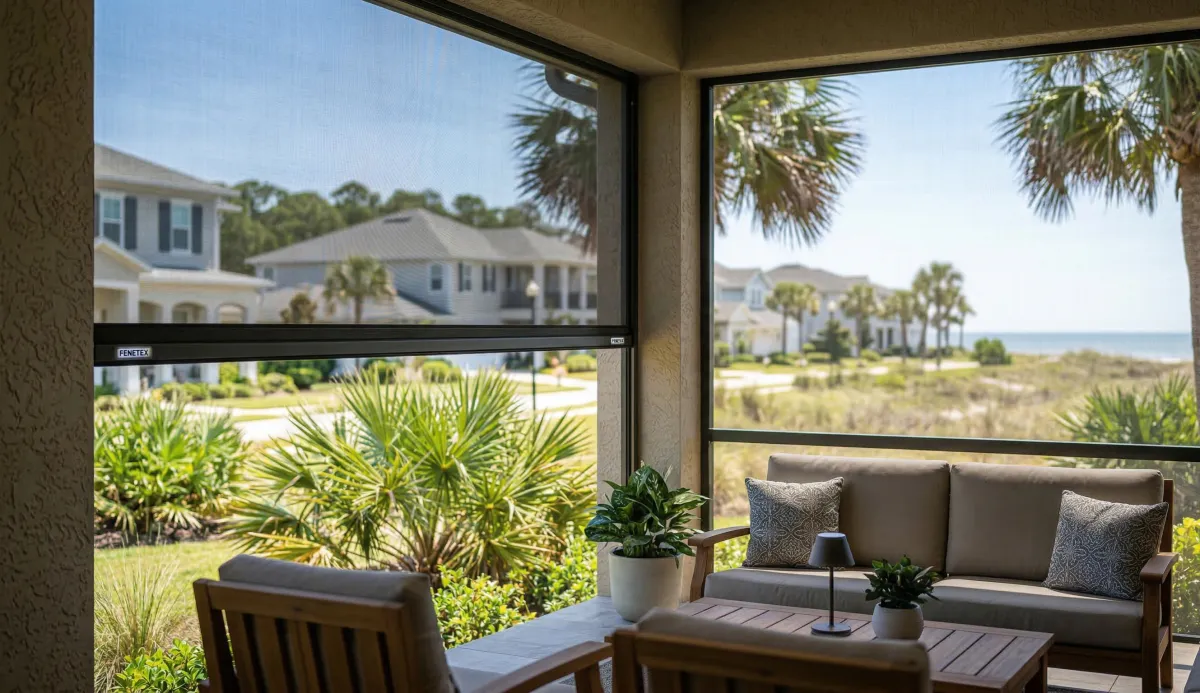
Motorized solar screens address both problems. They reduce patio heat to a level that extends usable hours by the better part of an afternoon. And they block up to 91 percent of UV rays — protecting the investment you have already made in outdoor furniture, finishes, and the space itself.
This is not a luxury addition. It is investment protection with a daily lifestyle return.
The UV Problem You Cannot See Until You See the Damage
Ultraviolet radiation is invisible and relentless. In Northeast Florida, the UV index reaches extreme levels (8 to 11+) during the peak summer months — a level the EPA classifies as requiring significant protective measures for skin exposure. The same radiation that dermatologists warn you about is acting on your outdoor furniture, your patio finishes, and the interior furnishings visible through your sliding glass doors every single day.
Here is what UV does to your outdoor space over time:
Fabric fading. Outdoor cushion fabrics — even those marketed as UV-resistant — degrade under sustained Florida sun exposure. Sunbrella and similar solution-dyed acrylics resist fading better than conventional fabrics, but they are not immune. After two to three summers of daily exposure on an unscreened patio in St. Augustine or Ponte Vedra Beach, visible color shift is common. After four to five summers, replacement is typical. A quality outdoor cushion set runs $1,500 to $4,000. Replacing it every four years adds $3,000 to $8,000 per decade in UV-driven replacement costs alone.
Furniture degradation. Wicker, teak, aluminum, and composite outdoor furniture all degrade under UV exposure — each in different ways. Wicker dries and becomes brittle. Teak grays and develops surface checking. Aluminum frames retain heat and can warp at joint connections. Composite materials fade and lose their texture definition. The $5,000 to $15,000 furniture investment on a typical Nocatee or Ponte Vedra Beach patio is quietly losing value every day it sits in direct sun.
Patio surface damage. Travertine is naturally resistant to UV — it is stone, after all — but sealants applied to travertine surfaces degrade under sustained UV exposure, requiring resealing every two to three years in direct-sun applications. Composite decking fades significantly. Stained concrete loses color intensity. The surface you chose for its appearance will not hold that appearance indefinitely without UV management.
Interior damage through glass. The sliding glass doors behind your lanai or patio transmit UV into the adjacent indoor space. Flooring, area rugs, upholstery, and artwork near west-facing or south-facing glass panels absorb UV daily — and the fading is often not noticed until the homeowner moves a piece of furniture and sees the contrast between the protected and exposed areas. This interior UV damage is a hidden cost of an unscreened outdoor space that most homeowners never attribute to the patio exposure.
The homeowners who replace their outdoor cushions every three years and reseal their patio every two years are not experiencing normal wear. They are experiencing the cost of an unscreened space in a subtropical UV environment. A motorized solar screen reduces that cost dramatically — and it pays for the reduction every day it is deployed.
How Fenetex Solar Screens Block UV and Reduce Heat
The Fenetex motorized screen system Titan Outdoor Solutions installs across Northeast Florida offers multiple fabric options — insect mesh, privacy mesh, and solar mesh. For UV protection and heat reduction, the solar mesh option is the focus of this post.
Fenetex solar mesh blocks up to 91 percent of UV rays depending on the fabric density selected. That number is not a marketing estimate. It is a measured performance specification based on the fabric's openness factor — the ratio of open space to closed space in the weave pattern. A lower openness factor means more fabric and less open space, which means more UV blocking, more heat reduction, and somewhat reduced outward visibility and airflow.
Here is what openness factor means in practical terms:
1% openness factor. Maximum UV blocking (up to 99%). Maximum heat reduction. Maximum privacy from outside looking in. Reduced outward visibility and airflow. Best for west-facing openings that receive direct afternoon sun and where heat reduction is the primary goal.
3% openness factor. Very high UV blocking (approximately 95–97%). Strong heat reduction. Good privacy. Moderate outward visibility — you can see general shapes and landscape features through the mesh but not fine detail. A strong all-around choice for patios in Palm Coast, Flagler Beach, and coastal communities where sun exposure is constant.
5% openness factor. High UV blocking (approximately 91%). Meaningful heat reduction. Moderate privacy. Good outward visibility — you can see the yard, trees, and sky clearly, with a slight softening of detail. This is the most popular option across Nocatee and St. Augustine because it balances sun protection with the open-air view that homeowners value.
10% openness factor. Moderate UV blocking (approximately 80%). Some heat reduction. Lower privacy. Strong outward visibility — the screen is barely perceptible from inside. Best for shaded or east-facing openings where UV exposure is lower and maintaining the view is the top priority.
The right openness factor for each opening on your home depends on the orientation (which direction does the opening face), the time of peak sun exposure (morning east sun versus afternoon west sun), and your personal balance between view preservation and heat reduction. In most Titan installations, we specify different openness factors for different openings on the same home — a tighter weave on the west-facing patio that catches the afternoon blast, a more open weave on the north-facing lanai that gets indirect light.
The Temperature Difference You Will Feel Immediately
The UV blocking is the long-term investment protection story. The heat reduction is the immediate comfort story — and the one that changes how you use your outdoor space from the first day the screens are deployed.
When Fenetex solar mesh is deployed across a patio or lanai opening, the screen intercepts solar radiation before it reaches the patio surface, the furniture, and the occupants. The perceived temperature on the screened side of the fabric drops meaningfully — homeowners across Nocatee, Ponte Vedra Beach, and St. Augustine consistently report that their screened outdoor spaces become comfortable hours earlier in the afternoon than they were unscreened.
The physics are straightforward. Solar radiation heats surfaces by direct absorption. When a screen intercepts 91 percent of UV and a significant portion of infrared radiation before it reaches the patio surface, the surface absorbs less energy, reaches a lower peak temperature, and radiates less heat back into the occupied space. The furniture stays cooler. The cushions are sitable. The patio surface is walkable. The space is usable.
This is not air conditioning. The screen does not cool the outdoor air. What it does is reduce the solar heat gain — the amount of energy the sun deposits into the space — by a margin large enough to shift the usability window from three months of the year to seven or eight.
On a 95°F afternoon in June — a standard summer day in St. Augustine — an unscreened west-facing patio surface can reach 140°F or higher. The same patio with a 5% openness solar screen deployed will register meaningfully lower surface temperatures. The difference is not subtle. It is the difference between going inside at noon and staying outside until 5 PM.
If you have ever touched a car steering wheel that was parked in the Florida sun versus one that was parked in a garage, you understand the difference a barrier makes. A motorized solar screen creates that same kind of barrier between the sun and your patio — deployable in seconds, retractable when the sun moves or the clouds arrive.
The Energy Savings on the Other Side of the Glass
There is a secondary financial benefit to motorized solar screens that most homeowners do not consider until their first summer electric bill after installation: reduced air conditioning costs in the adjacent indoor spaces.
When the Florida sun strikes an unscreened sliding glass door or window wall, solar energy passes through the glass and heats the interior space behind it. The air conditioning system must then offset that heat gain — running longer, working harder, and consuming more electricity to maintain the thermostat setpoint. In a home with a south-facing or west-facing lanai in Nocatee or Jacksonville, the solar heat gain through unshaded glass can represent a meaningful portion of the cooling load during peak summer months.
A motorized solar screen deployed on the exterior of that glass intercepts the radiation before it enters the home. The screen absorbs and redirects solar energy outside the building envelope rather than allowing it to pass through the glass and become trapped heat inside. The result is a measurable reduction in cooling load on the HVAC system — less runtime, lower electricity consumption, and reduced wear on the air conditioning equipment.
The specific savings depend on the size and orientation of the glass, the local electricity rate, the HVAC system efficiency, and the openness factor of the screen. In broad terms, exterior solar shading on south-facing and west-facing glass openings can reduce cooling energy through those openings by 25 to 40 percent — a figure supported by research from the Department of Energy and multiple building science studies on exterior shading devices.
Over a 20-year screen lifespan, those seasonal energy savings contribute meaningfully to the overall return on the motorized screen investment — on top of the furniture protection, the extended usability, and the hurricane protection provided by the same system.
Protecting What You Already Own The Investment Math
The cost of UV damage to an outdoor living space in Northeast Florida is cumulative and easy to ignore year by year — until you do the math across a decade.
Outdoor cushion replacement (every 3–4 years in direct sun): $1,500–$4,000 per cycle → $3,750–$10,000 over 10 years
Outdoor rug replacement (every 2–3 years): $500–$2,000 per cycle → $2,000–$8,000 over 10 years
Furniture refinishing or replacement (every 5–7 years): $3,000–$10,000 per cycle → $5,000–$15,000 over 10 years
Travertine or patio surface resealing (every 2–3 years in direct sun): $500–$1,500 per application → $2,000–$6,000 over 10 years
Interior furnishing damage through glass (cumulative): varies widely, but flooring replacement or refinishing near exposed glass can run $2,000–$8,000
The total ten-year UV damage cost on a typical Northeast Florida outdoor space: $12,750 to $47,000.
A Fenetex motorized solar screen system does not eliminate all of that cost — some degradation is inevitable in any outdoor environment. But by blocking 91 percent of UV, it reduces the degradation rate dramatically. Cushions that lasted three years now last seven. Furniture that needed refinishing at year five holds its finish past year ten. Travertine sealant that broke down in two years in direct sun lasts four in a screened environment.
The screen does not stop time. It slows it down meaningfully — and the savings accumulate every year the screen is in service.
Solar Screens, Insect Screens, and Hurricane Screens One System, Multiple Fabrics
One of the most common questions homeowners ask during Titan consultations is whether they have to choose between solar protection, insect protection, and hurricane protection. The answer is that the Fenetex motorized system supports all three — and in many installations, different fabric types are specified for different openings on the same home.
Solar mesh (covered in this post) prioritizes UV blocking, heat reduction, and glare management. Best for west-facing and south-facing openings that receive direct afternoon sun.
Insect mesh (covered in Week 5) prioritizes blocking mosquitoes and no-see-ums while maximizing airflow and visibility. Best for openings where evening insect protection is the primary need.
OmegaTex hurricane fabric (covered in Week 3) prioritizes certified storm protection — aramid fiber construction, Miami-Dade NOA certification, ASTM large missile impact rating. Best for large openings that face the highest wind and debris exposure during storms.
All three fabrics run on the same motorized housing, side channel, and motor system. The difference is the fabric itself — swapped at the specification stage, not the structural stage. This means you can have solar mesh on the west face of your pergola, insect mesh on the north face where bugs arrive from the tree line, and hurricane-rated OmegaTex on the south face that takes the brunt of storm winds — all operating from the same control system, all deploying and retracting independently.
Titan's free in-home assessment includes a fabric recommendation for each opening based on its orientation, exposure, and your priorities. We walk the space with you and explain why each opening gets the fabric it does — so the system works optimally in every condition Northeast Florida produces.
You can see multi-fabric installations in our project gallery and video gallery.
The Fabric Selection Guide What to Ask For
For homeowners in Nocatee, Ponte Vedra Beach, St. Augustine, Jacksonville, and Palm Coast evaluating solar screen options, here is a practical framework for the fabric conversation:
If your primary concern is afternoon heat and glare: Ask about 1% or 3% openness solar mesh on west-facing and south-facing openings. Maximum heat reduction. Strong UV protection. Moderate view-through.
If you want UV protection with a strong view: Ask about 5% openness solar mesh. The most popular option in our market — 91% UV blocking with clear outward visibility. Excellent balance for patios that face yards, golf courses, or water features where the view matters.
If you want solar protection AND insect protection on the same opening: Ask about dual-purpose fabrics or discuss whether two screens (one insect, one solar) on the same opening serve your needs better. In some configurations, a single fabric can address both — in others, separate screens provide more flexibility.
If you want solar protection AND hurricane protection: Ask about OmegaTex with solar properties. The hurricane-rated fabric provides meaningful UV reduction alongside its certified storm protection — making it a strong choice for openings where both sun exposure and storm exposure are high.
Titan's Fabric Selection Guide is available as a free downloadable resource — comparing openness factors, UV ratings, heat reduction, privacy levels, and hurricane ratings for every Fenetex fabric option. Download it from our blog or request a copy during your free consultation.
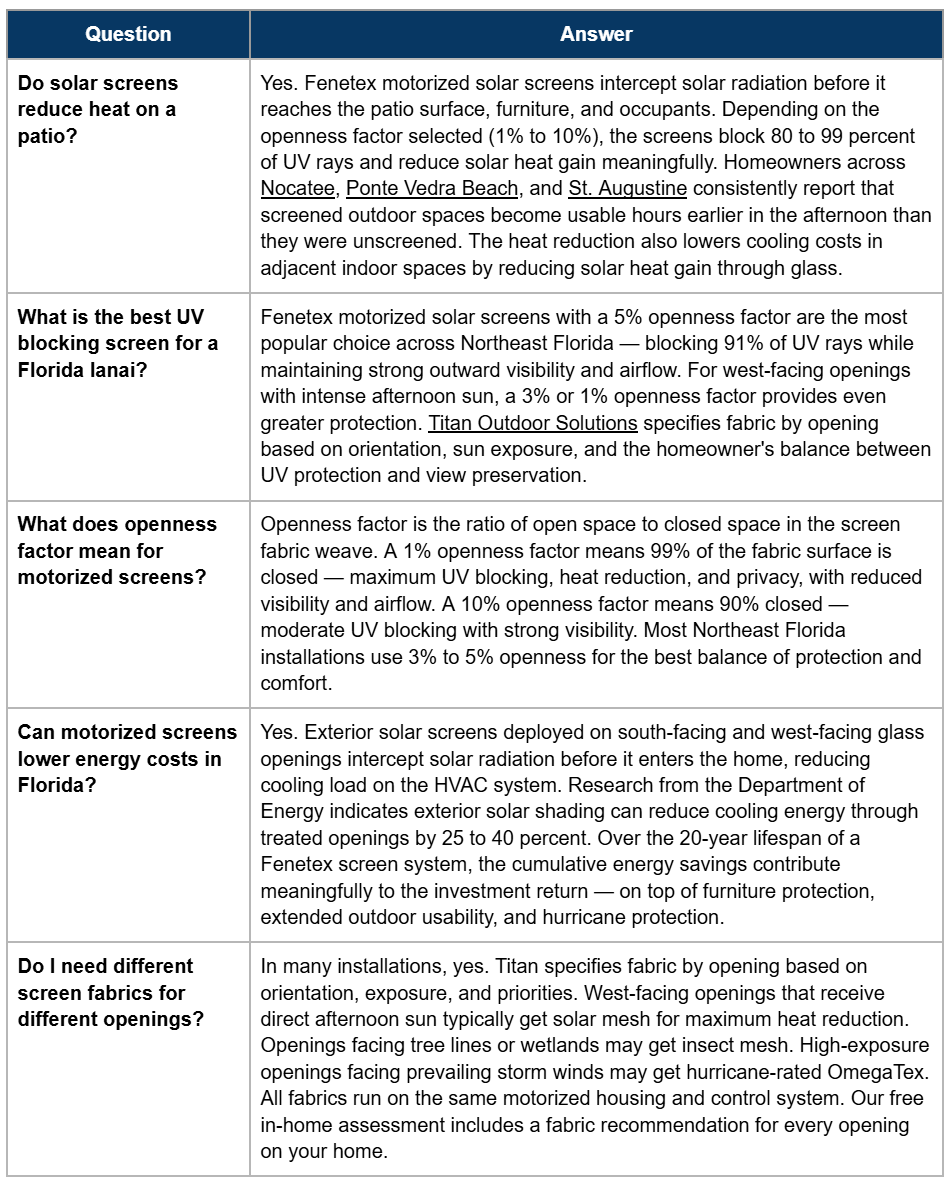
Frequently Asked Questions
Schedule Your Free Solar Assessment
Serving St. Augustine · Nocatee · Ponte Vedra Beach · Palm Coast · Jacksonville · Northeast Florida
We evaluate the sun exposure on every opening, recommend the right fabric and openness factor for each, and show you exactly how much usable outdoor time motorized solar screens will add to your day. Free. No obligation.
Call or text: (904) 484-7580 | TitanOutdoorSolution.com

Stay Informed
Per the StoryBrand framework — a clear, simple plan (3-4 steps max) reduces decision anxiety.
Beat the Florida Sun: UV Protection, Solar Shading & Heat Reduction with Motorized Screens
The mosquitoes get the blame. And they deserve it — as we covered in Week 5, they are the reason most Northeast Florida homeowners retreat inside at dusk.
But the sun is the reason they never made it outside in the first place.
From May through September, the afternoon sun in St. Augustine, Nocatee, Ponte Vedra Beach, and across St. Johns County turns an unscreened patio into a surface you cannot touch, a space you cannot sit in, and an environment that drives anyone without a death wish indoors by noon. Patio surface temperatures on exposed travertine, concrete, and composite decking regularly exceed 140°F in direct sun. Metal furniture frames become untouchable. Cushion fabric absorbs heat until the seating itself becomes a deterrent.
And while the heat is the immediate discomfort, the UV radiation is the silent cost.
Every hour your outdoor furniture, cushions, rugs, and fixtures spend in direct Florida sun is an hour of degradation. Fabrics fade. Colors bleach. Plastics become brittle. Wicker dries and cracks. The $8,000 furniture set you bought two years ago looks like it has been outside for a decade — because, in UV-equivalent exposure terms, it has.
Motorized solar screens address both problems. They reduce patio heat to a level that extends usable hours by the better part of an afternoon. And they block up to 91 percent of UV rays — protecting the investment you have already made in outdoor furniture, finishes, and the space itself.
This is not a luxury addition. It is investment protection with a daily lifestyle return.
The UV Problem You Cannot See Until You See the Damage
Ultraviolet radiation is invisible and relentless. In Northeast Florida, the UV index reaches extreme levels (8 to 11+) during the peak summer months — a level the EPA classifies as requiring significant protective measures for skin exposure. The same radiation that dermatologists warn you about is acting on your outdoor furniture, your patio finishes, and the interior furnishings visible through your sliding glass doors every single day.
Here is what UV does to your outdoor space over time:
Fabric fading. Outdoor cushion fabrics — even those marketed as UV-resistant — degrade under sustained Florida sun exposure. Sunbrella and similar solution-dyed acrylics resist fading better than conventional fabrics, but they are not immune. After two to three summers of daily exposure on an unscreened patio in St. Augustine or Ponte Vedra Beach, visible color shift is common. After four to five summers, replacement is typical. A quality outdoor cushion set runs $1,500 to $4,000. Replacing it every four years adds $3,000 to $8,000 per decade in UV-driven replacement costs alone.
Furniture degradation. Wicker, teak, aluminum, and composite outdoor furniture all degrade under UV exposure — each in different ways. Wicker dries and becomes brittle. Teak grays and develops surface checking. Aluminum frames retain heat and can warp at joint connections. Composite materials fade and lose their texture definition. The $5,000 to $15,000 furniture investment on a typical Nocatee or Ponte Vedra Beach patio is quietly losing value every day it sits in direct sun.
Patio surface damage. Travertine is naturally resistant to UV — it is stone, after all — but sealants applied to travertine surfaces degrade under sustained UV exposure, requiring resealing every two to three years in direct-sun applications. Composite decking fades significantly. Stained concrete loses color intensity. The surface you chose for its appearance will not hold that appearance indefinitely without UV management.
Interior damage through glass. The sliding glass doors behind your lanai or patio transmit UV into the adjacent indoor space. Flooring, area rugs, upholstery, and artwork near west-facing or south-facing glass panels absorb UV daily — and the fading is often not noticed until the homeowner moves a piece of furniture and sees the contrast between the protected and exposed areas. This interior UV damage is a hidden cost of an unscreened outdoor space that most homeowners never attribute to the patio exposure.
The homeowners who replace their outdoor cushions every three years and reseal their patio every two years are not experiencing normal wear. They are experiencing the cost of an unscreened space in a subtropical UV environment. A motorized solar screen reduces that cost dramatically — and it pays for the reduction every day it is deployed.
How Fenetex Solar Screens Block UV and Reduce Heat
The Fenetex motorized screen system Titan Outdoor Solutions installs across Northeast Florida offers multiple fabric options — insect mesh, privacy mesh, and solar mesh. For UV protection and heat reduction, the solar mesh option is the focus of this post.
Fenetex solar mesh blocks up to 91 percent of UV rays depending on the fabric density selected. That number is not a marketing estimate. It is a measured performance specification based on the fabric's openness factor — the ratio of open space to closed space in the weave pattern. A lower openness factor means more fabric and less open space, which means more UV blocking, more heat reduction, and somewhat reduced outward visibility and airflow.
Here is what openness factor means in practical terms:
1% openness factor. Maximum UV blocking (up to 99%). Maximum heat reduction. Maximum privacy from outside looking in. Reduced outward visibility and airflow. Best for west-facing openings that receive direct afternoon sun and where heat reduction is the primary goal.
3% openness factor. Very high UV blocking (approximately 95–97%). Strong heat reduction. Good privacy. Moderate outward visibility — you can see general shapes and landscape features through the mesh but not fine detail. A strong all-around choice for patios in Palm Coast, Flagler Beach, and coastal communities where sun exposure is constant.
5% openness factor. High UV blocking (approximately 91%). Meaningful heat reduction. Moderate privacy. Good outward visibility — you can see the yard, trees, and sky clearly, with a slight softening of detail. This is the most popular option across Nocatee and St. Augustine because it balances sun protection with the open-air view that homeowners value.
10% openness factor. Moderate UV blocking (approximately 80%). Some heat reduction. Lower privacy. Strong outward visibility — the screen is barely perceptible from inside. Best for shaded or east-facing openings where UV exposure is lower and maintaining the view is the top priority.
The right openness factor for each opening on your home depends on the orientation (which direction does the opening face), the time of peak sun exposure (morning east sun versus afternoon west sun), and your personal balance between view preservation and heat reduction. In most Titan installations, we specify different openness factors for different openings on the same home — a tighter weave on the west-facing patio that catches the afternoon blast, a more open weave on the north-facing lanai that gets indirect light.
The Temperature Difference You Will Feel Immediately
The UV blocking is the long-term investment protection story. The heat reduction is the immediate comfort story — and the one that changes how you use your outdoor space from the first day the screens are deployed.
When Fenetex solar mesh is deployed across a patio or lanai opening, the screen intercepts solar radiation before it reaches the patio surface, the furniture, and the occupants. The perceived temperature on the screened side of the fabric drops meaningfully — homeowners across Nocatee, Ponte Vedra Beach, and St. Augustine consistently report that their screened outdoor spaces become comfortable hours earlier in the afternoon than they were unscreened.
The physics are straightforward. Solar radiation heats surfaces by direct absorption. When a screen intercepts 91 percent of UV and a significant portion of infrared radiation before it reaches the patio surface, the surface absorbs less energy, reaches a lower peak temperature, and radiates less heat back into the occupied space. The furniture stays cooler. The cushions are sitable. The patio surface is walkable. The space is usable.
This is not air conditioning. The screen does not cool the outdoor air. What it does is reduce the solar heat gain — the amount of energy the sun deposits into the space — by a margin large enough to shift the usability window from three months of the year to seven or eight.
On a 95°F afternoon in June — a standard summer day in St. Augustine — an unscreened west-facing patio surface can reach 140°F or higher. The same patio with a 5% openness solar screen deployed will register meaningfully lower surface temperatures. The difference is not subtle. It is the difference between going inside at noon and staying outside until 5 PM.
If you have ever touched a car steering wheel that was parked in the Florida sun versus one that was parked in a garage, you understand the difference a barrier makes. A motorized solar screen creates that same kind of barrier between the sun and your patio — deployable in seconds, retractable when the sun moves or the clouds arrive.
The Energy Savings on the Other Side of the Glass
There is a secondary financial benefit to motorized solar screens that most homeowners do not consider until their first summer electric bill after installation: reduced air conditioning costs in the adjacent indoor spaces.
When the Florida sun strikes an unscreened sliding glass door or window wall, solar energy passes through the glass and heats the interior space behind it. The air conditioning system must then offset that heat gain — running longer, working harder, and consuming more electricity to maintain the thermostat setpoint. In a home with a south-facing or west-facing lanai in Nocatee or Jacksonville, the solar heat gain through unshaded glass can represent a meaningful portion of the cooling load during peak summer months.
A motorized solar screen deployed on the exterior of that glass intercepts the radiation before it enters the home. The screen absorbs and redirects solar energy outside the building envelope rather than allowing it to pass through the glass and become trapped heat inside. The result is a measurable reduction in cooling load on the HVAC system — less runtime, lower electricity consumption, and reduced wear on the air conditioning equipment.
The specific savings depend on the size and orientation of the glass, the local electricity rate, the HVAC system efficiency, and the openness factor of the screen. In broad terms, exterior solar shading on south-facing and west-facing glass openings can reduce cooling energy through those openings by 25 to 40 percent — a figure supported by research from the Department of Energy and multiple building science studies on exterior shading devices.
Over a 20-year screen lifespan, those seasonal energy savings contribute meaningfully to the overall return on the motorized screen investment — on top of the furniture protection, the extended usability, and the hurricane protection provided by the same system.
Protecting What You Already Own The Investment Math
The cost of UV damage to an outdoor living space in Northeast Florida is cumulative and easy to ignore year by year — until you do the math across a decade.
Outdoor cushion replacement (every 3–4 years in direct sun): $1,500–$4,000 per cycle → $3,750–$10,000 over 10 years
Outdoor rug replacement (every 2–3 years): $500–$2,000 per cycle → $2,000–$8,000 over 10 years
Furniture refinishing or replacement (every 5–7 years): $3,000–$10,000 per cycle → $5,000–$15,000 over 10 years
Travertine or patio surface resealing (every 2–3 years in direct sun): $500–$1,500 per application → $2,000–$6,000 over 10 years
Interior furnishing damage through glass (cumulative): varies widely, but flooring replacement or refinishing near exposed glass can run $2,000–$8,000
The total ten-year UV damage cost on a typical Northeast Florida outdoor space: $12,750 to $47,000.
A Fenetex motorized solar screen system does not eliminate all of that cost — some degradation is inevitable in any outdoor environment. But by blocking 91 percent of UV, it reduces the degradation rate dramatically. Cushions that lasted three years now last seven. Furniture that needed refinishing at year five holds its finish past year ten. Travertine sealant that broke down in two years in direct sun lasts four in a screened environment.
The screen does not stop time. It slows it down meaningfully — and the savings accumulate every year the screen is in service.
Solar Screens, Insect Screens, and Hurricane Screens One System, Multiple Fabrics
One of the most common questions homeowners ask during Titan consultations is whether they have to choose between solar protection, insect protection, and hurricane protection. The answer is that the Fenetex motorized system supports all three — and in many installations, different fabric types are specified for different openings on the same home.
Solar mesh (covered in this post) prioritizes UV blocking, heat reduction, and glare management. Best for west-facing and south-facing openings that receive direct afternoon sun.
Insect mesh (covered in Week 5) prioritizes blocking mosquitoes and no-see-ums while maximizing airflow and visibility. Best for openings where evening insect protection is the primary need.
OmegaTex hurricane fabric (covered in Week 3) prioritizes certified storm protection — aramid fiber construction, Miami-Dade NOA certification, ASTM large missile impact rating. Best for large openings that face the highest wind and debris exposure during storms.
All three fabrics run on the same motorized housing, side channel, and motor system. The difference is the fabric itself — swapped at the specification stage, not the structural stage. This means you can have solar mesh on the west face of your pergola, insect mesh on the north face where bugs arrive from the tree line, and hurricane-rated OmegaTex on the south face that takes the brunt of storm winds — all operating from the same control system, all deploying and retracting independently.
Titan's free in-home assessment includes a fabric recommendation for each opening based on its orientation, exposure, and your priorities. We walk the space with you and explain why each opening gets the fabric it does — so the system works optimally in every condition Northeast Florida produces.
You can see multi-fabric installations in our project gallery and video gallery.
The Fabric Selection Guide What to Ask For
For homeowners in Nocatee, Ponte Vedra Beach, St. Augustine, Jacksonville, and Palm Coast evaluating solar screen options, here is a practical framework for the fabric conversation:
If your primary concern is afternoon heat and glare: Ask about 1% or 3% openness solar mesh on west-facing and south-facing openings. Maximum heat reduction. Strong UV protection. Moderate view-through.
If you want UV protection with a strong view: Ask about 5% openness solar mesh. The most popular option in our market — 91% UV blocking with clear outward visibility. Excellent balance for patios that face yards, golf courses, or water features where the view matters.
If you want solar protection AND insect protection on the same opening: Ask about dual-purpose fabrics or discuss whether two screens (one insect, one solar) on the same opening serve your needs better. In some configurations, a single fabric can address both — in others, separate screens provide more flexibility.
If you want solar protection AND hurricane protection: Ask about OmegaTex with solar properties. The hurricane-rated fabric provides meaningful UV reduction alongside its certified storm protection — making it a strong choice for openings where both sun exposure and storm exposure are high.
Titan's Fabric Selection Guide is available as a free downloadable resource — comparing openness factors, UV ratings, heat reduction, privacy levels, and hurricane ratings for every Fenetex fabric option. Download it from our blog or request a copy during your free consultation.
Frequently Asked Questions
Schedule Your Free Solar Assessment
Serving St. Augustine · Nocatee · Ponte Vedra Beach · Palm Coast · Jacksonville · Northeast Florida
We evaluate the sun exposure on every opening, recommend the right fabric and openness factor for each, and show you exactly how much usable outdoor time motorized solar screens will add to your day. Free. No obligation.
Call or text: (904) 484-7580 | TitanOutdoorSolution.com


COMPANY
OUR PRODUCTS
SERVICE AREAS
SUPPORT
Copyright 2026. Titan Outdoor Solution.All Rights Reserved.