
Adding an Outdoor Fireplace in St. Augustine's Historic District: What HARB Review Involves
In St. Augustine's five historic preservation zoning districts, most exterior work needs a Certificate of Appropriateness from the Historic Architectural Review Board before a building permit is issued. The board meets once a month, and its application deadlines close about a month ahead. If you're reading this in mid-November, the next deadline is November 17, for the December 17 meeting.
This is the fourth post in Lit Before the Cold. Here's what the review covers, what it costs, what the building permit checks, where the published rules leave questions, and how to plan around the meeting dates.
Quick Answer
Do I need approval to add an outdoor fireplace or fire pit in St. Augustine's historic district?
Most likely, yes. The City of St. Augustine says a Certificate of Appropriateness (COA) is required for most work in its five Historic Preservation zoning districts, HP-1 through HP-5, reviewed against the city's Architectural Guidelines for Historic Preservation. A COA for site work or a site feature at a single-family home costs $250 plus advertising and notice costs. HARB meets on the third Thursday of each month at 1 p.m. The application deadline for the November 19, 2026 meeting passed on October 20; the deadline for the December 17 meeting is November 17. HARB approved a small courtyard fire pit on Charlotte Street in February 2026, with limits on its size and finish. Separately, the building permit tracks impervious surface and lot coverage, and adding 500 square feet or more of either requires a residential lot grading plan. If you're not sure whether your project needs review, the city asks you to contact its Historic Preservation staff at [email protected].
Does your project need review?
Probably. The city requires a Certificate of Appropriateness, or COA, for most work in its five historic preservation districts, HP-1 through HP-5. Not sure if you're in one? Pull up the city's GIS map, switch on the Zoning Districts layer and type in your address. Every application gets measured against the city's Architectural Guidelines for Historic Preservation.
A fire pit counts as exterior work. An outdoor fireplace counts. A masonry seat wall counts, and the patio under all of it counts too. Inside those five districts, plan on review unless staff tell you otherwise.
What goes in the application
The guidelines care about the outside of a property: buildings, objects and the site itself. They don't regulate interiors or how you use the place. They want scaled drawings, and their list of required details reads like a fire-project checklist: chimneys, above-ground fuel tanks, patios, walls (height, material and color) and exterior finishes. You'll need photos of your house and the houses on either side, too.
Then there's the dirt. The guidelines say digging may need a look from the city archaeologist before work begins. A gas line trench counts. So does a fireplace footing. City staff told us both projects need a building permit, and if the city decides the dig needs archaeology review, you also file an A14 Archaeological Review application through the permit portal, with construction plans or a lot survey that marks the work area. The city's archaeology zones map and review process page show how it works.
Has the board said yes to a fire pit?
Yes. On February 19, 2026, HARB approved a reworked courtyard at 58 Charlotte Street with a small fire pit in it, according to a published summary of the meeting. It wasn't waved through. Board members argued over whether a fire pit belonged in a colonial-era courtyard at all, and whether it was safe; others pointed out that colonial lots often had a fire or a well. The approval had strings attached. The pit could be about 4 feet across and 2 feet tall at most. The board leaned toward a coquina or white stucco finish, and the pavers are reclaimed brick.
That's one property, not a policy. Still, it tells you what the board pays attention to: how big it is, what it's made of, and whether it looks like it belongs there.
Want a gut check first?
You can ask the board for an Opinion of Appropriateness, or OOA, before you commit. It's usually optional. You bring conceptual plans, the board tells you what it thinks, and you refine from there. Just know an OOA isn't an approval. You'll still need the full COA before the city issues a building permit.
What it costs
| Application | Fee |
|---|---|
| Certificate or Opinion of Appropriateness: alteration, site work or a site feature that doesn't increase the area of structures | $250 plus advertising |
| Certificate or Opinion of Appropriateness: new single-family home or major alteration | $350 plus advertising |
| Appeal of a staff determination to HARB | $200 plus advertising |
On top of the fee, the city passes along what it spends on newspaper ads and notices to your neighbors. You pay those before the permit is issued.
Your lot has a hard-surface budget
The building permit is a separate check, and it looks at how much of your lot is covered. Stone, pavers and concrete all count. Add 500 square feet or more of coverage and the city also wants a residential lot grading plan.
Here are the numbers from the city code. In HP-1 through HP-3, new construction can cover the lesser of 70 percent of the lot or 7,000 square feet with buildings and hard surfaces, and single-family lots top out at an 80 percent impervious surface ratio. HP-5 is tighter: 50 percent for buildings and hard surfaces, and 70 percent impervious for single-family lots. Downtown lots are small. If yours is already near its limit, the patio around the fire may be a bigger problem than the fire.
Staff sign-off or a full hearing?
For a fire pit or a fireplace, plan on the full board. We asked the city directly. City of St. Augustine Historic Preservation staff told us a freestanding gas fire pit or a masonry outdoor fireplace anywhere in HP-1 through HP-5 needs HARB review "for sure."
The guidelines do keep a short pre-approved list, and staff confirmed the 2011 edition is still the version in effect. You still pull a permit, but you skip the hearing. Gas tanks are on it, and so are landscape features like walls, walks, patios and decks under $1,000. Most built fire features blow past that number; Titan's gas fire pits start at $3,000. Exterior work that isn't visible is on the list too, but read that one narrowly. Staff take it to mean completely hidden, like underground footings or ductwork inside a wall, not just out of sight from the street.
There is one fire-adjacent project that may skip the hearing: an infrared heater mounted inside an existing screened lanai. Depending on the design and where it goes, staff told us, they may be able to review it themselves. Staff decisions can be appealed to HARB within 30 days. Email [email protected] with a sketch and the product sheet and ask which route yours takes.
Mind the calendar
HARB meets once a month, usually on the third Thursday at 1 p.m., in the Alcazar Room at City Hall. You apply through the city's permit portal. The deadline is firm because the city has to publish legal notices. Here's where things stand:
| Meeting | Application deadline | Status |
|---|---|---|
| Thursday, November 19, 2026 | October 20, 2026 | Deadline passed |
| Thursday, December 17, 2026 | November 17, 2026 | Open, five days after this post |
| Thursday, January 21, 2027 (planned) | December 22, 2026 (planned) | Draft; the City Commission approves the 2027 schedule in December |
Downtown, watch the HARB calendar, not the thermometer. Miss November 17 and you're waiting on January 21.
Melanie Fraser, Titan's president, keeps her advice simple: get every document done and submitted before the deadline. If something's missing on deadline day, your application sits until next month. The city posts a submittal checklist, so use it, and don't forget the signed HARB Application Agreement. It's required.
That's the real reason to start early downtown. Most of our cold nights land between December and February, as the first post in this series showed. Miss the December meeting on a project that needs a full hearing, and you probably won't light it until well into the new year.
Gas, wood, infrared and the historic district
Burning rules apply downtown too. As the second post in this series covered, the City of St. Augustine bans bonfires and yard-debris burning but lists approved outdoor heating devices: wood-burning fire pits with metal mesh covers, commercially manufactured gas fire pits and chimineas, with dry, untreated firewood for anything wood-burning. The third post covers placement for wind.
There's also the option Titan Outdoor Solutions often recommends: an infrared heater set into a lanai wall. Titan's Melanie Fraser says those units can be as thin as 4 to 12 inches, so they usually need only a simple wall build-out. Inside an existing screened lanai, city staff told us, one may qualify for staff review instead of a full hearing. Put it in the same email as your sketch.
How to prepare
| Step | Why it matters |
|---|---|
| Check your zoning on the city's GIS map | Tells you whether your property is in HP-1 through HP-5 and HARB review applies |
| Email [email protected] with a sketch | Staff can tell you what review your project needs |
| Consider an Opinion of Appropriateness | Gets the board's guidance on a concept before the full application |
| Read the Architectural Guidelines and the city's submittal checklist | They're the standard the board uses, and the checklist shows what a complete application includes |
| Assemble every document, including the signed HARB Application Agreement | An incomplete application at the deadline waits for the next meeting |
| Check your lot's impervious surface and lot coverage | Patios and surrounds count, and 500 square feet or more triggers a grading plan |
| Budget $250 to $350 plus advertising | Fees and ad costs are due before a permit is issued |
| Work back from the next deadline | November 17 for December; December 22 (planned) for January |
Titan Outdoor Solutions is based in St. Augustine. If you're in the historic district and want a fire feature this winter, start the conversation early.
Next in this series, on Saturday: natural gas, propane and HOA approval in Nocatee and Ponte Vedra Beach.
Frequently Asked Questions
How often does St. Augustine's HARB meet?
Typically on the third Thursday of each month at 1 p.m. in the Alcazar Room at City Hall. The November 19 meeting's application deadline was October 20, the December 17 meeting's deadline is November 17, and city staff expect the January 21, 2027 meeting to have a December 22 deadline, pending approval of the 2027 schedule. Applications go through the city's Planning and Building Department permit portal, and Titan's Melanie Fraser advises having every document in order before the deadline, or the application waits a month.
Has HARB approved a fire pit in the historic district?
Yes, at least once recently. At its February 19, 2026 meeting, according to a published summary, the board approved a courtyard redesign at 58 Charlotte Street that included a small fire pit, with limits of about 4 feet across and about 2 feet high and a coquina or white stucco finish preferred. Each property is reviewed on its own.
Can a fire pit be approved by staff instead of the full board?
Not usually. City of St. Augustine Historic Preservation staff told us a freestanding gas fire pit or a masonry outdoor fireplace in HP-1 through HP-5 needs HARB review. The 2011 guidelines' pre-approved list is still in effect, but it covers things like patios and walls under $1,000 and work that is completely hidden, such as underground footings. An infrared heater inside an existing screened lanai may get staff review, depending on design and location. Staff decisions can be appealed to HARB within 30 days.
How much does HARB review cost?
For a single-family home, a Certificate of Appropriateness for site work or a site feature that doesn't increase the area of structures is $250, plus the cost of legal advertising and notices. Major alterations are $350 plus advertising. Those costs must be paid before a development permit is issued.
Does a patio around a fire pit count against lot coverage?
It can. The city's building permit process tracks impervious surface and lot coverage, and a stone or paver surround adds hard surface. Adding 500 square feet or more of lot coverage or impervious surface also requires a residential lot grading plan.
Sources
- City of St. Augustine. Historic Architectural Review Board (HARB): meeting dates and application deadlines. Accessed November 2026. citystaug.com
- City of St. Augustine. Historic Architectural Review Board (HARB) Applications, including the application fee schedule. Accessed November 2026. citystaug.com
- City of St. Augustine. Architectural Guidelines for Historic Preservation, Fourth Edition. October 2011. citystaug.com
- City of St. Augustine Planning and Building Department. Required Building Permit Documents. Accessed November 2026. citystaug.com
- City of St. Augustine. Code of Ordinances, Chapter 28 (Zoning), Article III, Secs. 28-160, 28-187 and 28-188 (as published by Zoneomics). Accessed November 2026. zoneomics.com
- City of St. Augustine. Historic Architectural Review Board meeting video, February 19, 2026. February 19, 2026. staugustinefl.new.swagit.com
- Citizen Portal. HARB approves courtyard redesign at 58 Charlotte Street with limits on fire pit and materials. February 2026. citizenportal.ai
- City of St. Augustine Historic Preservation staff. Email answers to Titan Outdoor Solutions on HARB review for outdoor fire features. November 5, 2026.
- City of St. Augustine. Archaeology Review Process. Accessed November 2026. citystaug.com
- City of St. Augustine Fire Department. Open Burning. Accessed November 2026. citystaug.com
- Titan Outdoor Solutions. Phone interview with Melanie Fraser, President, and William Davis, Vice President, on fire feature options and installation. November 5, 2026. titanoutdoorsolution.com
- Titan Outdoor Solutions. Outdoor Fireplaces and Fire Pits. Accessed November 2026. titanoutdoorsolution.com
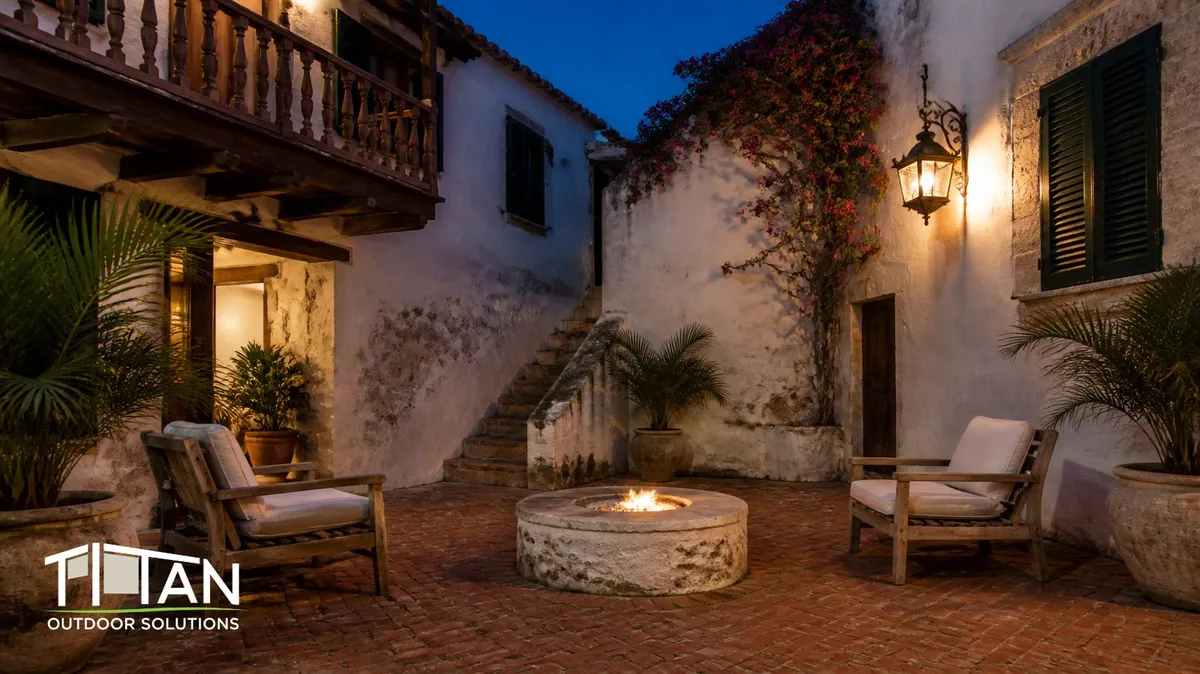
Cover image: AI-generated illustration. It does not show a Titan Outdoor Solutions installation or 58 Charlotte Street.


