
Will This Still Be Useful Once Hurricane Season Ends and the Cold, Wet Months Start?
Will This Still Be Useful Once Hurricane Season Ends and the Cold, Wet Months Start?
The last post in this series covered the engineering: how a StruXure pergola's sensors actually respond to rain and wind. That's a hurricane-season conversation. But hurricane season ends, and a fair question follows it: does any of that engineering matter once the storms stop?
It's a fair question because a lot of "storm-ready" products really are single-season purchases. They're useful for a few weeks a year, dead weight the rest of the time. This post is about whether a pergola avoids that trap. See the previous post in this series for how the sensors themselves work.
The two-season case, in plain terms
Titan Outdoor Solutions describes its pergola installations in Nocatee and St. Johns County as delivering comfortable outdoor dining across the full calendar. It's not a summer-only feature that goes dormant once the weather turns. That's a real claim worth examining rather than just repeating, so here's what actually backs it up mechanically.
A closed roof blocks rain in September the same way it blocks rain in January. Adjustable louvers that manage harsh summer sun are the exact same louvers that let in the lower, gentler winter sun when you want it. None of the hardware changes with the calendar. Only the reason you're using it does.
What actually changes between summer and winter use
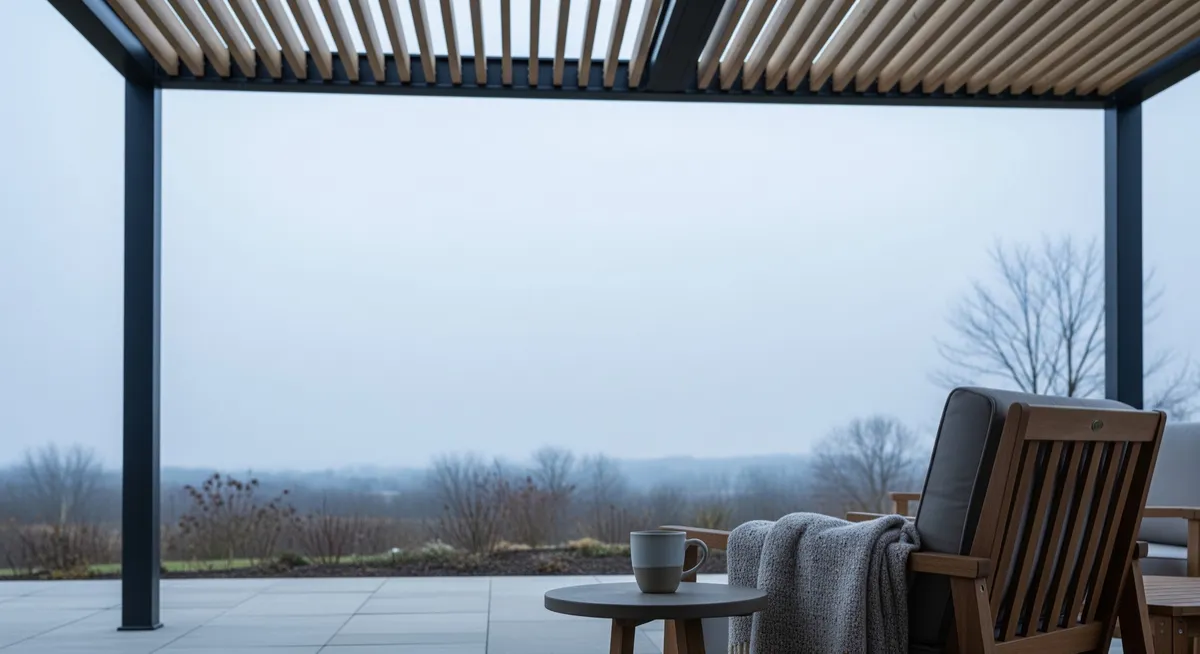
In summer, the job is usually shade. That means blocking a high, intense sun and cutting heat enough to make the space bearable. In Northeast Florida's cooler months, the job flips: the louvers open to let in low winter sun for warmth, and close fast when one of the region's damp, blustery cold fronts rolls through. Same structure, opposite request, same mechanism answering both.
This is also where a fireplace becomes a genuinely different addition rather than a redundant one. A pergola's louvers manage sun and rain, but they don't generate heat. On a cold, clear evening, that's the gap a heat source fills. More on exactly how that pairing works in a later post in this series.
Why this matters for the decision, not just the marketing
A structure that only earns its cost during a six-week storm window is a hard purchase to justify. A structure that does real work in hurricane season, then keeps doing real (different) work through a genuinely cool, wet winter, is a different calculation entirely. It's closer to a kitchen renovation than a storm-prep expense. That's the actual argument for treating this as a two-season structure rather than two separate purchases.
Frequently Asked Questions
Does the pergola work the same way in winter as it does in summer?
Mechanically, yes. The rain and wind sensors respond to actual weather conditions, not the calendar. What changes is what you're using the louvers for. In summer, that's shade. In the cooler months, it's letting in low winter sun and closing fast against cold fronts.
Is a pergola warm enough to sit under in winter on its own?
The structure itself manages sun and rain, not temperature. On genuinely cold evenings, a heat source like a fireplace is what actually keeps you warm underneath it. The two work together rather than one replacing the other.
How cold does it actually get in Northeast Florida in winter?
Mild by national standards, genuinely cool by local ones. Average winter temperatures in the region run roughly 46–66°F, cold enough with a damp wind behind it that an unsheltered outdoor space stops getting much use for a few months.
Sources
Titan Outdoor Solutions. Outdoor Living St. Johns County & Nocateepage: year-round dining claim. Accessed August 2026. titanoutdoorsolution.com
Titan Outdoor Solutions. Custom Outdoor Fireplacesproduct page: average Northeast Florida winter temperature range. Accessed August 2026. titanoutdoorsolution.com


